An application development project plan is your strategic roadmap, translating a great idea into a tangible product in your users' hands. It's the blueprint that aligns every stakeholder—from the C-suite to the development team—ensuring every task, resource, and timeline is geared towards a successful launch.
Why Your Project Plan Is Your Greatest Asset
A well-crafted plan is the key differentiator between a project that delivers real business value and one that drains resources. It transforms ambitious goals into a predictable, manageable process, establishing a framework that makes delivery repeatable and successful. For technology leaders, this blueprint is the key to delivering a measurable return on investment.
Countering Common Project Failures
A solid plan's primary outcome is controlling the budget and scope. With 70% of software projects exceeding their budgets, a defined project management approach is critical. Teams that use one are 15% more likely to hit their financial targets.
A detailed plan delivers tangible outcomes by tackling common failure points:
- It stops scope creep cold. The plan defines exactly what will and won't be built. For a logistics company building a fleet management app, this means locking in core features like real-time tracking, ensuring the team delivers a high-value MVP instead of getting sidetracked by nice-to-haves.
- It creates a single source of truth. When finance, marketing, and development all reference the same document, confusion about deliverables and deadlines disappears, leading to smoother execution.
- It maximizes resource efficiency. The plan maps tasks and dependencies, ensuring the right talent is on the right task at the right time. This prevents bottlenecks and keeps your most valuable asset—your team—productive and engaged.
Core Components Of A High-Impact Project Plan
Plan ComponentPrimary Business OutcomeScope DefinitionPrevents scope creep and ensures focus on high-value features.Requirements GatheringGuarantees the final product meets actual user and business needs.Milestones & DeliverablesCreates measurable progress points and keeps the project on track.Resource AllocationOptimizes team productivity and avoids talent bottlenecks.Timelines & Gantt ChartsProvides clear visibility into dependencies and project duration.Risk Management PlanIdentifies and mitigates potential issues before they derail the project.
Ultimately, a robust project plan allows you to shift from reactive problem-solving to proactive execution, providing the structure to ship high-quality software on time and within budget. For more ideas, check out this guide on crafting a comprehensive website project plan for another perspective.
Defining Scope and Business-Critical Requirements
This is where your application's vision gets real. Defining the project scope and pinning down business-critical requirements are the foundation of a successful application development project plan. Getting this wrong means fighting scope creep, blowing budgets, and delivering a product that misses the mark.
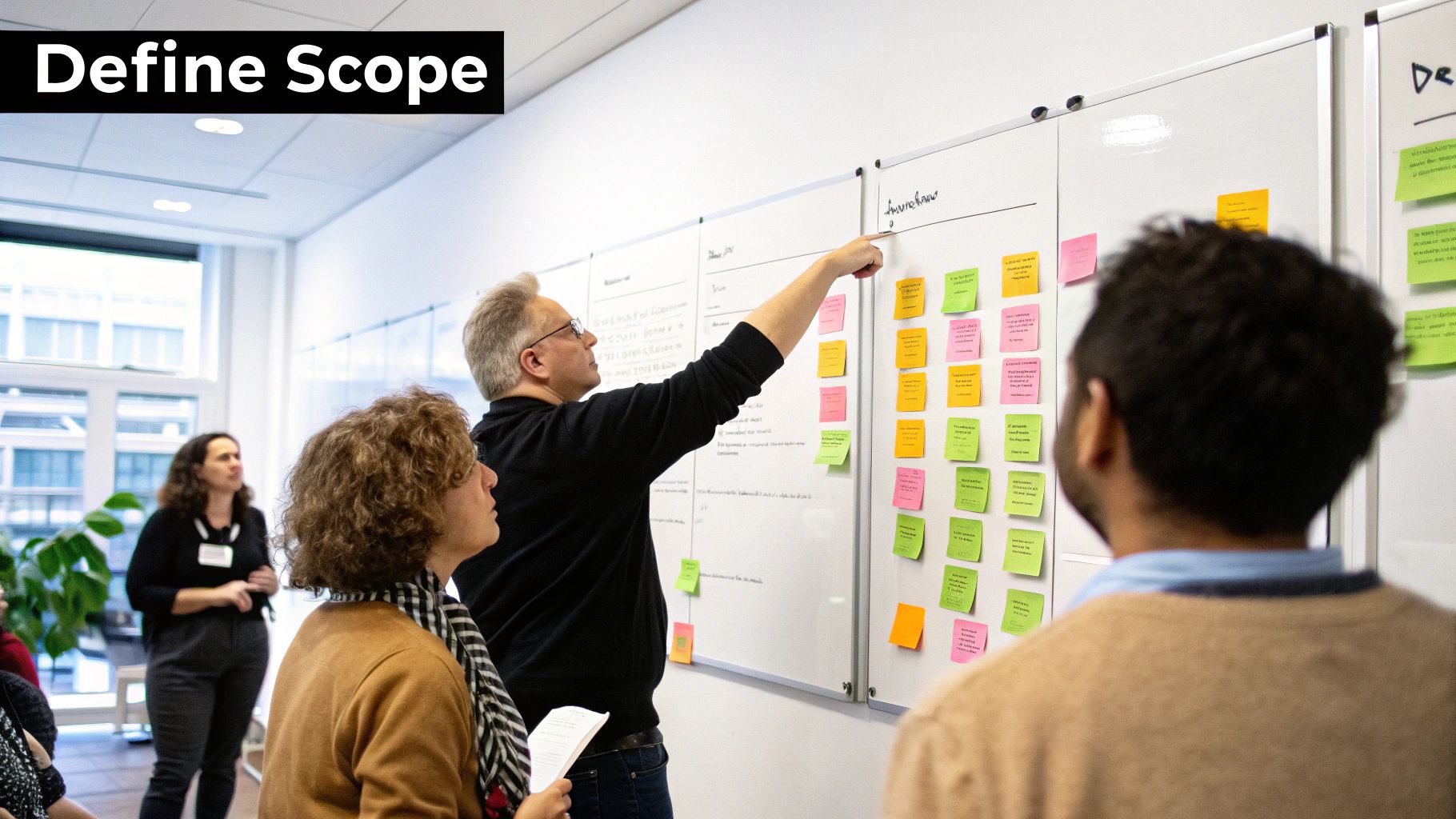
The goal of this phase is absolute clarity. A tight scope acts as a guardrail, keeping the project focused on features that drive business value. It forges a firm agreement between all stakeholders on exactly what will be built.
From Vague Goals to Concrete Requirements
Stakeholders often start with broad objectives. Your job is to translate these into specific, actionable requirements that an engineering team can build and test. This requires targeted conversations and collaborative workshops to uncover the real business problem. For instance, a stakeholder asking for "a better dashboard" might actually need "real-time inventory visibility to reduce stockouts by 15%." That's a requirement you can build against.
A well-defined requirement is unambiguous, testable, and directly tied to a business outcome. If you can't measure its success, it doesn't belong in the MVP.
Ditch stuffy Q&A sessions for interactive workshops. Mapping user journeys on a whiteboard is a powerful way to uncover hidden needs and dependencies that traditional meetings miss. You can see how these initial concepts get fleshed out by exploring the journey from wireframes to completion in our detailed guide.
Use Case: Improving Patient Engagement
A healthcare provider wants a mobile app to "improve patient engagement." This goal is too vague. Through workshops with clinicians, staff, and patients, we can break it down into tangible, outcome-focused user stories.
The Goal: Improve Patient Engagement
The Method: Collaborative workshops to define specific user needs.
The output is a prioritized list of features framed as user stories, keeping the focus on end-user value.
- Appointment Management: As a patient, I want to manage my appointments in the app to save time and avoid phone calls.
- Prescription Refills: As a patient, I need to request refills and see their status to ensure I never run out of my medication.
- Secure Messaging: As a patient, I want to send secure messages to my care team to get quick answers without an office visit.
- Lab Result Access: As a patient, I want instant notifications and access to my lab results to stay informed about my health.
Each user story is specific, measurable, and ladders up to the primary goal. Now the development team has a clear mandate.
Using a Requirements Traceability Matrix
For complex enterprise projects, a Requirements Traceability Matrix (RTM) is essential. It maps each requirement from its origin through to deployment, creating a clear line between business needs, functional specs, user stories, and test cases. This ensures every feature serves a documented purpose—a non-negotiable for compliance in regulated industries like finance or healthcare. It’s your best defense against scope creep, keeping your application development project plan focused on delivering what matters.
Designing Your Technical Architecture and Data Strategy
Once you know what the application will do, your application development project plan must define how it will be built. The technical architecture and data strategy are the foundation that will either support growth or create long-term constraints. Making deliberate choices here is crucial for scalability, security, and business value.
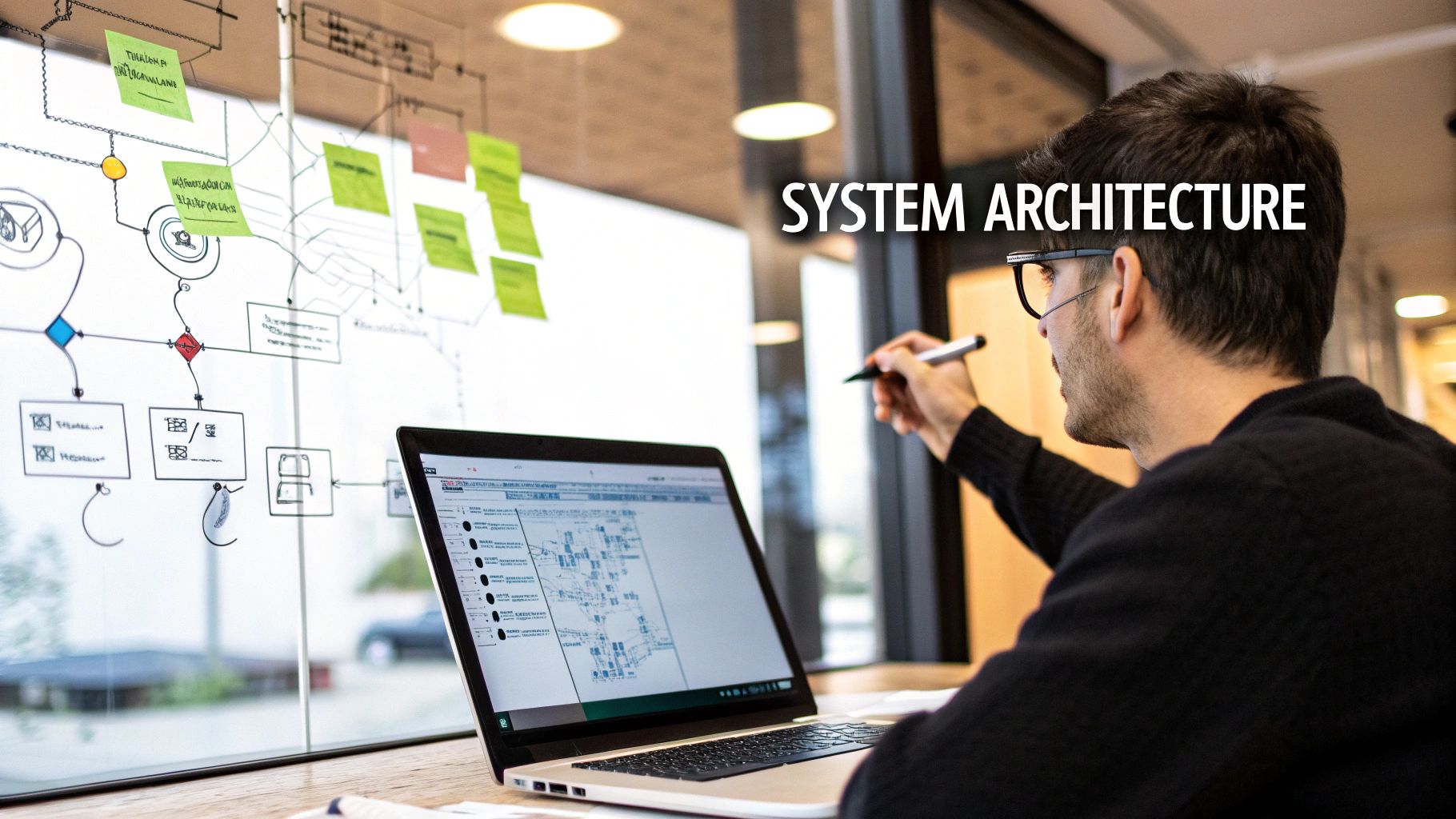
The decisions made here impact development speed, operational costs, and future innovation. A poor architecture can create significant technical debt before a single line of code is written.
Choosing the Right Tech Stack for the Job
Your technology stack—the combination of languages, frameworks, and databases—is a long-term commitment. Match the technology to your business needs, not just developer preferences.
Key considerations for a high-impact outcome:
- Scalability: Will the architecture support 1 million users as well as it does 1,000? A microservices architecture might be necessary for apps with varying growth rates across features.
- Team Expertise: Do you have the in-house talent to build and maintain the system? Choosing a niche technology can lead to hiring challenges and delays.
- Security & Compliance: Does the stack meet modern security standards? This is critical in regulated fields like finance or healthcare.
- Ecosystem: A technology with a vibrant community and rich third-party libraries can accelerate development and simplify troubleshooting.
Your tech stack is a long-term commitment. Prioritize technologies with a proven track record for stability and robust community support over the latest flavor-of-the-month framework.
The result should be a system design document that acts as a definitive blueprint, detailing every component, API contract, and data flow to eliminate ambiguity.
Use Case: Modernizing Fleet Management with a Data Strategy
A logistics company needs to replace its outdated fleet management system to gain real-time insights. Their goal is an application with live vehicle tracking, predictive maintenance, and AI-powered route optimization, requiring a platform that can handle massive streams of IoT data.
They choose a modern data platform like Snowflake instead of a traditional database. This decision delivers immediate business outcomes:
- Real-Time Analytics: They can query live data to see every vehicle's location, improving response times and customer satisfaction.
- Predictive Insights: With all data centralized, they can build machine learning models to predict engine failures, reducing downtime and maintenance costs.
- Future-Proofing for AI: The architecture is ready for advanced AI models to automate dispatching or optimize fuel efficiency, creating a significant competitive advantage.
This data-first approach shows that your application is only as good as the data strategy behind it. Your application development project plan must treat data architecture as a core component, not an afterthought.
Building Your Project Timeline and Resource Plan
With scope defined and architecture designed, your application development project plan must translate ideas into a time-bound execution strategy. A realistic timeline with clear milestones turns a static document into a dynamic guide for your team.
The first step is to break the development process into distinct, manageable phases. This approach prevents overwhelm and creates natural checkpoints to review progress and adapt as needed.
Breaking Down the Development Lifecycle
Segmenting the project into logical stages with clear objectives makes progress easy to track and communicate.
A typical project breakdown:
- Discovery and Planning: Finalize requirements, technical specifications, and the project plan.
- UI/UX Design Sprints: Create wireframes and interactive prototypes for early user feedback.
- Core Feature Development: Build the application's foundation in focused, agile sprints.
- Integration and Testing: Connect modules, run rigorous QA cycles, and resolve bugs.
- User Acceptance Testing (UAT): Get end-user validation that the app solves their problems.
- Deployment and Go-Live: Move the application into the live production environment.
Once phases are mapped, you can estimate the effort required for each. Aligning your schedule with a solid software development cost estimation is critical for keeping the budget and timeline in sync.
Sample Project Phase And Key Deliverables
Project PhasePrimary ObjectiveKey DeliverablesDiscovery & Strategy (Weeks 1-2)Validate the project's business case and define the technical approach.Finalized requirements document, high-level architecture diagram, project charter.UI/UX Design (Weeks 3-5)Create a user-centric, intuitive, and visually appealing interface.Wireframes, high-fidelity mockups, clickable prototype, style guide.Core Development (Weeks 6-12)Build the foundational backend services and primary application features.Functional APIs, core application modules, initial database schema.Integration & QA (Weeks 13-16)Connect all system components and conduct comprehensive testing cycles.Integrated application build, test case results, bug reports, performance metrics.UAT & Deployment Prep (Weeks 17-18)Secure end-user approval and prepare the application for launch.Signed-off UAT documentation, production environment configuration, deployment runbook.Go-Live & Support (Week 19+)Release the application to users and transition to ongoing operational support.Live application, post-launch monitoring plan, knowledge transfer documents.
Using Gantt Charts as Communication Tools
A Gantt chart is the visual pulse of your timeline. Its real power is as a dynamic communication tool, providing an instant snapshot of progress, dependencies, and potential roadblocks. It visually tracks start and end dates, task dependencies, assignments, and key milestones. This format is invaluable for stakeholder updates, clearly showing project status and the impact of any delays.
Your Gantt chart isn't just a schedule; it's a living narrative of your project's journey. Use it to tell a story of progress and to anticipate the next chapter before it arrives.
The project management software market is expected to grow from $7.24 billion in 2025 to $12.02 billion by 2030. Despite this, only 23% of organizations use dedicated PM software. High-performing organizations, however, show a 77% adoption rate, with 80% reporting improved communication as a direct result. You can discover more insights about these project management trends and how they impact success.
Allocating Resources to Prevent Bottlenecks
A timeline without a resource plan is a wishlist. Resource allocation involves assigning the right people to the right tasks at the right time. A well-balanced team is key to maintaining momentum.
Use Case: Manufacturing Shop Floor App A company building a supervisor app needs a diverse team: back-end engineers, mobile developers, a UI/UX designer, and a QA specialist. A smart plan schedules back-end API development and UI/UX design to run in parallel. This way, the mobile team has both the APIs and the designs ready when they need them, avoiding downtime. This proactive planning prevents common resource problems like bottlenecks and burnout, keeping your application development project plan on track and your team productive.
Integrating Risk Management and Quality Assurance
A robust application development project plan doesn't just chart a path to success; it anticipates and mitigates potential failures. Proactive risk management and a rigorous quality assurance (QA) plan are essential for ensuring the final product is secure, reliable, and functional.
Ignoring these can be costly: poor management contributes to 25% of project failures, with budgets overrunning by as much as 47% due to weak planning. If you want to dive deeper, you can explore more project management statistics here.
Building a Proactive Risk Register
A risk register is a living document that identifies potential threats, assesses their impact, and outlines mitigation strategies. The focus is on specific issues most likely to derail your timeline, budget, or quality.
Categorize risks for clarity:
- Technical Risks: Unstable third-party APIs or accumulating technical debt.
- Resource Risks: The potential departure of a key team member.
- Market Risks: A competitor launching a similar feature first.
For each risk, assign a probability and impact score to prioritize your focus on the most significant threats. The most critical component is the mitigation plan—the concrete steps you'll take to prevent the risk or lessen its impact. For instance, managing technical debt within your risk control framework requires a deliberate, proactive strategy.
Weaving Quality Assurance into the Fabric of Your Plan
Quality must be built in from day one, not inspected at the end. A comprehensive QA plan should be integrated directly into your project timeline, outlining the what, when, and how of your testing strategy. This ensures bugs are found early when they are cheap and easy to fix.
A mature QA process shifts the team's mindset from "finding bugs" to "preventing bugs." It embeds quality into every sprint, every code commit, and every feature discussion.
Your plan must specify different testing types, each with a distinct purpose:
- Unit Testing: Developers write automated tests for individual code components.
- Integration Testing: Ensures different application modules work together correctly.
- Performance Testing: Simulates user traffic to see how the application performs under stress.
- User Acceptance Testing (UAT): Real users validate that the application meets their needs.
Use Case: Mitigating Risk in a Telecom App
A telecom company is building a new customer app that must integrate with three poorly documented legacy billing systems. The risk of integration failure is high, with a catastrophic potential impact on the launch.
The Mitigation Plan: The project plan includes a two-week "spike" for a senior engineer to build proofs-of-concept for each legacy integration before main development begins. This single move de-risks the most complex part of the project upfront.
The Integrated QA Strategy: Simultaneously, the QA plan mandates automated integration tests for every API endpoint, which run nightly to catch any breaking changes immediately. Performance tests are scheduled to simulate 10,000 concurrent logins, ensuring the infrastructure can handle the load. This combined approach transforms the application development project plan into a strategic tool for delivering a high-quality product on time and on budget.
Common Questions About Application Development Plans
Even the best project plan will generate questions. Answering them upfront ensures alignment and confidence across the team and stakeholders. Here are some of the most common queries.
How Detailed Should My Project Plan Be?
The right level of detail depends on project complexity and team structure. For a small, agile team, a high-level plan focusing on major milestones and sprint goals is sufficient, with daily tasks managed in a backlog. For a large enterprise project in a regulated industry like finance, a granular plan with detailed tasks, technical specifications, and compliance checkpoints is necessary.
My Takeaway: The plan should provide enough detail to create clarity without becoming an administrative burden. It's a guide, not a rigid set of rules that stifles adaptability.
The goal is to provide enough structure for a new team member to quickly grasp the project's goals, their role, and what needs to happen next.
What Is The Best Way To Handle Changes?
Change is inevitable in software development. The key is to manage it with a formal change control process established from the start. This ensures that every change is a deliberate, well-informed decision.
An effective framework includes:
- Formal Request: All change requests must be documented, explaining the what and why.
- Impact Assessment: The project manager and tech leads evaluate the request's impact on the timeline, budget, and scope.
- Decision: A designated product owner or committee makes the final call.
- Communication: The decision is shared, and if approved, the project plan is immediately updated.
This structured process is the best defense against scope creep, ensuring every change is a conscious business decision.
How Often Should I Update The Plan?
Your project plan is a living document. Its update frequency should align with your project's rhythm. For Agile teams, reviewing and adjusting the plan at the end of each two-week sprint is ideal. This allows you to incorporate learnings and re-prioritize based on recent feedback.
For traditional Waterfall projects, updates typically occur at the end of major phases. Regardless of methodology, the plan must be updated immediately whenever a significant change to scope or timeline is approved. Regular reviews ensure the plan remains a relevant and valuable tool for guiding the team to a successful outcome.


