
The architecture of the Internet of Things is the foundational blueprint that enables physical devices, networks, data processing, and applications to work in concert. Think of it as the master plan for a smart system, outlining how every component—from a tiny sensor to a massive cloud server—will collaborate to deliver a specific business outcome.
Why a Solid IoT Architecture Matters
A well-designed IoT architecture is a strategic asset that directly fuels business performance. Without a coherent structure, an IoT initiative becomes a chaotic collection of disconnected devices and data silos, failing to deliver value. A solid architecture ensures you can securely and efficiently gather data from the physical world, process it, and act on the resulting insights.
The global IoT ecosystem is expanding rapidly. Projections show the number of connected devices will surpass 19.8 billion in 2025 and could exceed 40.6 billion by 2034. This growth highlights a critical shift toward data-centric architectures that leverage cloud, edge computing, and real-time analytics. You can explore more IoT growth statistics to grasp the scale of this expansion.
Connecting Architecture to Business Outcomes
A robust architecture is the bridge between IoT technology and tangible business results. It turns a stream of sensor readings into actionable intelligence that drives growth and efficiency.
Getting the architecture right unlocks key business outcomes:
- Operational Efficiency: Automate processes and predict equipment failure to optimize resource use. Use Case: A manufacturer uses sensor data for predictive maintenance, cutting machine downtime by over 30%.
- New Revenue Streams: Monetize data by creating new services. Use Case: An insurer offers usage-based vehicle insurance, or a smart home company provides subscription-based monitoring.
- Improved Customer Experiences: Provide personalized services and proactive support. Use Case: A smart retail system analyzes foot traffic to optimize store layouts and reduce checkout times, increasing customer satisfaction.
A great IoT architecture doesn't just connect devices; it connects data to decisions. It's the essential structure that ensures your technology investment translates into measurable improvements in efficiency, profitability, and customer value.
Ultimately, the architecture defines an IoT system's potential. It determines if a pilot project can scale globally, if it can withstand security threats, and if it will consistently deliver the insights needed to stay competitive.
Deconstructing the Core IoT Architectural Layers
An IoT architecture is best understood as a stack of distinct layers, each with a specific job. Data travels from the bottom layer—raw input from the physical world—up to the top, where it becomes a valuable business insight. A practical four-layer model provides a clear framework for this flow, allowing each part of the system to be built, secured, and scaled independently.
The Perception or Device Layer
This is the foundation, where the system physically interacts with the world through sensors that gather data and actuators that perform actions. Sensors are the system's eyes and ears, collecting information like temperature, motion, or location. Actuators are the hands, ready to turn a valve, unlock a door, or adjust a thermostat on command.
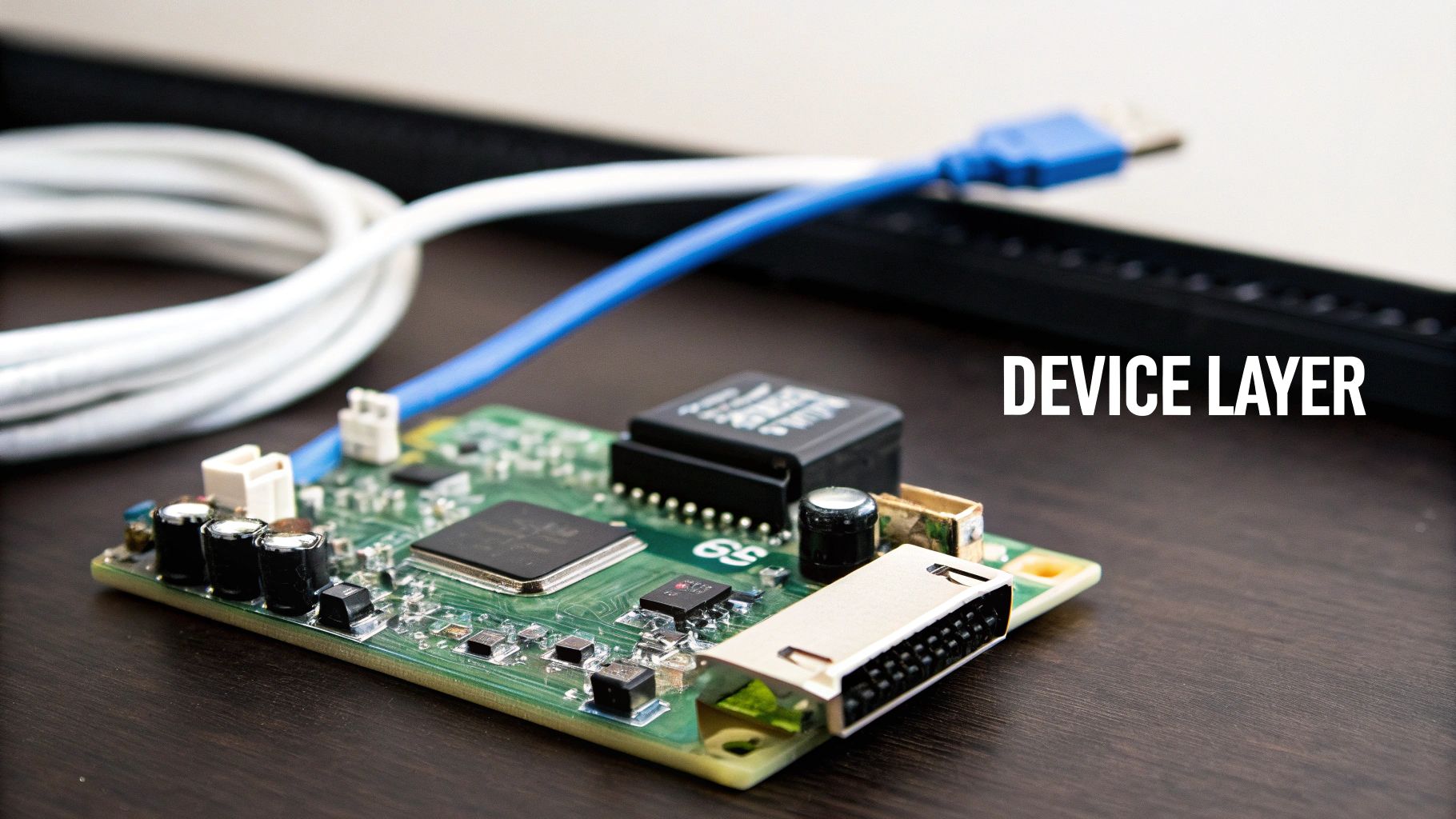
Use Case: In a smart factory, sensors on a conveyor belt detect vibrations that indicate a potential motor failure. In a logistics fleet, a GPS unit tracks a truck's location (sensor), while a remote command can lock its cargo container (actuator). This layer’s sole purpose is to convert a physical property into a digital signal or a digital signal into a physical action.
The Network or Transport Layer
Once data is created, it needs to travel. The Network Layer is the communication backbone that moves data from the device to a central processing hub. This layer consists of hardware and communication protocols that ensure data moves smoothly and securely.
Key components include:
- IoT Gateways: These middlemen aggregate data from nearby sensors, often translating it into a standard protocol before sending it onward. A gateway in a smart building might collect readings from dozens of Bluetooth temperature sensors and transmit them over Wi-Fi.
- Communication Protocols: The choice of protocol depends on range, power consumption, and data volume. Options include lightweight MQTT for simple messaging, LoRaWAN for long-range, low-power scenarios, and familiar protocols like Wi-Fi or cellular (4G/5G) for higher bandwidth needs.
This layer's efficiency directly impacts system responsiveness and operating cost. Projections show IoT devices in commercial buildings will jump from 2 billion to 4.12 billion by 2030, with wireless tech like Wi-Fi and BLE making up over 40% of connections. You can learn more about the growth of IoT in smart buildings.
The Processing or Middleware Layer
After crossing the network, data arrives at the Processing Layer—the brains of the operation. Here, the massive stream of raw data from devices is ingested, stored, and transformed into a structured, usable format.
This is where IoT platforms and cloud services reside. Their job is to convert raw sensor readings into clean, organized information. For example, a platform might turn a stream of voltage readings into a time-stamped record of degrees Celsius. This refined data is often stored in specialized time-series databases designed for IoT workloads.
The Processing Layer is the critical bridge between raw data collection and meaningful application. It refines the noisy, high-volume data streams from the physical world into clean, organized information ready for analysis and action.
The Application Layer
At the top of the stack, the Application Layer is where collected data generates tangible business value. This is the part of the system users interact with.
It can range from a mobile app controlling a thermostat to a complex dashboard giving a factory manager a real-time view of the production line. Use Case: In a logistics operation, the application is the fleet management portal where an operator sees every truck's live location, checks fuel levels, and receives alerts for delivery delays. This is where data becomes decisions.
The IoT Data Pipeline: From Edge to Insight
If the layers are the skeleton of an IoT system, data is its lifeblood. The value of any architecture of internet of things is measured by how efficiently it moves a data point from a sensor to a business insight. This journey is managed by the IoT data pipeline.
Think of the pipeline as a digital assembly line. Raw data (sensor readings, GPS coordinates) enters one end, moves through stages of refinement, and emerges as actionable intelligence. Each step is critical for turning raw, chaotic data into something clean, structured, and useful.
Mapping the Data Journey
The pipeline can be broken into four distinct stages:
- Data Ingestion: The front door where the system takes in massive streams of data from devices and gateways. The key challenge is reliably collecting high-velocity data without loss.
- Data Processing: Raw data is rarely usable as-is. Stream processing is used for real-time analysis (e.g., triggering an immediate alert), while batch processing is for analyzing large historical datasets (e.g., identifying quarterly maintenance trends).
- Data Storage: Processed data needs a home. Chronological sensor readings fit well in time-series databases, while large, unstructured datasets are often stored in a flexible data lake.
- Data Analytics and Action: The final step where clean, stored data is analyzed to find patterns and drive decisions. The output can be a dashboard for a human operator or an automated command sent back to a machine.
Centralizing Intelligence with Modern Data Platforms
As IoT systems grow, managing data across different storage solutions becomes complex. Modern data platforms like Snowflake solve this by creating a centralized data cloud. This pulls all IoT data—from real-time streams to historical archives—into a single source of truth.
This unified approach simplifies analytics, allowing teams to run complex queries on one massive dataset instead of stitching together data from multiple sources. A central platform accelerates the journey from raw reading to actionable insight, as seen in real-world examples of managing time-series data with Snowflake.
The ultimate goal of an IoT data pipeline is to shrink the time between a physical event and a smart business response. A well-designed pipeline doesn't just move data; it accelerates decision-making.
From Analytics to Autonomous Action with Agentic AI
The next frontier for the data pipeline is autonomous action, powered by Agentic AI. These are intelligent agents designed to not just analyze IoT data but to act on it in real time, without human intervention.
Use Case: An AI agent manages a commercial building's energy consumption. It constantly monitors data from thousands of sensors—temperature, occupancy, ambient light, and weather forecasts.
- Based on this live data, it makes hundreds of micro-adjustments every minute.
- It dims lights in empty rooms, tweaks the HVAC system based on occupancy, or pre-cools the building ahead of a heatwave.
The agent actively manages energy to achieve a specific outcome, such as reducing costs by 20%. This is the pinnacle of a mature architecture of internet of things—where the data pipeline culminates in intelligent, automated action.
Navigating the Edge vs Cloud Computing Trade-Off
A critical decision in IoT architecture is where to process data: in a centralized cloud or locally at the edge? This choice fundamentally shapes your system's performance, cost, and capabilities.
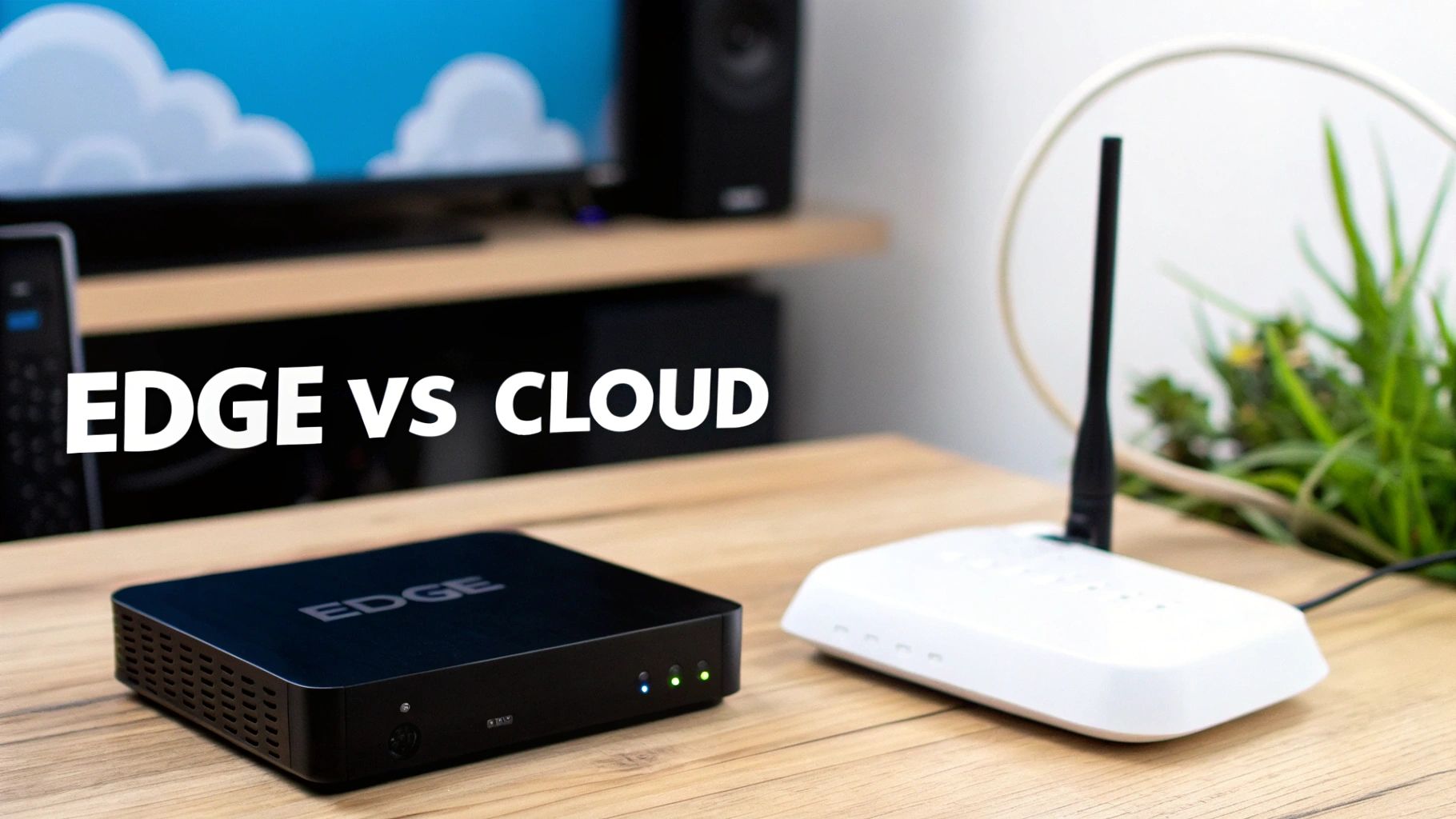
Cloud computing is the traditional model, where data travels from devices to centralized data centers for analysis. Edge computing flips this by pushing computation closer to the data's source, often on the IoT device or a nearby gateway. Neither is inherently better; the right choice depends on the job at hand.
Understanding the Key Trade-Offs
Choosing between edge and cloud is a balancing act. You are trading off speed for power, autonomy for scalability, and local control for centralized management.
Edge Computing vs Cloud Computing in IoT Architecture
FactorEdge ComputingCloud ComputingLatencyExtremely Low: Local processing enables near-instantaneous responses.Higher: Data travel introduces delays.Bandwidth CostsLower: Only essential data is sent to the cloud, reducing traffic.Higher: Transmitting raw data from thousands of devices is expensive.Device AutonomyHigh: Devices can operate without an internet connection.Low: Devices often depend on a constant cloud connection.ScalabilityScales at device level: Adding devices increases local processing.Massively Scalable: Cloud offers virtually limitless resources.SecurityData remains local: Reduces risk of interception during transit.Centralized Security: Robust protocols protect data in one location.
As IoT applications demand real-time responses, the industry is investing heavily in edge computing. You can read more about the rise of edge computing in IoT trends.
Use Cases Illustrating the Choice
Let's ground these trade-offs in real-world scenarios.
Use Case 1: A Self-Driving Car
For an autonomous vehicle, a fraction of a second can mean the difference between safety and an accident. It cannot afford the delay of sending sensor data to the cloud for a decision.
- Outcome: Instantaneous, life-or-death decisions.
- Architecture Choice: Edge computing is mandatory. Powerful onboard computers analyze camera, LiDAR, and radar data in real time to control the car.
- Cloud Role: Reserved for non-urgent tasks like map updates, sending aggregated driving data for AI model training, or long-term fleet diagnostics.
In mission-critical applications where latency can have immediate physical consequences, edge computing isn't just a preference—it's a requirement for safety and functionality.
Use Case 2: Smart Agriculture
A large farm uses sensors to maximize crop yields over a growing season. Timeframes are hours, days, and seasons, not milliseconds.
- Outcome: Long-term crop yield optimization.
- Architecture Choice: Cloud computing is a perfect fit. The system gathers massive historical datasets (soil moisture, weather patterns) and runs powerful machine learning models in the cloud to predict optimal planting times.
- Edge Role: Simple, immediate actions. A local gateway can trigger an irrigation system when a soil sensor detects dryness, without needing cloud confirmation.
The most sophisticated architectures are hybrids, using the edge for its speed and reliability and the cloud for its massive scale and analytical power.
Securing Your IoT Architecture: A Zero Trust Approach
Security cannot be an afterthought; it must be woven into the fabric of your IoT architecture from day one. With billions of devices coming online, each is a potential entry point for threats. The old model of a secure internal network is obsolete.
The Zero Trust model provides a modern strategy based on a simple principle: never trust, always verify. It assumes threats can exist anywhere, inside or outside your system. Every device, user, and data request must prove its identity and authorization before gaining access, every single time.
Implementing this model means building security into every layer, creating a defense-in-depth strategy that protects the entire ecosystem.
Pillars of a Zero Trust IoT Architecture
A successful Zero Trust framework is built on a set of coordinated security principles applied consistently across the architecture of internet of things.
- Device Identity and Authentication: Every device needs a unique, tamper-proof digital identity, often stored in secure hardware elements, to ensure only legitimate devices can join the network.
- Secure Communication: All data must be encrypted, both when moving across the network (in transit) and when stored on a device or in the cloud (at rest). This prevents snooping and tampering.
- Network Segmentation: The network is carved into isolated microsegments. If one segment is compromised, the breach is contained and cannot spread, dramatically limiting the potential damage.
- Continuous Monitoring and Analytics: Security is an ongoing process. The system must constantly monitor device behavior, network traffic, and access patterns to detect anomalies and potential threats in real time.
Implementing Security Across Every Layer
These principles must be applied holistically, from the smallest sensor to the central cloud platform. This end-to-end approach is the core strength of the Zero Trust model.
For example, a medical device's firmware (device layer) must be hardened. The patient data it sends must be encrypted (network layer). Access to that data in the cloud (processing layer) must be strictly controlled through identity and access management policies.
In a Zero Trust framework, security is not a gatekeeper at the perimeter but a constant companion to every piece of data and every device, throughout its entire lifecycle.
Compliance and Frameworks
A secure architecture must also align with regulatory requirements like GDPR or HIPAA. Following established security frameworks from organizations like NIST (National Institute of Standards and Technology) provides a proven blueprint for building a comprehensive and compliant security program.
Putting It All Together: Real-World Reference Architectures
Theoretical models are useful, but the true test of an architecture is its performance in the field. By examining practical reference architectures, we can see how abstract components translate into tangible business results.
Industrial IoT Predictive Maintenance
Outcome: Reduce costly, unplanned factory downtime.
Unplanned downtime costs manufacturers an estimated $50 billion annually. A predictive maintenance architecture attacks this problem by identifying potential equipment failures before they happen.
Architecture: Vibration and temperature sensors stream data to a local IoT gateway. This data is fed into an edge analytics engine for real-time analysis.
- Immediate Action: If the engine detects a vibration pattern signaling imminent bearing failure, it sends an instant alert to the maintenance team.
- Long-Term Insight: Aggregated data is sent to a central cloud platform, where machine learning models are trained on historical data to improve prediction accuracy over time.
This hybrid edge-cloud setup delivers the immediate response needed to prevent failure and the deep intelligence to improve long-term performance. As systems grow, modeling becomes critical for mitigating risk as IoT systems expand.
A well-designed IIoT architecture flips the script from reactive repairs to proactive maintenance. It’s a fundamental shift from fixing what's broken to preventing breakdowns in the first place, which has a direct and massive impact on the bottom line.
Smart Retail and Customer Analytics
Outcome: Optimize store layouts and inventory to increase sales.
Retailers need to understand customer behavior to create better shopping experiences. A smart retail architecture uses IoT to gather these insights while prioritizing customer privacy.
Architecture: A combination of BLE beacons and overhead video sensors tracks anonymous customer movement.
To ensure privacy, all initial video processing happens at the edge. An edge device analyzes the raw feed to generate anonymized data points, like foot traffic heatmaps or dwell times in aisles. Only this anonymized data is sent to a central analytics platform for review. No personally identifiable information ever leaves the store.
Key Decisions for a CTO:
- Protocol Selection: Are BLE beacons accurate enough, or is another technology needed for tracking in-store movement?
- Edge Hardware: What processing power is needed on-site to handle real-time video analysis without creating a privacy risk or performance bottleneck?
- Platform Choice: Which central analytics platform is best suited for visualizing geospatial retail data for inventory and marketing teams?
This architecture provides powerful insights—like identifying checkout bottlenecks or underperforming displays—that help retailers make data-driven decisions to increase sales.
IoT Architecture: Your Questions Answered
Diving into IoT architecture often raises a few questions. Here are straightforward answers to common queries from teams planning their IoT strategy.
What Is the Most Important Layer in an IoT Architecture?
While all layers are interdependent, the Processing/Middleware Layer is arguably the most critical. This is the engine room that transforms raw, noisy data from sensors into clean, structured information that drives business outcomes.
Without a solid data processing strategy, all the information collected is just noise. The Processing Layer is what unlocks the value in your data.
A classic mistake is focusing on the devices (Perception Layer) without a clear strategy for the data they will generate. The real value is unlocked when that data is processed effectively to drive a specific outcome.
How Do I Choose the Right Communication Protocol?
The right protocol is a trade-off between range, power consumption, data volume, and cost. There is no single "best" protocol; the choice depends on your use case.
A quick guide:
- Short-range, low-power (e.g., smart home sensors): Bluetooth Low Energy (BLE) or Zigbee are excellent choices.
- Long-range, low-power (e.g., agriculture, smart cities): LoRaWAN is a strong contender.
- High-bandwidth (e.g., video cameras): Wi-Fi or cellular (5G) are necessary, but consume more power.
Can a Small Business Implement an IoT Architecture?
Absolutely. The rise of cloud-based IoT platforms from providers like AWS and Azure, combined with falling sensor costs, has made IoT accessible to businesses of all sizes.
A small logistics company can build a simple architecture using off-the-shelf GPS trackers (Device Layer) that report over a cellular network (Network Layer) to a cloud platform (Processing Layer). From there, they can create a real-time dashboard (Application Layer) to track their fleet. This helps optimize routes and delivery times without a massive upfront investment. The key is to start small, solve a single business problem, and scale from there.


