An IoT architecture is the digital nervous system for your business. It's the framework that connects physical assets—machinery, vehicles, buildings—to the cloud, turning real-world events into smart, automated actions that drive results.
This isn't about a single technology. It's the strategic combination of hardware, software, and networking that creates a feedback loop between your physical operations and your digital strategy, enabling outcomes like predictive maintenance, automated logistics, and enhanced efficiency.
Your Business and the IoT Digital Nervous System
A successful IoT architecture acts like a biological nervous system. It’s built to sense the environment, process information, and trigger a meaningful response. Each component has a specific job, but they only create value when they work together seamlessly.
At its core, the system must handle data from potentially millions of devices, process it efficiently, and deliver insights that empower action. The goal isn’t just to connect things—it's to create a continuous conversation between your physical world and your digital platforms that leads to better business outcomes.
The Core Layers and Their Purpose
An IoT architecture is a functional stack where each layer turns raw sensor readings into high-value business intelligence. This structure clarifies how a simple temperature reading on a factory floor can lead to a multi-million-dollar operational improvement.
Let's look at how the main components work together to deliver business outcomes:
- Device Layer (The Senses): This is where the physical world meets the digital. Sensors and actuators are the eyes, ears, and hands of your system, collecting raw data like temperature, location, or vibration.
- Edge Layer (The Reflexes): Not all data needs to travel to a central brain. The edge layer brings processing power closer to the devices, enabling instant, reflexive actions—like a safety valve shutting off automatically without waiting for a cloud command.
- Cloud Layer (The Brain): This is the command center for deep analysis, machine learning, and long-term data storage. The cloud aggregates data from all sources, runs complex analytics, and hosts the applications that drive major strategic decisions.
Use Case: Logistics Fleet Management A GPS sensor on a delivery truck (Device) sends its location to a gateway in the vehicle (Edge). The gateway immediately checks if the truck deviates from its route. If so, an alert is sent to the central platform (Cloud), which notifies the dispatcher and analyzes fleet-wide patterns to optimize all future delivery schedules. This layered approach delivers both immediate response and long-term strategic insight. You can explore how IoT and simulation mitigate risks as systems grow.
The Core Layers of IoT Architecture and Their Business Purpose
This table breaks down the layers, their functions, and the direct business outcomes they achieve.
LayerCore FunctionKey TechnologiesBusiness OutcomeDeviceSenses and interacts with the physical world.Sensors (GPS, temperature), Actuators (valves, motors), MicrocontrollersReal-time operational visibility and control over physical assets.EdgeFilters, aggregates, and processes data locally for immediate response.IoT Gateways, Edge Servers, Fog Computing NodesReduced latency for critical actions, lower data transmission costs, improved reliability.GatewayManages device connectivity, translates protocols, and secures data transfer.MQTT/CoAP Brokers, Cellular/LoRaWAN GatewaysSecure, reliable, and scalable communication between devices and the cloud.CloudStores, analyzes, and visualizes massive datasets; hosts applications.AWS IoT, Azure IoT Hub, Snowflake, ML PlatformsData-driven strategic insights, predictive maintenance, new business models.
Ultimately, designing the right IoT architecture is about making smart choices on where data is collected, processed, and acted upon.
An effective IoT architecture delivers the right information to the right place at the right time. Whether it’s an immediate alert on the edge or a deep analytical insight from the cloud, the structure must serve the business outcome.
These decisions directly shape your system's cost, scalability, and the speed at which you can respond to new challenges and opportunities.
Understanding the Four Essential Layers of IoT Architecture
A modern IoT architecture is a four-layer stack that turns raw data from the physical world into business intelligence. This structure ensures that information is collected, processed, and analyzed efficiently to create value at every step.
The design of these layers directly impacts your system's speed, cost, and ability to scale. Let’s break down what each layer does.
Layer 1: The Device Layer
This is the physical foundation where your system meets the real world. The Device Layer is comprised of sensors that gather data (temperature, motion, location) and actuators that perform actions (shutting a valve, adjusting a thermostat). These devices are the source of all the raw data that fuels the system.
Use Case: Cold Chain Logistics Temperature sensors inside refrigerated containers constantly monitor the climate. If the temperature rises above a set threshold, an actuator automatically activates a cooling unit, preventing the spoilage of sensitive goods like pharmaceuticals and saving millions in potential losses.
Layer 2: The Edge Layer
Sending all raw data from thousands of devices straight to the cloud is slow, inefficient, and expensive. The Edge Layer solves this by acting as a local processing hub, moving computation closer to the devices. This layer consists of IoT gateways or on-site servers that perform initial data filtering, aggregation, and analysis.
This delivers three key outcomes:
- Reduced Latency: Decisions are made in milliseconds, which is critical for safety systems like a factory robot that must stop instantly if a person enters a restricted area.
- Lower Costs: Filtering irrelevant data at the source slashes bandwidth usage and cloud storage fees.
- Improved Reliability: Critical functions continue to operate even if the cloud connection is lost.
Use Case: Fleet Management A gateway in each truck processes GPS data locally to trigger immediate geofencing alerts if a vehicle strays off-route, rather than waiting for the cloud to process location pings and send a command back.
Layer 3: The Cloud Layer
The Cloud Layer is the central brain of the IoT architecture. While the edge handles immediate, tactical tasks, the cloud is where deep, strategic analysis occurs. This layer uses powerful data platforms, servers, and storage to handle massive amounts of information.
Here, aggregated data is stored, analyzed, and visualized. Machine learning models are trained on historical data to predict equipment failures, spot trends, and optimize entire workflows. This is where you uncover the big-picture insights that drive significant business improvements.
Use Case: Energy Management An energy company aggregates consumption data from thousands of smart meters in the cloud. By analyzing this dataset, it can predict peak demand, optimize the power grid for efficiency, and offer customers personalized energy-saving tips.
The true value of an IoT architecture is realized in the cloud, where data from countless individual assets is transformed into collective intelligence that reshapes business strategy.
Layer 4: The Application Layer
The Application Layer is the human interface where processed insights are presented to end-users. It includes mobile apps, web dashboards, and integrations with enterprise software like a CRM or ERP system.
This layer translates complex data into clear, actionable information. An operations manager doesn't see raw sensor readings; they see a dashboard alert that a specific machine is 85% likely to fail next week, enabling proactive maintenance.
Use Case: Smart Building Occupants use a mobile app (Application) to adjust office lighting and temperature. The app communicates with the cloud, which analyzes data from occupancy sensors (Device) and HVAC systems (Actuator) to create an energy-efficient environment, all presented through a simple interface. This layer closes the loop, turning data into tangible human value.
Choosing the Right IoT Connectivity Protocols
In any IoT architecture, connectivity moves data from devices to the edge and the cloud. The right choice is a strategic one, dictated by what you need to achieve. A poor choice leads to dead batteries and choked networks. The key is to weigh the trade-offs between range, power, bandwidth, and cost.
Short-Range Protocols for Dense Environments
Short-range protocols are workhorses for applications where devices are concentrated in a specific area, like a factory floor or a smart building. They provide high-bandwidth connections over shorter distances.
- Wi-Fi (including Wi-Fi 6): Ideal for high-data applications where power isn't a major constraint, such as streaming high-definition video from quality control cameras in a smart factory.
- Bluetooth Low Energy (BLE): Perfect for small, battery-powered sensors that send infrequent bursts of data, like asset tracking beacons in a warehouse or environmental sensors in an office.
Wi-Fi now powers 32% of all global IoT connections. In manufacturing, which leads IoT adoption at 34% of deployments, a modern factory averages 178 IoT sensors per 10,000 square feet. This density demands robust connectivity to ensure critical data always gets through.
Long-Range Protocols for Sprawling Deployments
When devices are spread across cities, farms, or utility grids, long-range protocols are required. These technologies are engineered to send small data packets over many kilometers while consuming minimal power. The leading options are LoRaWAN and Cellular IoT.
The most successful IoT deployments match the connectivity protocol to the business reality. A smart farm doesn't need high-bandwidth video; it needs a low-cost, low-power way to get soil moisture readings from a sensor five kilometers away.
This outcome-first approach ensures technology serves the operational goal.
Comparing Key IoT Protocols
The decision often comes down to comparing technical specs against business needs. It's also critical to consider modern security mechanisms like identity-based WiFi security (IPSK) to ensure every device is properly authenticated.
Here’s a breakdown of how these protocols stack up:
| Protocol | Typical Range | Bandwidth | Power Consumption | Common Use Cases | | :--- | :--- | :--- | :--- | | Wi-Fi 6 | Up to 100 meters | Very High | High | Smart factories, connected hospitals, high-density venues | | Bluetooth LE | Up to 100 meters | Low | Very Low | Asset tracking, smart home sensors, wearable devices | | LoRaWAN | 5-15 kilometers | Very Low | Extremely Low | Smart agriculture, city-wide metering, environmental monitoring | | Cellular IoT | Extensive (National) | Low to Medium | Low | Fleet management, smart utility grids, remote asset tracking |
For example, an agricultural enterprise monitoring soil conditions across thousands of acres would find LoRaWAN ideal. The sensors send only a few bytes of data daily, and their batteries must last for years. Conversely, a smart building operator deploying HD security cameras needs the massive bandwidth of Wi-Fi 6. Picking the right tool makes your IoT architecture operationally sound and cost-effective.
The Critical Role of Edge Computing in Real-Time Decisions
In a serious IoT architecture, sending every piece of data to the cloud is too slow. This latency is a dealbreaker where milliseconds matter. The solution is edge computing—a strategy that moves processing power out of the cloud and closer to the data source.
Think of it as a reflex. If you touch a hot stove, your hand snaps back instantly without waiting for your brain to analyze the situation. Edge computing gives your IoT system that same immediate response capability.
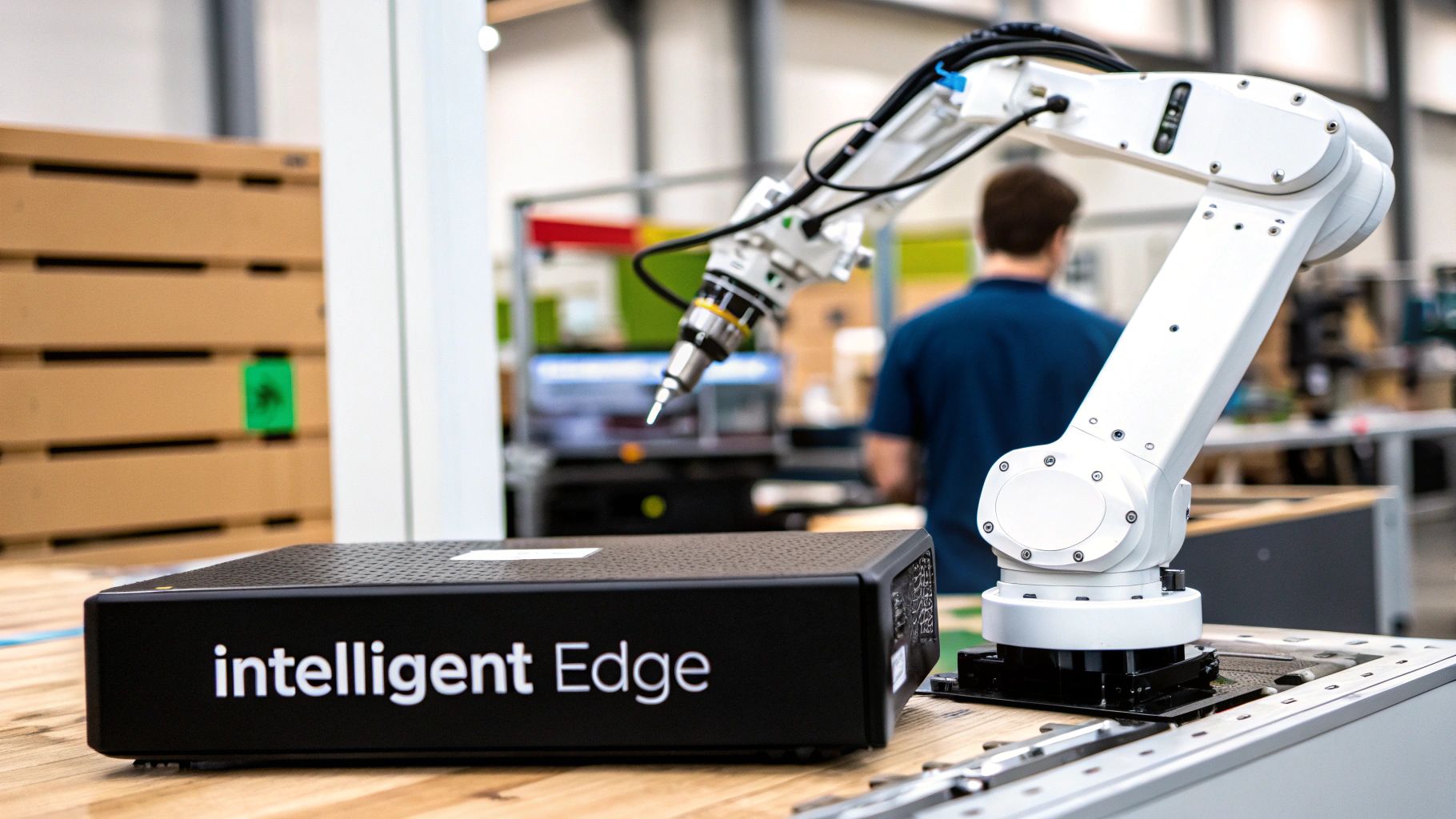
This is a non-negotiable part of a high-performance IoT architecture. By handling critical tasks locally, you achieve faster, more resilient, and more efficient operations.
Why the Intelligent Edge Is Essential
Moving to an 'intelligent edge' approach solves three major bottlenecks of purely cloud-centric systems, making the entire operation more robust.
The measurable benefits are:
- Drastically Reduced Latency: For industrial robotics or autonomous vehicles, real-time responses are crucial. An edge device can detect an anomaly and trigger a shutdown in milliseconds—a dangerously slow task if left to the cloud.
- Significant Bandwidth Savings: Streaming raw data 24/7 is expensive. Edge devices pre-process, filter, and aggregate data locally, sending only meaningful summaries or critical alerts to the cloud.
- Enhanced Offline Functionality: If the internet connection fails, a cloud-only system stops. An edge-powered system continues its core operations autonomously, ensuring business continuity.
With global cellular IoT connections projected to hit 3.8 billion and generate 79.4 zettabytes of data annually, edge computing is essential. Running AI models for local inference (AIoT) can cut cloud traffic by up to 90%. This distributed structure is also vital for security, as IoT cyberattacks soared to 112 million incidents in a single year. You can explore more about these expanding IoT trends on ithinx.io.
Edge Computing Use Cases in Action
The power of the edge is clear when solving real-world problems where speed and reliability are paramount.
Smart Buildings Instead of sending occupancy data from hundreds of sensors to the cloud, an on-site edge server crunches the numbers in real time. The HVAC system instantly adjusts airflow and temperature in specific zones as people move, optimizing comfort while slashing energy costs.
Manufacturing and Robotics A robotic arm on an assembly line uses a camera with an embedded AI model. This edge device analyzes the video feed on the factory floor to spot product defects. If a flawed part is identified, the robot immediately removes it, preventing it from moving down the line and ensuring instant quality control.
Edge computing isn't about replacing the cloud; it's about complementing it. It handles the urgent, time-sensitive tasks locally, freeing up the cloud to focus on big-data analytics and long-term strategy.
Building an intelligent edge into your IoT architecture delivers better business outcomes. By processing data where it's created, you build a faster, more cost-effective, and more reliable system that can respond instantly to the real world.
Unlocking Business Value with Snowflake and Agentic AI
Once data is gathered, filtered, and delivered, the real work begins: transforming a torrent of raw information into strategic, automated business intelligence. The key is connecting powerful cloud data platforms with intelligent AI systems.
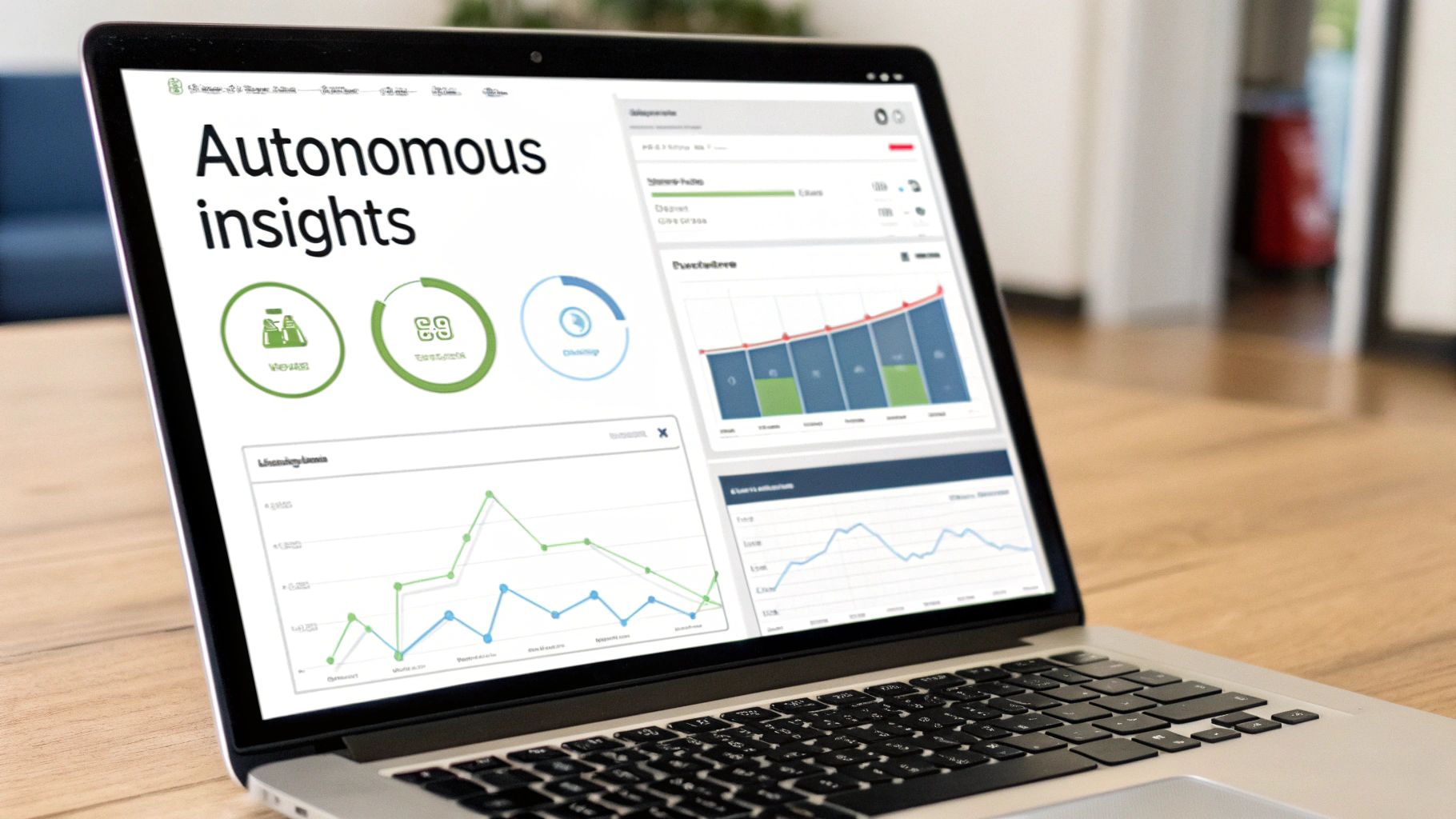
Solid data pipelines are needed to move processed information from gateways into a scalable cloud platform like Snowflake. It’s designed to handle the sheer volume and speed of time-series data from enterprise IoT systems, allowing you to ingest and query petabytes without a performance drop. This robust data foundation enables the next leap: Agentic AI.
From Data Analytics to Automated Action
Agentic AI goes beyond traditional analytics dashboards. Instead of just displaying data for humans, AI agents are autonomous systems that can monitor data streams, spot complex patterns, and execute multi-step workflows on their own.
Operating within your cloud environment, these agents query data in Snowflake to find anomalies, trends, or specific triggers. When a condition is met, the agent initiates a cascade of actions across different business systems. The reasoning and language skills behind these agents are powered by technologies like Large Language Models (LLMs).
Real-World Use Cases of Integrated IoT and AI
Combining a scalable data platform with autonomous AI agents unlocks outcomes that were recently science fiction, evolving systems from simple monitoring to proactive, intelligent automation.
Use Case 1: Fleet Management Automation A logistics company manages thousands of delivery trucks, with sensors streaming engine performance data to the cloud.
- Data Ingestion: Sensor data pours into a central Snowflake instance.
- AI Agent Monitoring: An AI agent with the goal of maximizing fleet uptime continuously sifts through the data, looking for fault patterns that precede engine failure.
- Autonomous Action: When the agent detects a recurring fault pattern, it cross-references maintenance logs, automatically schedules preventative service for all affected trucks, orders the necessary parts, and updates the inventory system—all without human intervention.
This automated workflow prevents breakdowns, reduces downtime, and optimizes the supply chain.
The ultimate goal of a modern IoT architecture is not just to collect data but to create a closed-loop system where insights automatically drive physical-world actions, creating a cycle of continuous improvement.
Use Case 2: Energy Grid Optimization An energy provider uses smart meters to track consumption across hundreds of thousands of properties.
- Data Ingestion: Meter readings stream into Snowflake every few minutes.
- AI Agent Monitoring: An AI agent monitors grid load and weather forecasts to prevent blackouts and optimize energy distribution.
- Autonomous Action: The agent predicts a surge in energy demand due to an approaching heatwave. It immediately reroutes power, brings renewable sources online, and sends targeted conservation alerts to customers in the affected area.
By integrating IoT architecture with a data platform like Snowflake, organizations can master massive data volumes. This is demonstrated in Faberwork’s work with time-series data on Snowflake. This final integration unlocks the full potential of an IoT ecosystem, turning operational data into a true competitive advantage.
Your IoT Architecture Questions, Answered
When designing an enterprise-grade IoT system, a few critical questions always arise. Answering them correctly is key to ensuring your project delivers business value. This section provides direct answers to common challenges in the architecture of iot.
How Do You Actually Secure a Modern IoT Architecture?
IoT security is a multi-layered strategy that must be integrated from the start.
It begins at the Device Layer with secure boot processes and hardware-based identities to prevent tampering. Next, all network data must be protected with encrypted protocols like TLS and network segmentation to contain breaches. Finally, the Cloud Layer requires iron-clad identity and access management (IAM), data encryption at rest, and continuous threat monitoring.
The gold standard is a 'zero-trust' security model. Assume nothing is trustworthy by default. Every connection and data request must be verified, which massively shrinks the attack surface.
What's the Single Biggest Challenge When Scaling an IoT Solution?
The biggest challenge is managing device proliferation and data volume.
Scaling from 100 to 100,000 devices introduces immense complexity. A powerful device management platform is essential for provisioning, over-the-air (OTA) firmware updates, and remote diagnostics. Architecturally, you must design for massive data ingestion from day one. Using a scalable cloud data platform like Snowflake is critical to avoid performance bottlenecks as your device fleet grows.
Should We Build Our Own IoT Platform or Just Use a Public Cloud Service?
For most companies, using a public cloud platform like AWS IoT or Azure IoT is the smartest move. They provide pre-built infrastructure for connectivity, security, and data management, dramatically reducing development time and upfront costs.
Building a platform from scratch is a monumental effort requiring deep, specialized expertise. A hybrid approach often works best:
- Let a public cloud handle the heavy lifting like device authentication and data ingestion.
- Focus your developers on building the unique application logic and analytics that create business value.
This strategy accelerates time-to-market while allowing you to own the parts of your solution that differentiate you.
How Does Edge Computing Affect the Overall Cost of an IoT Solution?
Edge computing requires a higher upfront investment in local hardware, but it can significantly slash long-term operational costs.
By processing data at the edge, you drastically reduce the volume of raw data sent to the cloud. This lowers your cloud storage bills and data transmission costs, which can be substantial in large-scale deployments. For data-intensive applications like video analytics or industrial monitoring, this trade-off often leads to a much lower total cost of ownership (TCO) over the solution's lifetime.


