For too long, finance teams were the company's historians, painstakingly piecing together what already happened. Think endless hours pulling data from separate systems—ERPs, CRMs, payroll—and wrestling it into static, backward-looking reports. It was a reactive grind that left almost no time for actual strategy.
Business Intelligence (BI) flips that script. Instead of just reporting the numbers, BI tools deliver a single, live view of the company’s financial health. This outcome-focused approach transforms finance pros from number crunchers into strategic advisors who guide the business forward.
From Reporting The Past To Predicting The Future

The real value of BI isn't just faster reporting; it's about asking better questions to achieve better outcomes. You move beyond, "What were our revenues last quarter?" to "Which product lines are driving the most profit, and why?" It's about seeing the story behind the numbers.
For example, a BI platform can instantly overlay sales data from your CRM with expense data from your ERP. The outcome? You can see the true, all-in profitability of a single customer or a specific marketing campaign, enabling smarter investment decisions.
By unifying data, BI for finance transforms the finance function from a cost center focused on compliance into a value-creation engine that actively steers the company toward its goals.
Before we go deeper, let's look at the contrast between the old way and the new.
The Evolution from Traditional to BI-Driven Finance
ActivityTraditional Finance ApproachBI-Driven Finance ApproachReportingManual, static, backward-looking reports.Automated, real-time dashboards with interactive visuals.Data SourcesSiloed systems (ERP, CRM) requiring manual export.A single source of truth with unified data from across the business.AnalysisDescriptive: "What happened?"Predictive & Prescriptive: "Why did it happen and what should we do?"ForecastingBased on historical trends and gut feelings.Driven by statistical models for higher accuracy.Role of FinanceScorekeeper and compliance officer.Strategic partner and business advisor.
This table just scratches the surface. The shift is less about new software and more about a new mindset—one focused on proactively shaping the future instead of just documenting the past.
Driving Profitability With Data
This isn’t just theory; BI delivers a measurable impact on the bottom line. Take the banking sector: McKinsey’s Global Banking Annual Review found that banks' revenues after risk costs hit a record $5.5 trillion, with net income soaring to $1.2 trillion. A huge driver was using BI to manage portfolios, optimize pricing, and spot new revenue streams. You can dig into the specifics in the full banking industry review from McKinsey.
You don’t have to be a global bank to see these results. With BI for finance, any company can achieve tangible outcomes:
- Spot Cost Inefficiencies: Get a clear view of overspending by drilling down into trends by department, project, or vendor to cut waste.
- Optimize Cash Flow: Use predictive models to forecast liquidity, making smarter, proactive decisions about managing payables and receivables.
- Improve Forecast Accuracy: Build financial projections on a solid foundation of historical and live market data, reducing guesswork and risk.
Ultimately, BI gives CFOs the power to make faster, sharper decisions that manage risk and directly grow the business. This jump from manual data entry to automated, strategic thinking is what it takes to build a future-ready finance function.
How Financial KPIs Drive Business Outcomes
Let’s move past theory. The real power of BI for finance shows up in its direct impact on business health. This isn't about building flashy dashboards; it's about making key performance indicators (KPIs) so clear and immediate that they compel action. This is where raw data turns into tangible results.
Instead of waiting for a month-end report, finance leaders can watch critical KPIs in real time. That immediacy transforms metrics from historical artifacts into active levers for steering the company.
Translating Live KPIs into Strategic Action
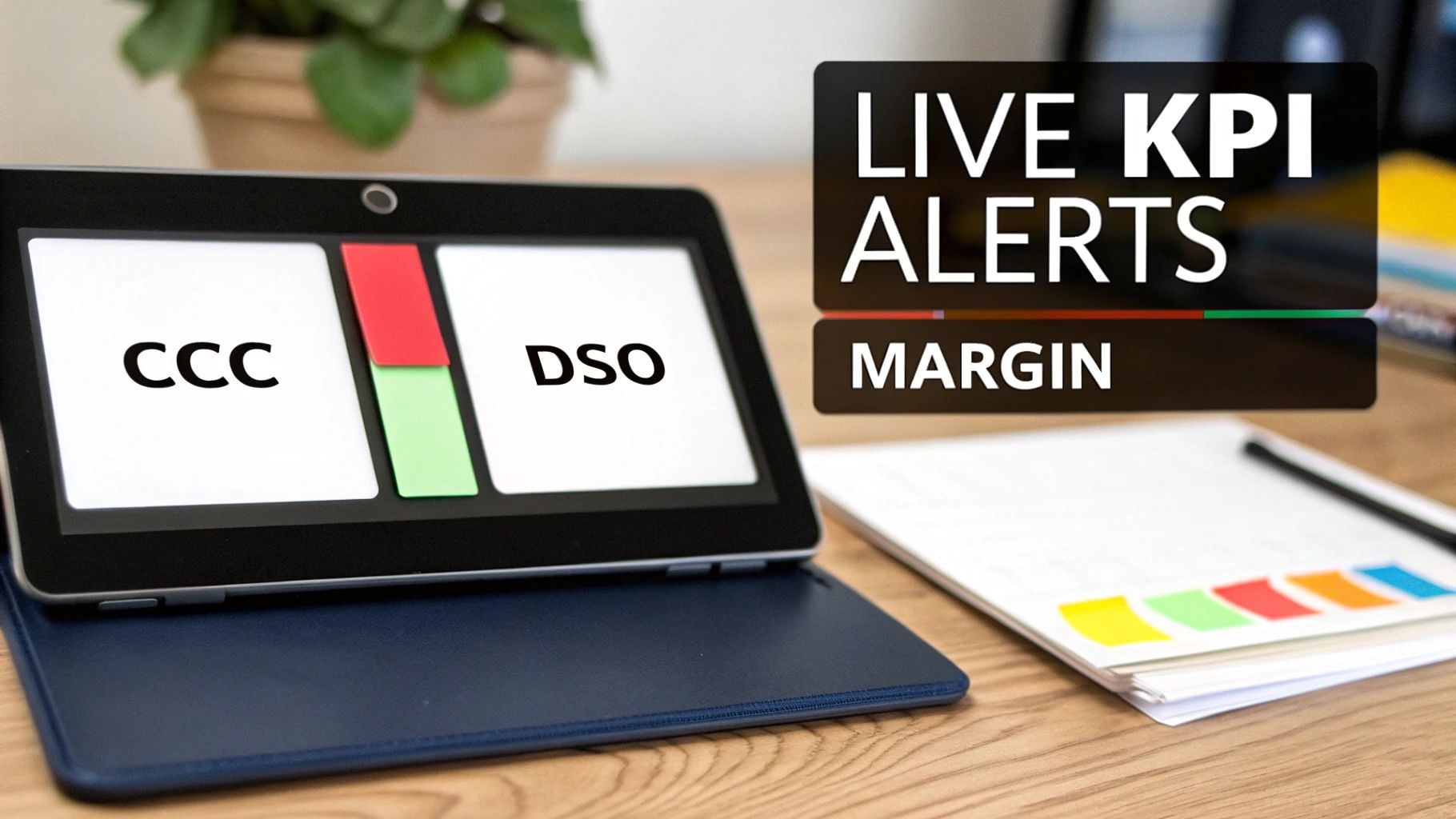
Imagine a CFO gets a live alert: the company’s Cash Conversion Cycle (CCC) just jumped by five days. In the past, this insight might have been buried in a quarterly review, long after the chance to act was gone.
With a modern BI platform, that single alert sparks immediate, data-backed questions:
- Is inventory turnover slowing? The BI tool can drill into product-level data in seconds to find slow-moving stock.
- Are customers paying slower? The Days Sales Outstanding (DSO) dashboard can spotlight specific invoices or customer groups causing the delay.
- Are we paying suppliers too quickly? The system can instantly check payment terms against contracts to flag discrepancies.
Going from a high-level KPI alert to granular root-cause analysis is what separates BI-driven finance from old-school reporting. The focus shifts from just knowing a number to understanding the story behind it and taking corrective action. You can learn more about gaining this level of control in our guide on becoming a smart controller for improved profitability.
A real-time alert on a declining Gross Margin Return on Investment (GMROI) is no longer a historical footnote. It becomes an immediate directive to renegotiate supplier contracts or adjust pricing strategies before the quarter ends.
Use Cases: From Insight To Outcome
This straight line from data to decision is proving indispensable. A recent Financial Services Outlook 2025 report from Slalom highlights that 85% of leading financial services firms now use BI platforms to drive strategy.
Here’s how this translates into specific business outcomes:
- Inventory Optimization: A retailer uses a GMROI dashboard to spot unprofitable product lines. They clear out low-margin inventory, freeing up $1.2 million in working capital to invest in better-performing products.
- Accelerated Cash Flow: A manufacturing firm’s BI system flags a spike in DSO for a key customer segment. The AR team uses this data to resolve payment issues, cutting the average collection time by eight days and improving cash flow.
- Strategic Supplier Management: By monitoring its procure-to-pay cycle, a logistics company identifies an opportunity to extend payment terms with a major supplier. This adjustment bolsters their cash position, allowing them to seize a time-sensitive investment opportunity.
In each case, the BI system delivered the context needed to make a specific, profitable decision. This is how BI for finance evolves from a reporting tool into a direct contributor to the bottom line.
Visualizing Success with Financial Dashboards
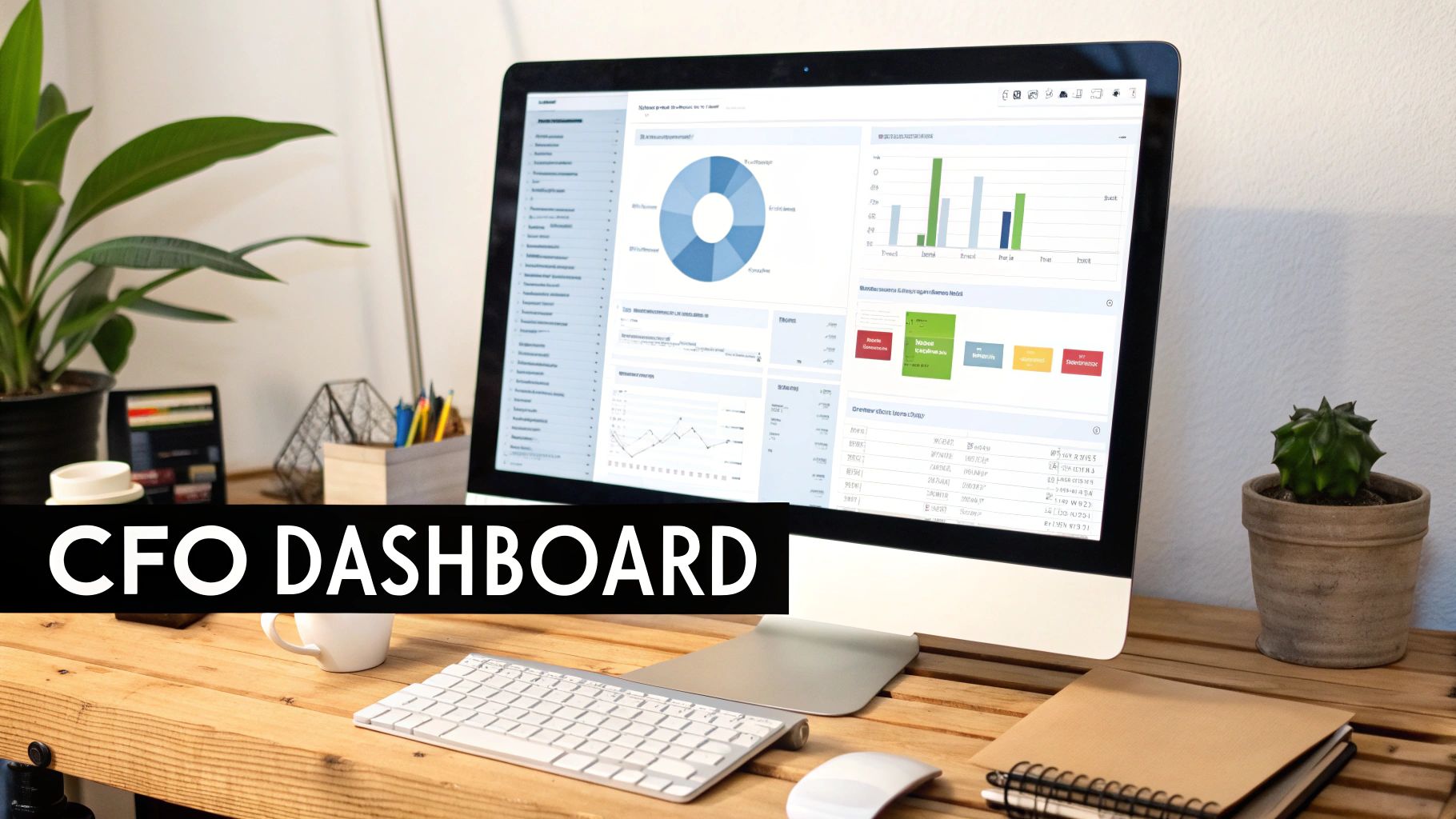
Live KPIs are the heartbeat of a business, but financial dashboards are the complete health report. This is where abstract data becomes visual intelligence, allowing leaders to see through the clutter and make confident decisions. A good dashboard doesn't just show numbers; it tells a story and answers critical questions at a glance.
Forget digging through spreadsheets. Think of it as a command center for your company’s financial health. Here are three practical use cases showing how BI for finance turns raw data into decisive action.
The CFO Dashboard: Strategic Oversight in One View
The CFO Dashboard offers high-level, strategic oversight by pulling the most important financial metrics into one place. It’s the 30,000-foot view that instantly shows if the company is on course.
Outcome: Immediately spot deviations from the financial plan, enabling a rapid response to issues before they escalate. A sudden dip in margin, for instance, isn't just an alert—it’s a trigger to drill down and find the root cause, protecting profitability for the quarter.
The Profitability Analysis Dashboard: Uncovering Margin Opportunities
Not all revenue is good revenue. The Profitability Analysis Dashboard goes beyond the top line to reveal the true bottom-line impact of every product, service, or customer.
Outcome: Make surgical decisions about where to invest resources for maximum return. A business might discover its highest-selling product has paper-thin margins, while a smaller product line is a profit powerhouse. Armed with this knowledge, leadership can adjust pricing, discontinue unprofitable offerings, or double down on high-margin segments to directly boost financial health.
The Cash Flow Forecasting Dashboard: Proactive Liquidity Management
Cash is king, and surprises are never good. The Cash Flow Forecasting Dashboard offers a forward-looking view of liquidity, projecting cash inflows and outflows.
Outcome: Prevent liquidity crises and enable smarter capital deployment. If a forecast flags a potential cash crunch in six weeks, leaders can act now—by drawing on a line of credit or launching a campaign to speed up collections. This proactive stance keeps the business resilient and agile.
Building Your Modern Financial Data Stack

Powerful financial insights don't just appear; they're built on a solid technological foundation. A modern data stack is the engine that drives effective BI for finance, turning a chaotic mix of data sources into a single, reliable stream of intelligence.
This structured approach eliminates the grueling, error-prone task of manual data reconciliation. Instead of your team spending days pulling spreadsheets, they get a "single source of truth"—one trusted, unified place for all financial data.
The Core Components of Your Data Library
Putting this central library together involves a few key steps, each powered by specific tools. This architecture enables the self-service analytics that frees your finance team to focus on high-value strategy instead of tedious data prep.
The rapid growth of the global business intelligence market shows just how critical this infrastructure has become. The market, valued at US$ 37.22 billion, is projected to hit US$ 73.36 billion by 2033, climbing at a compound annual growth rate of roughly 7.7%. This boom is fueled by the intense need for data-driven decisions in finance, a trend you can explore in the global business intelligence market forecast by Renub Research.
To get there, you'll need these essential components.
Key Components of a Modern Financial Data Stack
A modern financial data stack brings together several layers of technology to create a seamless flow from raw data to actionable insight. Here’s a look at the essential tools and the role they play.
ComponentPurposeExample ToolsData SourcesOriginal systems where financial and operational data is generated.ERPs (NetSuite, SAP), CRMs (Salesforce), Payroll SystemsETL/ELT ToolsExtract data from sources, clean it, transform it into a consistent format, and load it into the warehouse.Fivetran, dbt, AirbyteCloud Data WarehouseA powerful, scalable repository for storing all your structured data for fast querying and analysis.Snowflake, Google BigQuery, Amazon RedshiftBI & Analytics LayerThe tools where users connect to the warehouse to build dashboards, reports, and explore data.Power BI, Tableau, Looker
Each component is a crucial link in the chain, ensuring that the data your team uses is clean, consistent, and always available. You can see a real-world example of how this works in our guide to handling time-series data with Snowflake.
By investing in a well-architected data stack, you're not just buying technology. You are fundamentally changing how your finance team operates, shifting their time from manual data wrangling to strategic analysis that drives business growth.
This structured setup is the essential plumbing that makes real-time KPIs, interactive dashboards, and predictive forecasting possible.
The Future of Finance with Agentic AI
The BI systems we’ve discussed provide a clear view of your business. The next evolution, Agentic AI, moves beyond just looking at data to actively doing something with it. Imagine your financial analysis isn't just a report you pull, but a task performed by an intelligent agent working alongside your team.
This is what Agentic AI brings to finance. It’s a huge jump from simple automation, which is great at repetitive jobs. Agentic AI can take on complex analysis and first-pass decision-making, acting like a tireless digital analyst.
Beyond Automation to Augmentation
Think of it this way: Traditional automation is like an Excel macro, helpful but rigid. Agentic AI is like a sharp junior analyst you can delegate tricky tasks to—one who learns and can handle ambiguity.
This tech doesn’t replace finance pros; it augments their skills. The AI handles the analytical heavy lifting, freeing up the team for high-level strategy. Your role shifts from data cruncher to strategic advisor, supercharged by an AI counterpart.
The real payoff from Agentic AI is how it smashes the insight-to-action cycle. Instead of waiting for a person to dig through a report, an AI agent can serve up the "so what?" in seconds.
Practical Use Cases on the Horizon
This isn't sci-fi; the applications are becoming practical. An AI-powered financial agent could independently handle tasks that currently take hundreds of hours each quarter.
Consider these near-future use cases:
- Autonomous Variance Analysis: An AI agent automatically pulls actuals vs. budget, flags the top five variances, investigates the root causes in the ERP, and drafts a preliminary narrative explaining its findings.
- Proactive Anomaly Detection: An AI agent constantly monitors real-time spending. It could spot a strange transaction, check it against contracts, and only escalate genuinely suspicious items with a full summary attached.
- Automated Board Reporting: An AI agent could create the first draft of the monthly financial review. It would pull the latest data from BI dashboards, spot key trends, and write narrative summaries—complete with charts and takeaways—ready for the CFO’s final strategic review.
These AI agents are a force multiplier for your finance team. They perform the first layer of analysis, freeing up human experts to validate findings, add business context, and make the final strategic call.
Your Roadmap to a Successful BI Implementation
Let's move from theory to reality. Getting a BI solution running in your finance department can be straightforward with a practical, phased roadmap that delivers value fast.
This approach builds momentum. You start small, solve a high-impact problem, and prove the concept before scaling. It's how you avoid a massive project that burns cash and morale without showing a single win.
Phase 1: Define Your Objectives and Secure Buy-In
Before looking at software, define what a "win" looks like. Vague goals like "improve reporting" lead to failure. Get specific. Is your goal to slash the time to close the books? Improve cash flow forecast accuracy? Pinpoint true customer profitability?
Once you have a clear objective, map out the stakeholders who will benefit—not just finance, but leaders in sales or marketing who depend on your numbers. Getting them on board from day one is critical for adoption. With a clear objective and aligned stakeholders, you can choose the right tools for the job.
Phase 2: Execute a Focused Pilot Project
Nothing demonstrates value like a focused pilot. Pick one well-defined use case, like building a profitability dashboard for your top product line. This keeps the scope tight and delivers tangible results in weeks, not years.
Be prepared: data quality will be a focus here. A pilot is brilliant at highlighting inconsistencies and gaps. This is a good thing. It lets you tackle data quality issues on a small scale, setting best practices for later.
The goal of a pilot is not perfection; it's progress. A successful pilot delivers a "minimum viable product" that solves an immediate business problem and gets people excited about what's next.
Phase 3: Measure ROI and Foster a Data-Driven Culture
With a successful pilot, you have hard evidence to justify more investment. Measuring return on investment (ROI) is about connecting the BI tool to real business outcomes.
Build your ROI case around clear, measurable results:
- Reduced Reporting Hours: Tally the time saved by automating reports. If your team gets back 40 hours a month, that's a week of high-value strategic work reclaimed.
- Improved Forecast Accuracy: Measure the gap between BI-driven forecasts and actual results. A 5% improvement can lead to much smarter decisions.
- New Cost-Saving Opportunities: Document specific examples where a dashboard uncovered an inefficiency that led to direct cost reductions.
Ultimately, user adoption is what separates a tech project from a business transformation. Offer training, celebrate early wins, and encourage your team to use data to challenge old assumptions. This creates a powerful feedback loop: more usage leads to better insights, driving greater value for the entire company.
Frequently Asked Questions About BI for Finance
Diving into BI for finance naturally brings up practical questions about timelines, messy data, and company size. Addressing these concerns upfront helps clear up the fog around implementation.
Here are the most common questions we hear from finance leaders.
How Long Does It Take to Implement a BI Solution for Finance?
It's probably faster than you think. A well-planned pilot project can start delivering real value in just 6-12 weeks.
The key is to avoid boiling the ocean. We focus on a single, high-impact area first, like sales profitability or cash flow forecasting. This gets you a working dashboard and actionable insights quickly.
A full, company-wide rollout is a longer journey, handled in phases over several months. But the goal is to get quick wins early.
Our Financial Data Is a Mess. Do We Need to Fix It All First?
No. This is the biggest myth that holds companies back. You do not need perfect data to get started. A good BI partner helps you pinpoint the critical data for your first project.
The BI implementation process itself is one of the best data cleanup tools you'll ever have. It shines a bright light on inconsistencies and shows you which sources need attention first. You clean it up strategically as you build, not in one overwhelming project beforehand.
Is BI for Finance Only for Large Corporations?
Not anymore. Modern cloud tools have made powerful BI accessible and affordable for almost any company.
Platforms like Snowflake and Power BI are built to scale. You can start small with a focused project and a manageable budget, then expand as your business grows.
The core benefits—data-driven decisions, greater efficiency, and strategic insights—are just as crucial for a growing business as they are for a Fortune 500 company. The right tools level the playing field, empowering any finance team to become a true strategic partner.
Ready to see how Faberwork can help build a BI solution that fits your unique needs? Contact us to discuss your goals.


