In today's business world, data isn't just a byproduct—it's the fuel for your competitive edge. Big data analysis solutions are the engines that turn massive, complex data into clear, actionable intelligence. They are how modern companies uncover hidden patterns, predict trends, and make smarter decisions that directly drive growth and tangible business outcomes.
Why Big Data Analysis Is Your New Growth Engine

When competition is fierce, the ability to act on information faster than rivals is the key differentiator. Every customer interaction, supply chain movement, and internal process generates a constant stream of data. Without a solid plan to analyze it, that data is just untapped potential—a library full of priceless books no one ever opens.
Big data analysis gives you the tools to read, understand, and act on the information your business generates every second. This isn't about running simple reports; it's about digging deep to find the "why" behind the numbers and turning raw data into a practical blueprint for your next strategic move. The goal is to achieve measurable business outcomes, not just collect more information.
From Data Overload to Actionable Insight
The sheer volume of data can feel impossible to manage. The global big data market is exploding, set to grow from USD 199.63 billion in 2024 to USD 573.47 billion by 2033. With the global datasphere expected to hit 175 zettabytes by 2025, manual analysis is a non-starter. Powerful, automated solutions are now essential.
Platforms like Snowflake are built to handle this complexity, providing the foundation to process enormous datasets efficiently. By structuring and analyzing this information, organizations can achieve specific, high-impact goals.
The key outcomes of effective big data analysis include:
- Boosted Operational Efficiency: Pinpoint and fix supply chain bottlenecks, optimize resource allocation, and automate routine work to reduce costs.
- Deeper Customer Engagement: Gain a granular view of customer behavior to deliver personalized experiences, increase loyalty, and boost lifetime value.
- New Revenue Streams: Analyze data to spot unmet market needs, develop new data-driven products, and identify clear opportunities for expansion.
The core purpose of a big data analysis solution is to convert your largest, most complex asset—your data—into your most powerful driver of business growth and operational excellence.
Integrating AI solutions unlocks even deeper insights and smart automation. By connecting intelligent agents to a well-organized data platform, you can move beyond analyzing what happened to predicting what will happen next—a capability that separates market leaders from the pack.
Designing a Future-Proof Data Architecture
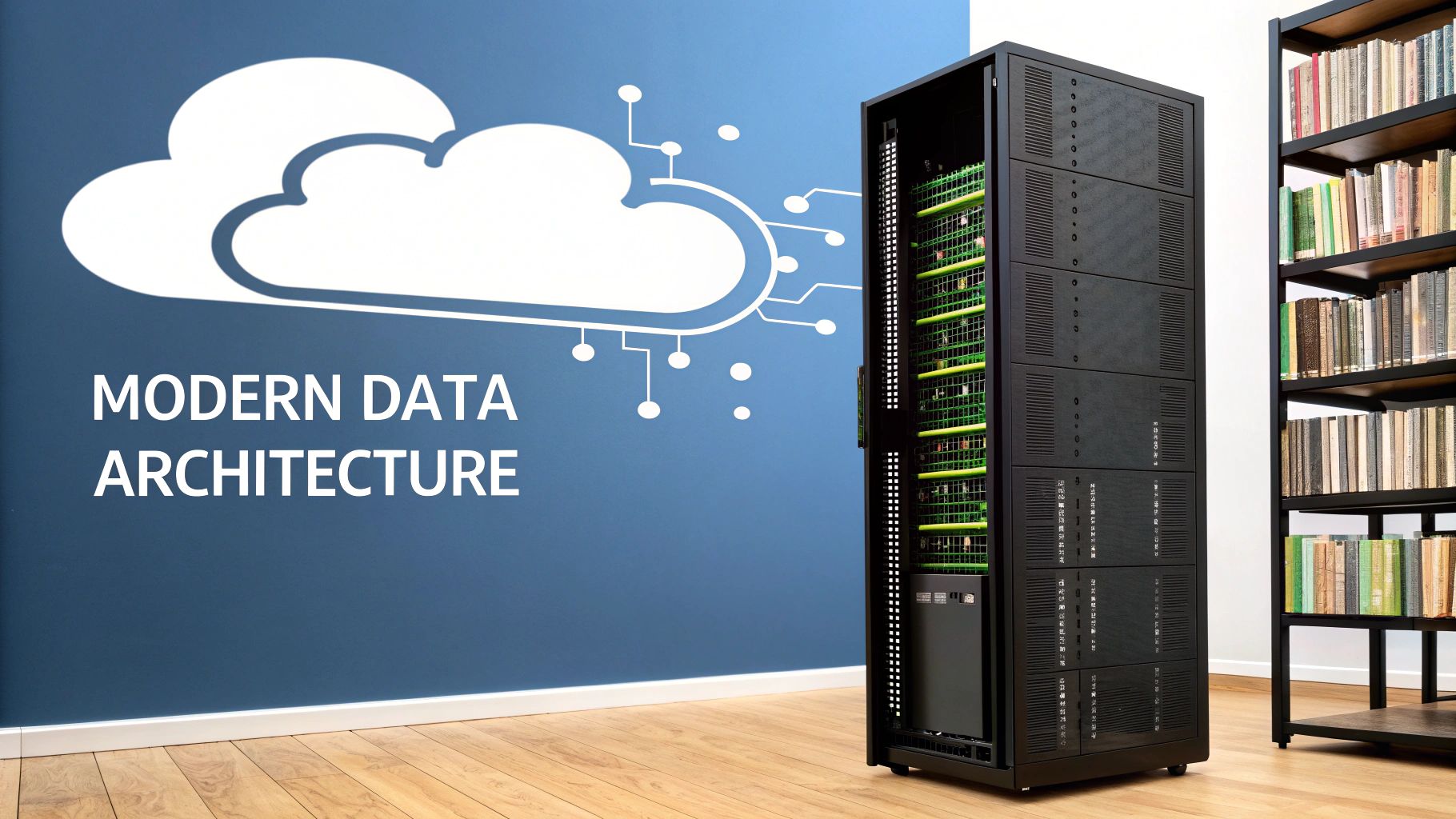
A successful big data project requires an architecture that can grow and adapt with the business. The days of rigid, on-premise systems are over. Modern enterprises need a flexible foundation that can handle unpredictable workloads and deliver insights on demand. The goal is a system that’s not just powerful today, but ready for whatever comes next.
This means moving away from legacy models where processing power and storage are permanently bundled. A traditional data warehouse is like a small library with one librarian; if too many people request books at once, a long queue forms. This creates performance bottlenecks and balloons costs, as the only fix is to upgrade the entire library, even for temporary peaks.
The Snowflake Advantage: Separation of Compute and Storage
Modern platforms like Snowflake have transformed this model by separating compute (the librarian) from storage (the library). This architectural change is a game-changer for big data analysis solutions. It’s like having multiple, independent "librarians" (compute clusters) accessing the same central "library" (your data) at once, without getting in each other's way.
This separation delivers two immediate, powerful outcomes:
- Performance on Demand: If marketing needs to run a complex query, they can instantly spin up a powerful compute cluster to get it done fast, with zero impact on the finance team running reports on a separate cluster.
- Cost Efficiency: You only pay for the processing power you actively use. Once a task is finished, compute resources shut down, stopping costs immediately. This avoids the massive expense of keeping idle servers running for occasional peak loads.
Of course, a key part of this architecture is effective cloud resource and capacity planning to ensure scalability remains cost-efficient.
Introducing Agentic AI for Intelligent Automation
With a flexible foundation in place, the next step is to embed intelligence into your data ecosystem with Agentic AI. Instead of analysts manually writing queries, you can deploy autonomous AI agents that interact directly with your data.
Imagine giving an AI agent a high-level business goal, like, "Identify the top three factors causing shipping delays in our European supply chain last quarter."
An AI agent can autonomously plan and execute a series of tasks to find the answer. It can query sales data, analyze logistics information, and even pull in external weather data. It then synthesizes the findings and generates a concise report with actionable recommendations.
This transforms your data platform from a passive repository into a proactive, intelligent partner. These agents can automate complex analysis, monitor data for anomalies, and trigger workflows in other business systems, delivering answers directly tied to strategic decisions.
Putting Big Data to Work with Real Use Cases

The real value of a big data architecture is measured by the business problems it solves. Big data analysis delivers a concrete advantage when applied to specific operational challenges, turning massive datasets into decisions that cut costs, improve service, and mitigate risks.
Each use case tells a story, starting with a stubborn business problem and ending with a measurable, data-driven win. This is why the market is booming, with global spending projected to climb at a 12.8% CAGR through 2025. Industries like retail, finance, and telecom are leading the charge by applying data to their most pressing challenges.
Use Case: Optimizing Logistics with Fleet Management
For logistics companies, small inefficiencies create massive costs across a large fleet. Optimizing routes, managing fuel consumption, and providing timely deliveries are constant struggles.
- Problem: A national logistics provider faced inefficient routing, high fuel bills from excessive idling, and an inability to give customers accurate ETAs for their fleet of 5,000 trucks.
- Solution: They implemented a big data platform to analyze real-time GPS coordinates, engine diagnostics, and traffic data. Geofencing was used to create virtual perimeters around delivery zones, automatically triggering alerts for arrivals, departures, or unauthorized stops.
- Outcome: A unified dashboard provided complete fleet visibility, leading to a 15% reduction in fuel consumption by correcting inefficient driver habits. On-time delivery rates improved by 20%, boosting customer satisfaction.
By turning a constant flood of location data into an actionable tool for operational control, the company achieved a clear and tangible ROI from its big data analysis solution.
Use Case: Modernizing Telecom Operations on Snowflake
Telecommunications giants manage some of the most complex networks on the planet, with their systems generating billions of data points daily. Legacy systems often choke on this volume, leading to slow diagnostics and costly downtime.
A major challenge is sifting through immense amounts of time-series data from network equipment to predict failures before they happen. This requires a platform that can handle enormous scale and complex queries without fail. For a deeper look, you can learn more about managing time-series data with Snowflake.
Use Case: Smart Building Energy Savings with TensorFlow
Commercial buildings are notorious energy hogs. Building managers often rely on static HVAC schedules that don't account for real-time occupancy or weather, leading to significant waste.
- Problem: A property management firm needed to slash energy costs across its commercial high-rises. Their HVAC systems ran on fixed timers, wasting money heating or cooling empty floors.
- Solution: They deployed a big data analysis solution to pull in data from thousands of IoT sensors measuring temperature, humidity, and occupancy. This data was fed into a TensorFlow machine learning model on a scalable cloud platform.
- Outcome: The model learned the building's thermal properties and began predicting energy needs with high accuracy. By dynamically adjusting HVAC settings in real-time, the firm achieved a 25% reduction in energy consumption and a healthier bottom line while maintaining occupant comfort.
Your Practical Implementation Roadmap
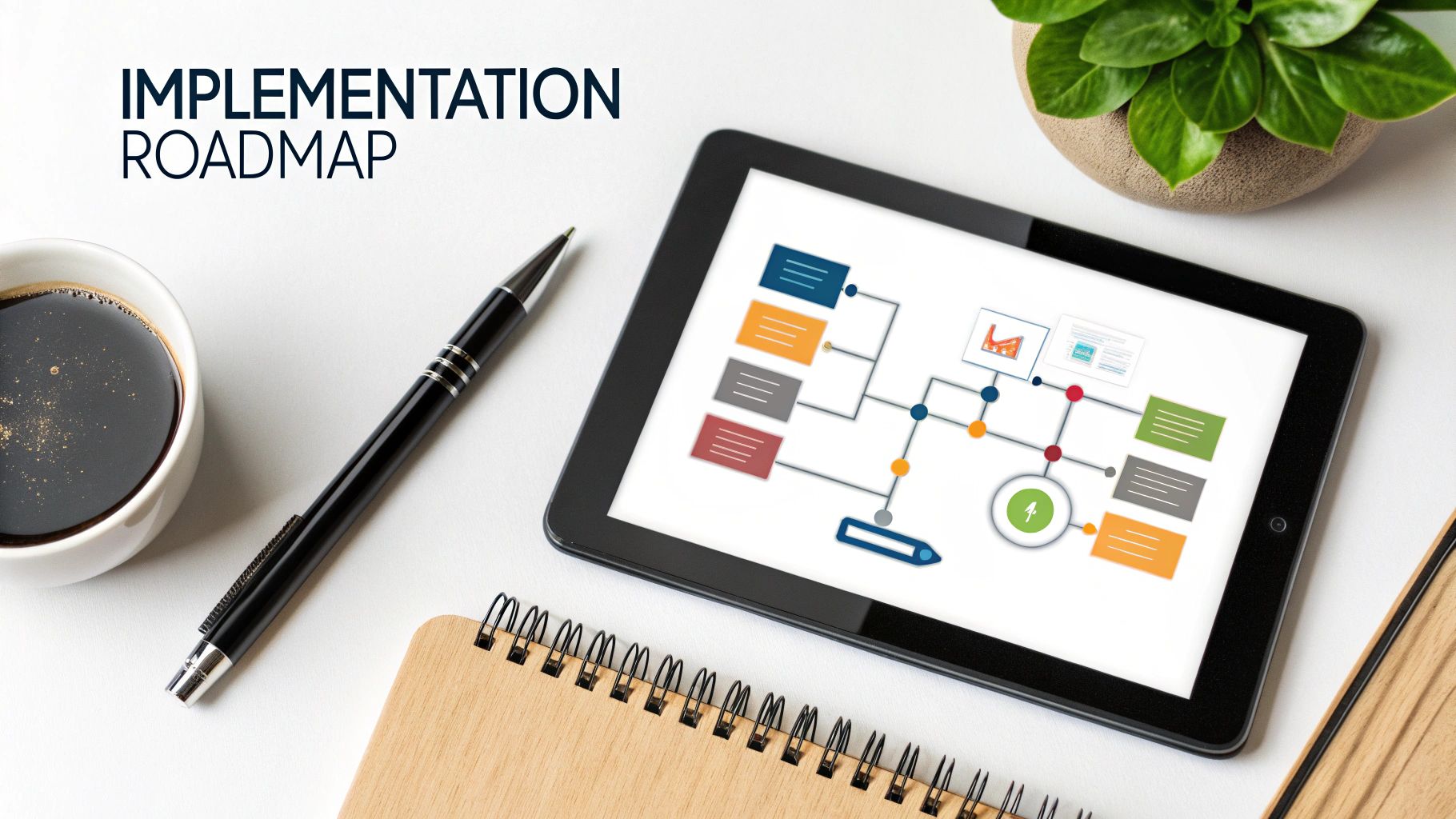
Starting a big data project without a plan is like sailing without a map. A structured implementation roadmap turns an ambitious idea into a value-generating project, ensuring every technical choice is tied to a core business goal from day one. This methodical approach is key to managing complexity and ensuring a return on your investment.
The journey starts with strategy, not technology. The first phase is discovery and goal-setting. Pinpoint the specific business problems you need to solve. Are you aiming to cut operational costs, deliver hyper-personalized customer experiences, or mitigate supply chain risks? Nailing down these outcomes provides the focus needed to keep the project on track.
Charting the Course from Discovery to Deployment
Once you know why you're doing this, you can shift to the how. This involves building the technical blueprint, choosing the right platform, planning your data migration, and preparing for deployment.
A solid roadmap for big data analysis solutions typically follows these logical steps:
- 1. Discovery and Goal Setting: Work with stakeholders to define clear, measurable business objectives and identify the highest-impact use cases.
- 2. Platform and Vendor Selection: Evaluate technologies and partners based on scalability, cost-efficiency, and alignment with your specific goals.
- 3. Data Assessment and Migration: Analyze your current data sources. Develop a plan to clean and migrate data, supported by a robust governance framework.
- 4. Pilot Project and Deployment: Start with a small, manageable project to prove the concept and demonstrate value before scaling enterprise-wide.
- 5. Ongoing Optimization and Scaling: Continuously monitor performance, refine analytical models, and scale the solution as your business grows.
Building In-House Versus Collaborating with an Expert Partner
A major decision is whether to build the solution with your own team or bring in a specialized partner. Each path has trade-offs in speed, cost, and risk. Building it yourself offers total control but requires a significant upfront investment in hiring and training niche experts.
Deciding between an in-house build and a partnership is a critical step. The right choice depends on your organization's capabilities, budget, and timeline.
Implementation Approach Comparison
FactorIn-House TeamExpert Partner (e.g., Faberwork)Speed to ValueSlower; requires hiring, training, and a steep learning curve.Faster; immediate access to experienced professionals and proven processes.Upfront CostHigh; costs for recruitment, salaries, benefits, and specialized training.Lower initial outlay; predictable project-based or retainer costs.Expertise & SkillsLimited to current staff; skills gaps can stall the project.Instant access to a deep bench of certified specialists in data engineering, AI, and security.RiskHigher; project can be derailed by employee turnover or unforeseen technical hurdles.Lower; partners have navigated similar challenges and de-risk the project with established methods.FocusInternal IT team is often stretched thin between new initiatives and daily operations.Dedicated team focused solely on delivering your big data project successfully.
Ultimately, while an in-house team offers direct control, a partner often provides a faster, more reliable, and less risky path to achieving your business goals.
Partnering with an expert provides immediate access to certified experience and proven methodologies, dramatically accelerating your timeline and de-risking the project, especially for complex security and governance requirements.
The market's explosive growth highlights the need for outside expertise. Projections show an additional USD 193.2 billion growth in the big data market from 2024 to 2029, according to big data market growth on Technavio.com. This growth drives demand for partners who can deliver AI-powered platforms that turn massive datasets into actionable intelligence.
How to Measure Success and Prove ROI
Implementing a big data analysis solution is a major investment. Its true worth is measured in business outcomes, not technical achievements. Metrics like data processing speed are important to your tech team, but they don't resonate with the C-suite. To prove success, you must draw a clear line from your analytics to tangible business improvements.
The key is to focus on business-centric Key Performance Indicators (KPIs). Instead of reporting on query times, show how data insights led to financial gains or smoother operations. This shifts your data project from a cost center to a powerful value driver.
Defining Your Business-Centric KPIs
Before starting the project, define the exact business metrics you aim to improve. This aligns everyone on what success looks like from day one. Ditch technical jargon to build a compelling business case.
Set specific, measurable targets tied to core business functions. Here are examples of outcome-focused KPIs:
- Operational Cost Reductions: Target direct savings, such as a 15% decrease in logistics fuel consumption or a 10% reduction in equipment maintenance costs due to predictive analytics.
- Customer Lifetime Value (CLV) Increases: Show the financial impact of better engagement, such as a 5% lift in repeat purchases from personalized marketing campaigns.
- Supply Chain Efficiency Gains: Quantify improvements, like reducing stockouts by 20% or shaving an average of two days off delivery lead times.
The most powerful way to prove the value of a big data analysis solution is to translate every insight into a clear financial impact. The goal is to answer the question, "How did this investment make our business stronger?"
Linking Analytics Outputs to Financial Outcomes
Ultimately, it all comes down to Return on Investment (ROI). To calculate it, you must connect your analytics work to actual dollars and cents by attributing specific business wins to the insights your data platform uncovered.
Consider a real-world scenario. A retail company uses its big data platform to analyze customer behavior and identify a high-value segment at risk of churning.
- Identify the Problem: The platform flags a 12% drop in purchase frequency among a customer segment representing 30% of total revenue.
- Deploy a Data-Driven Solution: The marketing team launches a targeted retention campaign with personalized offers for this at-risk group.
- Measure the Outcome: Over the next quarter, the churn rate within that segment drops by 50%, saving the company an estimated $1.2 million in annual revenue.
In this case, the ROI calculation is straightforward. You compare the revenue saved—directly attributable to the data insight—against the cost of the analytics platform and the marketing campaign. This creates a clear, defensible story that proves the value of your big data analysis solutions to any executive.
Accelerating Your Data Strategy with the Right Partner
Embarking on a big data project can feel overwhelming. You face massive information volumes, a dizzying array of technologies, and a shortage of skilled experts. This is where a strategic partner becomes more than a vendor—they become essential to making your data strategy a reality.
A good partner accelerates your journey from concept to working solution, de-risking the project with proven methods and deep technical knowledge. They instantly fill skills gaps with a team experienced in building robust big data analysis solutions. This allows you to bypass the long, expensive process of hiring and training and focus directly on achieving business outcomes.
Bridging the Gap Between Data and Decisions
The right partner focuses on results, not just technology. They understand that success is measured by the real value delivered to the business. This practical mindset centers on building systems that solve your most pressing problems.
Expertise in advanced frameworks like Agentic AI is a key differentiator. A partner with this knowledge can help you build an ecosystem that actively finds and delivers insights, turning your data from a stored asset into a proactive engine for growth.
A strategic technology partner provides the specialized expertise and focused execution needed to translate the potential of your data into measurable, reliable business growth, ensuring your investment delivers a clear and compelling ROI.
Working with a dedicated technology firm can drastically shorten your time-to-value. They become an extension of your team, focused on ensuring your big data projects succeed and truly move the needle for your organization. To see what this relationship looks like, you can explore the benefits of collaborating with Faberwork, a Snowflake Partner.
Common Questions We Hear
When exploring big data analysis solutions, many questions arise. Getting straight, practical answers ensures your technology investments align with business needs. Here are a few of the most common questions we hear from business leaders.
What's the Very First Thing We Should Do?
The most critical first step is strategic, not technical. Before considering any technology, get crystal clear on the business problems you're trying to solve. This is essential for tying your investment to measurable outcomes.
Start with a discovery phase to pinpoint high-impact use cases. Are you trying to cut operational costs by 15%, boost customer retention through personalization, or mitigate supply chain risks? Defining this "why" first provides the focus needed to select the right tools and design a solution that delivers real value.
How Is Snowflake Really Different from Our Old Data Warehouse?
Traditional data warehouses are like a car where the engine and trunk are welded together. To get a bigger engine, you must also get a bigger trunk. They bundle compute and storage, forcing you to scale both together. This is inefficient, creates performance bottlenecks, and causes costs to spiral.
Snowflake's modern architecture completely separates them. This is the game-changer for big data analytics.
This separation means you can spin up massive processing power for a complex query and then scale it back to zero in seconds, all without affecting your stored data. You only pay for what you use. This elasticity is what the unpredictable demands of big data and AI require, making it a far more cost-effective and scalable foundation.
The key difference is flexibility. Snowflake’s decoupled architecture allows independent scaling of resources, eliminating the performance and cost constraints that plague legacy data warehouse systems when faced with large, unpredictable analytical queries.
How Can We Be Sure Our Data Is Secure in the Cloud?
Security is a valid and critical concern. Modern platforms like Snowflake build in multiple layers of protection, not as an afterthought, but as a core part of their architecture. Essential best practices include:
- Role-based access control (RBAC) to ensure users only see the data they are authorized to access.
- End-to-end data encryption for data in transit and at rest.
- Data masking to protect sensitive information (PII) while still allowing analysts to work with the dataset.
Beyond platform features, working with an experienced partner who understands compliance frameworks like GDPR or HIPAA is crucial. They can help you architect a solution that meets strict industry regulations and aligns with your internal governance policies, making your data both secure and useful.
What Is This "Agentic AI" I Keep Hearing About?
Agentic AI represents a significant leap forward from simple query-and-response systems. It involves creating autonomous AI "agents" that can understand a high-level goal, then reason, plan, and execute a series of complex tasks to achieve it.
For example, instead of a data scientist spending hours running queries, you could give an AI agent a goal like, "Figure out the root cause of last month's supply chain delays and draft a summary for the COO." The agent could then autonomously query logistics data, analyze shipping logs, cross-reference weather patterns, and pull supplier performance data to deliver a report with actionable insights.
It transforms your data platform from a passive library into a proactive, intelligent partner that gets you to the "why" faster.


