In retail, business intelligence turns mountains of raw operational data into clear, actionable outcomes. It’s not just about collecting numbers; it's about understanding what they mean for your inventory, your customers, and your bottom line. BI helps you move from guessing what customers want to knowing what they’ll buy next, driving measurable growth.
Why Business Intelligence is a Retail Essential
Running a retail business on gut feelings is no longer an option. Business intelligence (BI) is your strategic compass, transforming data from sales, inventory, and customer interactions into a clear roadmap for growth. This shift from reactive problem-solving to proactive, data-informed strategy is fundamental to staying competitive.
The retail analytics market's projected growth from $8.66 billion in 2024 to $10.77 billion in 2025 shows how quickly the industry is adopting data-driven strategies. For more on this trend, explore these retail personalization trends from Coaxsoft.
From Raw Data to Actionable Outcomes
BI connects disparate data points—a customer’s online click, a point-of-sale transaction, a warehouse scan—to reveal the bigger picture. This allows leaders to answer critical questions with confidence. Instead of just asking, "What were last quarter's sales?" a retailer with BI can ask, "Which marketing campaign drove the most in-store traffic for our highest-margin products, and how can we replicate that success?"
By creating a single source of truth, BI empowers every department to make coordinated decisions that directly boost profitability and customer loyalty.
Tangible Outcomes You Can Expect
Adopting a data-first mindset delivers measurable results across the entire organization. Throughout this guide, we'll focus on the practical use cases of business intelligence for retail and the concrete outcomes they generate.
- Outcome: Reduced Inventory Waste. Accurately forecast demand using historical data to stop losing money on overstock or missing sales from stockouts.
- Outcome: Optimized Merchandising and Pricing. Use market basket analysis to discover which products sell well together, creating better promotions and dynamic pricing strategies that protect margins.
- Outcome: Enhanced Customer Experiences. Deliver personalized offers and recommendations based on purchase history to build loyalty and increase customer lifetime value.
- Outcome: Improved Operational Efficiency. Analyze real-time performance metrics to pinpoint supply chain bottlenecks and streamline store operations.
Ultimately, a well-executed BI strategy doesn't just create reports; it produces results. It transforms data into your most valuable asset for anticipating market shifts and staying ahead of the competition.
Putting Retail BI to Work: Practical Use Cases and Real Results
The true value of business intelligence for the retail industry emerges when you apply it to solve specific, high-impact problems. BI isn't just about dashboards; it's about generating tangible returns by shifting from reactive fixes to proactive, data-driven growth. Let's explore four core areas where BI delivers significant outcomes.
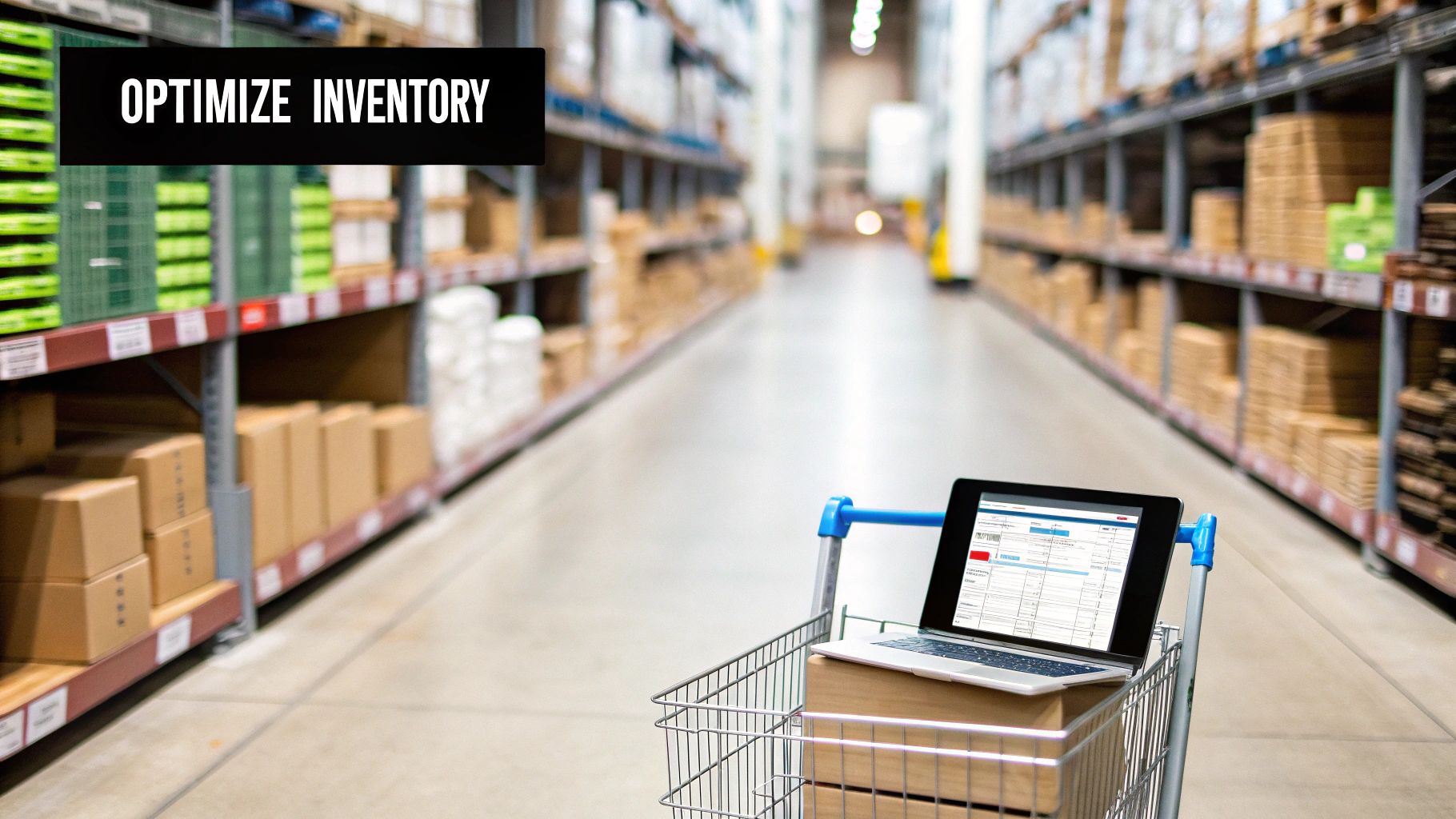
Use Case 1: Master Inventory and Supply Chain Management
Poor inventory management kills profitability. Overstock destroys margins with markdowns, while stockouts lead to lost sales. BI balances supply and demand with precision by generating accurate demand forecasts based on historical sales, seasonal trends, and external factors.
Example: A fashion brand launching a new collection uses BI to track real-time sales data. Seeing which styles are selling fastest in specific regions, they can rapidly shift inventory to high-demand locations and adjust production, maximizing sales before the trend fades.
This data-driven approach delivers concrete financial benefits:
- Lower Carrying Costs: Matching stock levels to actual demand frees up capital.
- Increased Sales: Keeping popular items in stock prevents lost revenue.
- Improved Cash Flow: Faster inventory turnover means cash is working for you, not sitting on a shelf.
Use Case 2: Optimize Merchandising and Product Assortment
Knowing what customers buy is good; knowing how they buy is a game-changer. Merchandising analytics uses BI to uncover hidden connections between products and shopping habits. A classic technique is market basket analysis, which identifies items frequently purchased together.
Example: A grocery store discovers that customers buying premium coffee often add organic milk and artisanal bread to their cart. With this insight, they can create a "gourmet breakfast" promotion or place these items near each other to lift sales for all three.
This approach also informs assortment planning, guiding decisions on which new products to introduce and which to discontinue based on performance data. Modern platforms excel at handling these complex datasets, as seen in our work with time-series data with Snowflake.
Key Retail BI Applications and Their Business Impact
BI ApplicationBusiness OutcomeKey KPIs to TrackInventory & Supply ChainReduce stockouts and overstock, improve cash flow.Inventory Turnover, Carrying Costs, Stock-to-Sales RatioMerchandising & AssortmentIncrease average transaction value and sales per square foot.Average Basket Size, Product Affinity, GMROIDynamic PricingMaximize profit margins and maintain competitive positioning.Price Elasticity, Gross Margin, Competitor Price IndexCustomer AnalyticsBoost customer loyalty, retention, and lifetime value.Customer Lifetime Value (CLV), Churn Rate, Repeat Purchase Rate
Each application is designed to drive a specific, measurable improvement in the business.
Use Case 3: Implement Dynamic and Competitive Pricing
Pricing is a delicate balance. Price too high, and you lose customers; price too low, and you sacrifice margin. BI enables a smarter, dynamic pricing model by analyzing competitor data, internal sales figures, and inventory levels in real-time.
Example: An electronics retailer can use BI to automatically adjust the price of a popular TV based on a competitor's flash sale or a sudden spike in demand, maximizing profit without manual intervention.
To see how AI is revolutionizing this area for online stores, explore this guide on AI E-commerce Transformation.
Use Case 4: Leverage Customer Analytics to Build Loyalty
Customer loyalty is paramount. BI provides the tools to understand customers on a deeper level, enabling personalized experiences that build lasting relationships. By segmenting customers based on their purchase history and browsing behavior, you can move beyond generic marketing.
Example: A sporting goods retailer identifies a segment of customers who regularly buy running shoes. Instead of a generic store-wide discount, they send this group an exclusive offer for a new model, driving higher conversion rates and making customers feel valued.
Recent data shows customer analytics generated 34% of revenue in 2024, with churn prediction and lifetime-value modeling leading the way.
Building Your Modern Retail Data Foundation
To achieve these outcomes, you need a powerful technical backbone. A modern retail data foundation collects, processes, and serves reliable information, acting as the engine for your BI strategy. This approach eliminates data silos—where sales, inventory, and marketing data live in separate, disconnected systems—by creating a single, unified hub. The result is a single source of truth for the entire organization.

Why a Data Cloud Like Snowflake is Essential
Traditional data warehouses can't handle the volume and variety of modern retail data. A data cloud platform like Snowflake is designed for this challenge. Its architecture allows you to scale computing power up for peak seasons like Black Friday and then scale it down to control costs—a flexibility older systems can't match.
As a Snowflake Partner, we leverage this technology to build robust data solutions for our clients.
The Journey From Raw Data to Actionable Insight
Building a data foundation is a logical process that turns messy data into clean, reliable insights. This ensures that decision-makers receive accurate, timely information ready for analysis.
The journey follows four key stages:
- Ingestion: Data is pulled from all sources, including e-commerce platforms, POS systems, supplier databases, and marketing tools.
- Storage and Consolidation: All data is loaded into a central repository like Snowflake, breaking down silos and creating a single source of truth.
- Transformation: Raw data is cleaned, structured, and standardized into a consistent, usable format. For instance, customer data from multiple sources is merged into a single profile.
- Visualization and Analysis: The prepared data is connected to BI tools like Tableau or Power BI, where it comes to life in dashboards and reports, enabling users to uncover insights.
This structured pipeline builds trust. When teams work from the same reliable information, they can make faster, more confident, and aligned decisions.
Investing in a modern data foundation provides the essential infrastructure to compete and win in today's retail landscape.
Your Roadmap to a Successful BI Implementation
A successful BI strategy requires a clear game plan. This practical, step-by-step approach ensures your retail BI project delivers value from day one.
Start with Clear Business Goals
The most critical first step is defining business outcomes. Before discussing technology, clarify what you want to achieve. A vague goal like "become more data-driven" is insufficient. You need specific, measurable objectives.
Good goals sound like this:
- "Reduce inventory carrying costs by 15% within the next year."
- "Increase average transaction value by 10% through smarter cross-selling."
- "Lower customer churn by 5% in our top loyalty tier this quarter."
These targets focus your entire BI strategy on solving problems that deliver a clear return on investment.
Identify and Consolidate Your Data
With your goals set, identify the data needed to achieve them. Retail data is often scattered across disconnected systems like POS, e-commerce platforms, and supply chain portals. Your task is to map these sources and plan to unify them. The goal is a complete view of your business, free from the data silos that obscure insights.
A successful business intelligence for retail industry implementation is built on a single source of truth. When all teams work from the same trusted data, decision-making becomes faster and more coordinated.
Run a Focused Pilot Project
Avoid trying to implement everything at once. Start small with a focused pilot project tied to a key business goal, such as optimizing stock levels for your top-selling product category.
This agile approach offers several advantages:
- Prove Value Quickly: A successful pilot demonstrates tangible ROI in months, making it easier to secure buy-in for expansion.
- Learn and Adapt: Your team can identify challenges and refine your approach on a manageable scale.
- Build Momentum: An early win generates excitement and shows the organization what's possible with data.
Scale, Govern, and Foster a Data-First Culture
Once your pilot proves its value, scale the solution to other departments. As you grow, strong data governance and a data-first culture are essential. Data governance establishes clear rules for managing and using data, ensuring accuracy and security.
Simultaneously, foster a culture where data informs daily decisions. This involves training teams on BI tools and, more importantly, teaching them to ask the right questions. This combination of a strategic roadmap, quality data, and user adoption ensures long-term success.
The Future of Retail is Autonomous with Agentic AI
Business intelligence shows you what's happening in your business. Agentic AI takes the next step by empowering your systems to act on those insights automatically. It moves you from seeing problems to proactively solving them. Think of Agentic AI as a digital workforce that executes tasks based on BI insights, 24/7. Your data becomes an active trigger for automated operations.
From Insight to Automated Action
Agentic AI doesn't just flag a problem—it fixes it. It executes complex, multi-step tasks based on real-time data from your BI platform, creating a powerful loop of insight and action.
Here are some real-world use cases:
- Use Case: Autonomous Inventory Replenishment. A BI dashboard shows a low-stock alert. Instead of just notifying a human, an AI agent checks demand forecasts, verifies supplier availability, and automatically drafts a purchase order to prevent a stockout.
- Use Case: Proactive Customer Churn Prevention. Analytics identify high-value shoppers with declining activity. An AI agent immediately launches a personalized re-engagement campaign with a targeted offer to win them back—no manual intervention required.
This is rapidly becoming a retail standard. 15% of organizations already use AI-powered analytics, and over 27% of retailers plan to expand access to these tools.
Creating a Real Competitive Edge
Pairing BI with Agentic AI creates a significant competitive advantage. While competitors analyze reports, your autonomous system has already identified and acted on the opportunity. This drives efficiency that is impossible to match manually.
By automating routine data-driven tasks, your teams are freed to focus on strategic thinking, innovation, and customer relationships that drive long-term growth.
This evolution is non-negotiable for forward-thinking retailers. A solid guide to AI automation for business can show you what’s possible. The shift from analyzing data to automatically executing on it will define the next generation of leaders in business intelligence for retail industry.
Turn Your Retail Data Into a Competitive Edge
Business intelligence is the engine of modern retail. By turning raw data into strategic action, you can enhance operational efficiency, create personalized customer experiences, and build sustainable profitability. Market leaders have moved beyond guesswork and embraced data-driven certainty. This journey begins with a solid data foundation and a clear vision for the outcomes you want to achieve.
Your Path to a Data-Driven Future
A strong BI strategy is about leading the market, not just competing in it. It empowers you to anticipate market shifts, optimize your supply chain, and build lasting customer loyalty.
The ultimate goal is a retail ecosystem where every decision—from inventory orders to marketing campaigns—is informed, intelligent, and impactful. This is what separates thriving retailers from those struggling to survive.
Faberwork is your expert partner to design the strategy, build the architecture, and implement the AI-powered solutions that will help you win. Let's work together to turn your data into your most powerful asset.
Common Questions About Retail BI
As you explore business intelligence, practical questions arise. Here are answers to some of the most common queries about implementing a retail BI initiative.
What Is the First Step to Starting a BI Project?
The first and most important step is to define a clear business goal. Don't start with technology; start with an outcome, such as, "we need to reduce our inventory carrying costs by 15%." Anchoring the project to a specific, measurable business problem ensures that your entire strategy—from data selection to KPIs—is aligned to deliver a tangible return. This focus is also key to gaining executive buy-in.
How Does Snowflake Specifically Benefit a Retail Data Strategy?
Snowflake is ideal for retail's complex data environment. It can handle massive, unpredictable data streams from POS systems, websites, and supplier feeds. Its architecture allows retailers to scale computing power up for peak seasons like Black Friday and then scale back down to control costs.
A key advantage is Snowflake's secure data sharing, which enables live collaboration with suppliers and partners. This creates a more transparent supply chain without the complexities of traditional data transfer methods.
This flexibility and collaborative capability set it apart from older systems that cannot keep up with the pace of modern retail.
Can We Implement BI Without a Massive Upfront Investment?
Yes. A phased approach is the best strategy. Start with a focused pilot project on a single, high-impact area, like improving sales forecasting for your top-selling product category. This allows you to demonstrate real value quickly with a manageable budget and minimal risk. Modern cloud platforms and pay-as-you-go BI tools eliminate the need for large upfront capital investments in hardware, making BI accessible to retailers of all sizes.
How Long Does It Take to See Results From a Retail BI Project?
With a well-defined pilot project, you can see valuable insights and initial results in as little as 90 days. The goal of this first phase is to prove the concept and show a clear return on a small, controlled scale. While a full, enterprise-wide implementation takes longer, this agile approach ensures you are creating value and learning as you go, rather than waiting months for a "big bang" launch.


