For years, retailers ran on last year's sales reports and gut instinct. In today's market, that's like navigating a superhighway with a paper map. Business intelligence (BI) is the GPS. It transforms the overwhelming flow of data from sales, customers, and your supply chain into a clear, actionable dashboard.
This shift moves decision-making from hunches to data-backed strategies, giving managers a live view of what's happening now. The outcome is the ability to fine-tune everything from inventory levels to marketing campaigns, driving real, measurable growth.
What Is Business Intelligence in Retail?
Imagine a store manager during the peak holiday season. Without BI, they’re guessing, using last year’s numbers to predict this year’s rush. It’s a shot in the dark that often leads to stockouts or overstocked shelves.
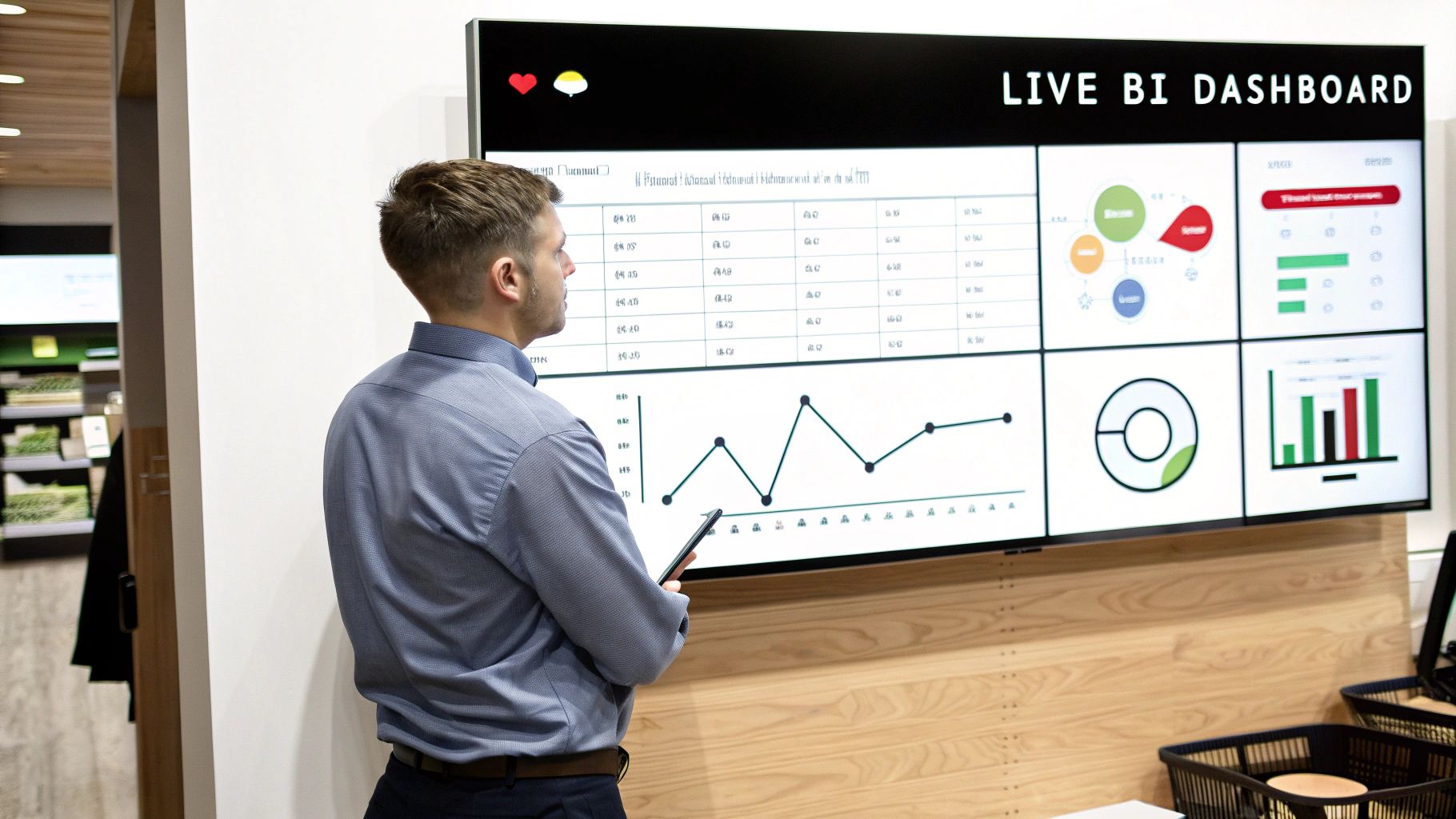
Now, picture that same manager with a live BI dashboard. They see real-time foot traffic, track online cart abandonment, and view inventory levels across every location. This is the core of business intelligence in retail: using data to serve up actionable information that empowers smarter, faster decisions.
Instead of just reporting what happened, BI reveals why it happened and provides the foresight to react effectively. This is essential in a world of rapidly changing consumer behavior and volatile supply chains.
From Raw Data to Smarter Outcomes
At its core, retail BI answers critical questions with hard data. It connects seemingly unrelated points—like local weather, a social media trend, and in-store sales—to reveal patterns and opportunities. This is how data becomes a competitive advantage.
Here are the direct outcomes a retailer achieves with a solid BI strategy:
- Understand Customer Behavior to Increase Sales: By analyzing purchase histories, a BI system can identify high-value customers and predict which promotions will successfully drive purchases. For example, a clothing retailer can identify customers who buy a new coat every winter and send them a targeted early-bird offer, boosting sales and loyalty.
- Optimize Inventory to Reduce Waste: BI tools forecast demand using historical sales, seasonality, and local events to ensure the right products are in the right place. A grocery store can use BI to predict a surge in demand for barbecue supplies before a holiday weekend, preventing stockouts and maximizing sales.
- Boost Operational Efficiency to Lower Costs: BI dashboards monitor store performance and track staff productivity, spotting supply chain bottlenecks before they become costly. A national chain can identify its top-performing store layouts and replicate them, increasing sales per square foot across the board.
The impact is so significant that 87% of retailers worldwide are projected to be using at least one AI technology in their operations by 2025. This shows how critical BI has become for turning data into bottom-line results.
Why Gut Feelings Are No Longer Enough
Relying on experience alone is too risky when market trends pivot overnight. A successful campaign last year could easily fail this year due to a new competitor or a shift in consumer values. Business intelligence replaces that guesswork with evidence.
Business intelligence is the strategic bridge between what your data knows and what your business needs to do. It transforms scattered information into a clear roadmap for profitability and growth.
Ultimately, BI empowers genuine data-driven decision making. It’s a fundamental shift from "I think this will work" to "the data shows this will work." This ensures that major decisions—from marketing spend to logistics—are backed by evidence, reducing risk and unlocking new potential for success.
The table below breaks down the immediate outcomes retailers see with a BI strategy.
Key Outcomes of Implementing Retail BI
Business AreaChallenge Without BIOutcome With BIExample Metric ImprovedMerchandisingGuesswork on product mix and pricing.Data-driven assortment planning.Category Sales GrowthMarketingGeneric, one-size-fits-all campaigns.Personalized, targeted promotions.Customer Lifetime Value (CLV)InventoryFrequent stockouts or costly overstocks.Optimized stock levels, reduced waste.Inventory Turnover RateOperationsInefficient store layouts and staff scheduling.Improved in-store experience and productivity.Sales Per Square FootSupply ChainDelays and bottlenecks go unnoticed.Proactive issue identification and resolution.On-Time Delivery Rate
A strong BI foundation creates a ripple effect of smarter, more profitable decisions across the entire organization.
Where Does Your Retail Data Actually Come From?
Great business intelligence starts with the right data. But having piles of information isn't enough; you need to turn it into Key Performance Indicators (KPIs) that act as the vital signs for your business's health.
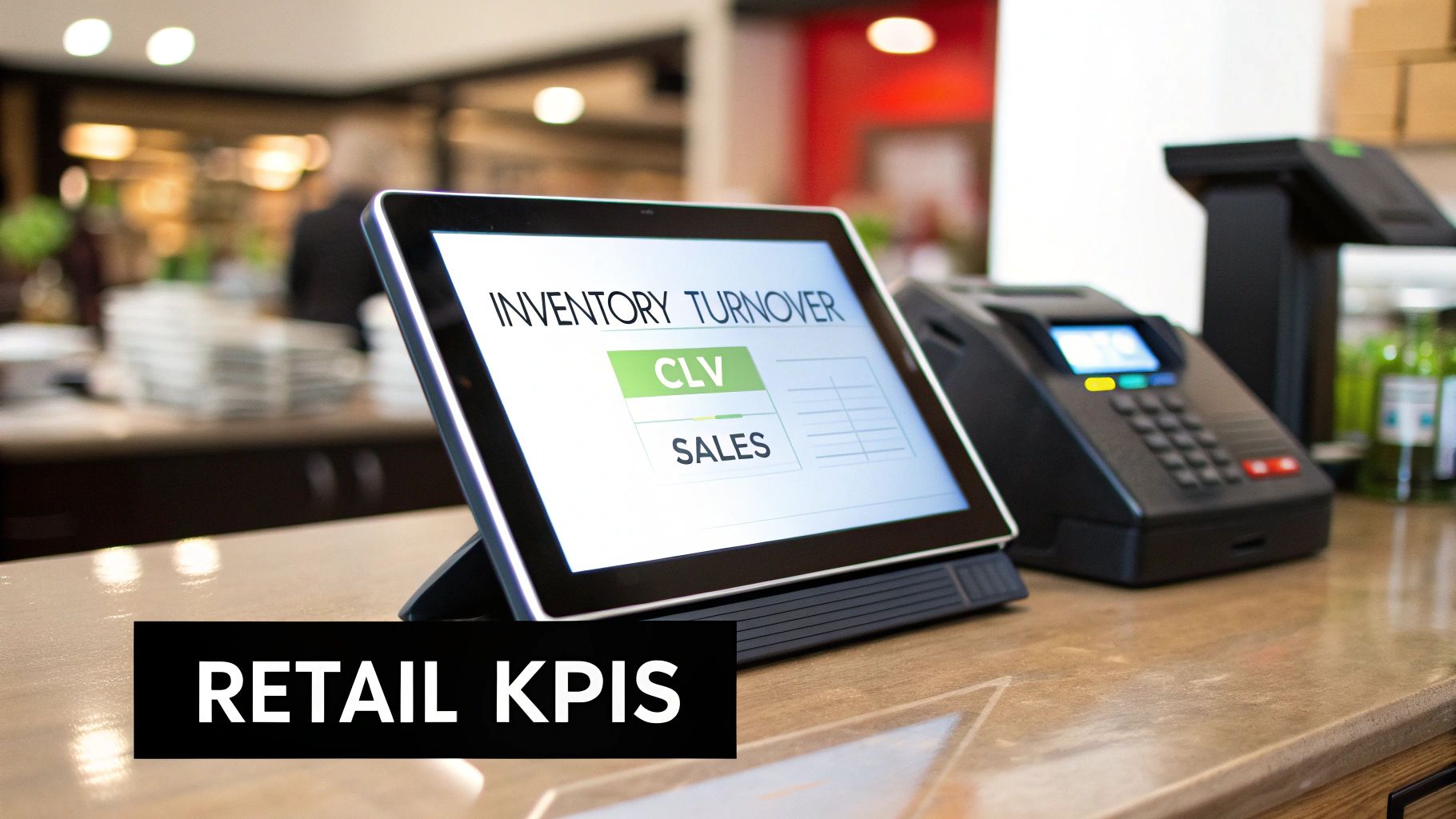
Don't just think of KPIs as numbers. Each one tells a story. A high Inventory Turnover indicates a healthy supply chain where products fly off the shelves. A low turnover hints at sluggish demand or merchandising that isn't connecting with shoppers. Similarly, Customer Lifetime Value (CLV) is a direct measure of brand loyalty. These are the concrete stories a strong business intelligence retail strategy is built on.
Connecting KPIs to Their Data Origins
To track these KPIs, you must pull information from different systems across your company. Your BI platform’s job is to put these pieces together to see the full picture.
Here’s a look at the typical data sources:
- Point-of-Sale (POS) Systems: This is ground zero for transaction data—what was sold, when, where, and for how much. It's the primary source for metrics like Sales per Square Foot and Average Transaction Value (ATV).
- Customer Relationship Management (CRM) Platforms: Your CRM tracks purchase histories and loyalty program activity, directly feeding KPIs like Customer Churn Rate and CLV.
- Enterprise Resource Planning (ERP) Systems: The ERP manages supply chain logistics and inventory levels. It provides the raw data to calculate Inventory Turnover and track Supplier On-Time Delivery Rates. This data allows for more sophisticated strategies, like retail customer journey mapping, giving you a deeper view into customer behavior.
- E-commerce and Web Analytics Platforms: These platforms track every click, view, and purchase on your website, making them essential for measuring Conversion Rate, Cart Abandonment Rate, and digital marketing effectiveness.
The Quest for a Single Source of Truth
The biggest challenge for most retailers is that this priceless data is stuck in disconnected systems. The CRM doesn't talk to the ERP, and POS data lives on its own island, creating data silos that make it impossible to get a clear view of the business.
This is why a modern data platform like Snowflake is so critical. It acts as a central hub—a single source of truth—by pulling in data from all these different streams. It can handle everything from structured sales data to semi-structured website clickstream data. You can explore more about enhancing logistics with Python and data analytics on a unified platform.
By bringing all your data into one place, you eliminate inconsistencies and ensure everyone—from marketing to merchandising—is working from the same reliable playbook. This solid foundation makes powerful retail analytics possible.
A unified platform cleans, processes, and organizes the data, ensuring that when you ask your BI tool a question, the answer is accurate, trustworthy, and ready to be acted upon.
Building Your Modern Retail Data Foundation
To unlock powerful insights from business intelligence in retail, you first need a solid base. For retail analytics, that foundation is a modern data architecture designed to handle the volume and variety of data your business creates daily.
This is about creating a central nervous system for your retail operation. This system must be strong enough to power everything from a daily sales report to sophisticated, AI-driven automations.
From Data Silos to a Central Hub
The old way of trapping information in disconnected systems is a dead end. You need a platform that acts as a single source of truth, and this is where solutions like Snowflake come in. They are built to pull in data from a vast range of sources, effectively knocking down the walls between departments.
This modern approach means collecting information from every touchpoint:
- E-commerce Platforms: Capturing every click, search, and purchase.
- In-Store Systems: Pulling data from POS terminals and foot traffic counters.
- Marketing and CRM Tools: Consolidating customer interactions from email, social media, and loyalty programs.
- Supply Chain and ERP Software: Integrating logistics data and inventory levels.
Bringing this data together provides a complete, unified picture of your business that was previously out of reach.
Why a Scalable Architecture Matters
A hallmark of a modern data platform is its ability to handle different types of data. Retail data is messy, ranging from structured sales figures to semi-structured customer reviews. A platform like Snowflake is designed to store and process both formats seamlessly.
This flexibility future-proofs your business. As new data sources emerge, your architecture can adapt without requiring a complete overhaul. It scales with you, ensuring you can handle growing data volumes and more complex questions without hitting a performance wall. For a deeper look, you can learn about managing complex datasets like time-series data with Snowflake to see how this works in the real world.
The diagram from Snowflake below shows how these pieces fit together.
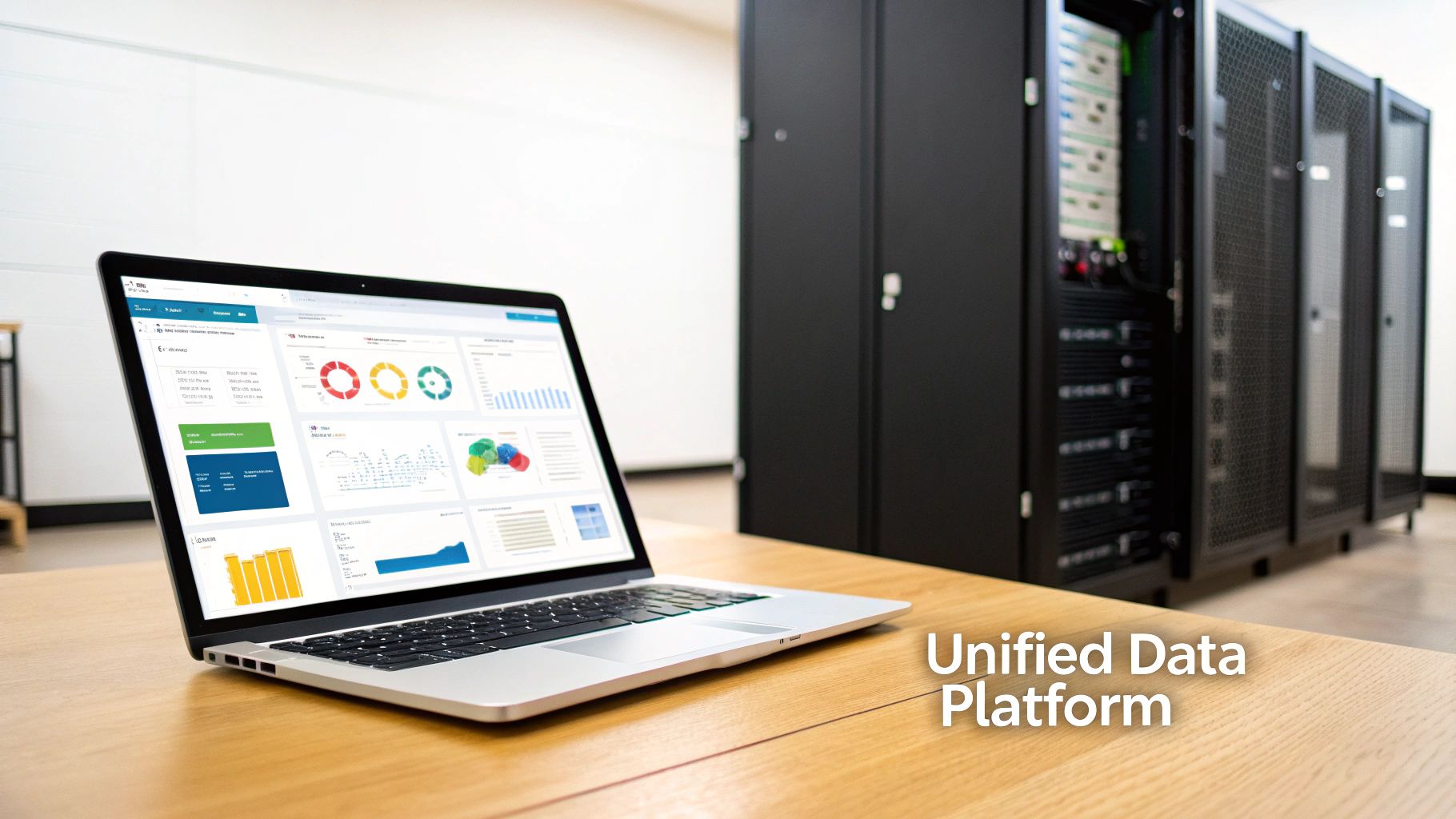
The flow is clear: raw data sources on the left are transformed into actionable business outcomes on the right, all enabled by the central platform.
The Launchpad for Advanced AI
Building this modern data foundation is the non-negotiable first step toward using advanced tools like Agentic AI. You can't run intelligent automation on messy, unreliable, or stale data. An AI agent needs clean, real-time information to make smart decisions, whether it's dynamically adjusting prices or automatically reordering stock.
A well-architected data platform doesn't just store information; it activates it. It turns raw data from a passive asset into an active driver of efficiency, personalization, and competitive advantage.
By investing in this foundational layer, you're not just improving your reporting. You are setting the stage for a more automated, intelligent, and responsive retail operation.
Putting Agentic AI to Work in Your Operations
A modern data foundation is the launchpad, but the real excitement begins when you move from simply analyzing data to automatically acting on it. This is where Agentic AI turns your business intelligence into a proactive partner. Instead of just showing you a problem, an AI agent can execute the solution.
This leap from insight to action is the next frontier of business intelligence in retail. Here are three use cases where AI agents don't just recommend—they get the job done.
Use Case 1: Dynamic Price Optimization
- Problem: Manual pricing is too slow. By the time a manager analyzes competitor prices and sales data, the market has already changed, resulting in lost revenue.
- AI Solution: An AI agent constantly analyzes competitor pricing, internal inventory, and live demand signals. Working within predefined business rules (e.g., maintain a 35% margin), it makes thousands of micro-adjustments to prices throughout the day.
- Outcome: Direct boost to profit margins and sales. Your pricing strategy becomes fluid and responsive, ensuring you capture maximum revenue for every product, second by second.
Use Case 2: Intelligent Inventory Management
- Problem: Relying on historical sales data leads to stockouts on popular items and costly overstocks on slow-movers, tying up capital and losing sales.
- AI Solution: The AI agent analyzes historical data alongside predictive signals like social media trends and supplier lead times. When it predicts a future stockout, it automatically generates and places a purchase order with the right supplier.
- Outcome: Drastically fewer stockouts and less excess inventory. This leads directly to fewer lost sales, lower carrying costs, and better cash flow, freeing your team for strategic planning.
This is the difference between being told you're about to have a problem and having a system that solves it for you before it happens. It turns your supply chain from a reactive cost center into a proactive, intelligent operation.
Use Case 3: Hyper-Personalization at Scale
- Problem: Generic, one-size-fits-all marketing fails to connect with individual customers, leading to low engagement and missed sales opportunities.
- AI Solution: An AI agent acts as a personal shopper for every customer. It analyzes each person's browsing behavior, purchase history, and loyalty data to deliver hyper-personalized content, from unique promotional offers to dynamically generated product recommendations on your website.
- Outcome: Major lift in customer engagement, leading to higher conversion rates, increased average order value (AOV), and greater customer lifetime value (CLV). The retail analytics market is set to grow from $7.73 billion in 2025 to $11.97 billion by 2030, with dynamic pricing alone capable of boosting margins by 5-7%. You can discover more insights about the role of big data in retail personalization.
A Practical Roadmap for BI Implementation
Launching a full-scale BI solution all at once is a recipe for failure. A phased approach that delivers clear wins at every stage is a much smarter path. This turns a massive project into an actionable roadmap.
This methodical rollout ensures your investment in business intelligence for retail is tied directly to solving real business problems.
Phase 1: Discovery and Strategy
Start with your business problems, not technology. What are your biggest operational headaches? Are you struggling with stockouts? Are marketing campaigns falling flat? Pinpointing these pain points gives your BI initiative a clear focus.
This step is about defining what success looks like. Once you know the desired outcome, you can work backward to determine the data and tools you need.
Phase 2: Data Audit and Platform Selection
With clear goals, audit your data. Map out your key sources—POS, CRM, ERP—and assess their quality and accessibility. This will reveal inconsistencies and data silos.
Understanding these gaps is essential for picking the right technology platform, like Snowflake, that can unify and clean your data.
The goal is to choose a technical foundation that solves today's challenges and is flexible enough to scale for future ambitions like AI and automation.
Once you have a clear picture, you can confidently pick the tools that will form your retail intelligence ecosystem.
Phase 3: The High-Impact Pilot Project
Instead of a company-wide launch, start with a focused pilot project designed to deliver a measurable win in a short timeframe, often within a few months.
A perfect pilot tackles a single, pressing issue. Common starting points include:
- Sales Forecasting: Build a predictive model for one product category to reduce stockouts.
- Marketing Campaign Analysis: Create a dashboard to measure the ROI of a single digital marketing channel.
- Customer Segmentation: Identify your top 5% of customers and build a targeted loyalty campaign.
A successful pilot proves ROI to leadership and creates internal champions for the BI initiative.
Phase 4: Scaling and Governance
After the pilot proves its value, it's time to scale. Expand the solution to other departments, guided by the lessons learned.
As you expand, data governance becomes critical. Set up clear rules for data access, quality, and security to ensure that as more people use the system, the data remains reliable and secure.
This final phase is about embedding data-driven thinking into your company's DNA. Working with an experienced partner like Faberwork can be instrumental here. By following this roadmap, you transform BI from a complex project into a sustainable engine for growth.
Measuring the ROI of Your BI Investment
Proving the real-world value of a major initiative is non-negotiable. A BI platform is meant to be an engine for growth and efficiency. Measuring its Return on Investment (ROI) is how you prove that your business intelligence retail strategy is a profit driver, not a cost center.
The key is to connect BI capabilities directly to tangible business outcomes. By breaking down its impact across key business areas, you can put a real number on the value it delivers.
Quantifying the Impact on Key Operations
The most straightforward way to calculate ROI is by tracking improvements in specific, high-value areas.
Here’s a simple framework for measuring the ROI of your retail BI investment:
- Inventory Management: BI-powered demand forecasting cuts the costs of holding excess inventory (carrying costs) and minimizes lost sales from stockouts.
- Formula: ROI = (Reduced Carrying Costs + Recaptured Lost Sales) - BI Investment Cost
- Marketing Effectiveness: BI helps run targeted campaigns that increase Customer Lifetime Value (CLV) and drive higher conversion rates on promotions.
- Formula: ROI = (Increase in CLV + Revenue from Higher Conversions) - BI Investment Cost
- Operational Efficiency: Data-driven insights fine-tune staff scheduling and supply chain logistics, reducing labor and transportation costs.
- Formula: ROI = (Labor Cost Savings + Logistics Cost Savings) - BI Investment Cost
A Real-World ROI Example
Imagine a retailer holding $5 million in excess seasonal stock, costing them $1.25 million annually in carrying costs (25%). They also estimate losing $750,000 in sales from constant stockouts of top products.
After implementing a BI platform, improved forecasting cuts excess inventory by 40% and reduces lost sales by 60%. The ROI calculation becomes straightforward and powerful, providing clear financial justification for the investment.
This data-driven approach transforms BI from a reporting tool into a strategic asset that directly grows revenue and cuts costs.
Answering Your Top Questions About Retail BI
When exploring a modern data strategy, a few key questions always come up. Here are straight, practical answers for your journey into business intelligence for retail.
How Long Does a Retail BI Implementation Take?
The timeline depends on the scope. A focused pilot project can deliver results in as little as 3-4 months. A full, enterprise-wide rollout with AI and automation is more realistically 9-18 months. The key is a phased approach that delivers incremental wins along the way, building momentum and proving value.
Can We Use BI if Our Data Is Messy?
Absolutely. That's a primary problem modern data platforms like Snowflake were built to solve. The first phase of any BI project involves creating data pipelines to pull everything together, clean it, and standardize it.
This process turns your biggest headache—messy, siloed data—into your most powerful strategic asset. You end up with a single source of truth the entire organization can trust.
What Is the Difference Between Traditional BI and AI-Powered BI?
Traditional BI is descriptive; it tells you what happened (e.g., last month's sales). AI-powered BI is predictive and prescriptive; it forecasts what will happen and suggests the best response. Agentic AI takes it a step further by automating that action for you, like dynamically adjusting prices or reordering stock.
How Secure Is Retail Data in the Cloud?
Security is non-negotiable. Modern cloud data platforms are built with multiple layers of defense, including end-to-end encryption, role-based access controls, and compliance with regulations like GDPR. A well-configured cloud architecture is often far more secure than older on-premise systems, offering centralized monitoring and constant updates against the latest threats.


