Enterprise automation isn't just another software install; it's your company's digital nervous system. Think of it as a strategic framework that connects and coordinates everything your business does to achieve specific outcomes.
The goal is to build intelligent, end-to-end processes that free your team from repetitive work. This allows them to focus on strategic initiatives that drive real growth, turning your operations from a cost center into a competitive advantage.
What Are Enterprise Automation Solutions in Practice?

This “digital nervous system” is a unified system that ensures every part of the business—from finance and HR to operations and customer service—works in perfect sync. It creates seamless workflows that deliver tangible business outcomes. This isn’t just one tool; it’s an integrated platform weaving different technologies together.
The Core Components of Automation
To understand how this system works, it helps to break it down. Each component has a specific job, but they collaborate to manage everything from simple data entry to complex decisions.
- Robotic Process Automation (RPA): The “hands” of your digital workforce. RPA bots handle high-volume, repetitive jobs like copy-pasting data, filling out forms, or moving files—but faster and with zero errors.
- Business Process Management (BPM): The “brain” or conductor. BPM orchestrates complex workflows across multiple departments. It defines the rules and logic for how tasks flow, ensuring processes run consistently and efficiently.
- Artificial Intelligence (AI): The “learning” capability. AI and machine learning algorithms analyze data, spot patterns, and make nuanced decisions. This allows the system to handle unexpected issues, understand customer emails, and improve over time.
From Disconnected Tasks to Seamless Operations
The true power of enterprise automation solutions lies in how these parts connect. A standalone RPA bot can automate invoicing, but an integrated platform links that process to inventory, customer communications, and financial reporting.
This creates an uninterrupted flow of information and action across the entire organization.
The ultimate outcome is a business that is more responsive, efficient, and resilient. By automating the underlying operational fabric, you empower your team to stop managing tedious processes and start focusing on strategic initiatives that fuel growth and innovation.
The market reflects this shift. The global enterprise automation market, valued at USD 48 billion, is projected to reach USD 137 billion by 2033, with a CAGR of 10.8%. This growth is driven by cloud technologies that enable companies to scale and manage data effectively. You can discover more insights about the enterprise automation market growth. The trend is clear: businesses are moving toward comprehensive platforms that deliver holistic value.
The True Business Impact and ROI of Automation

The real worth of automation is measured in tangible outcomes. This isn’t just about trimming expenses; it’s about rewiring your operations to be more resilient, innovative, and profitable. The return on investment (ROI) appears when automation becomes the engine of your competitive advantage.
Radically Improved Operational Efficiency
The most immediate outcome is a massive jump in speed and accuracy. Manual tasks are prone to errors, delays, and burnout; automation eliminates these problems.
- Use Case: Finance Department
- Problem: Manually keying in thousands of vendor invoices is slow and error-prone.
- Outcome: An automated system processes invoices in seconds, 24/7, without mistakes. This frees the finance team to focus on strategic financial planning instead of data entry.
This shift from reactive task-juggling to proactive strategy is the hallmark of great automation. It lets your best people—your most valuable assets—apply their brains where it counts, directly boosting the bottom line.
By clearing bottlenecks and ensuring consistency, automation solutions cut operational costs while improving output quality.
A Superior Customer Experience
In today’s market, customer experience is paramount. Automation helps you deliver faster, more personal, and more reliable service at scale.
- Use Case: Customer Support
- Problem: Support requests languish in an inbox, leading to slow response times and customer frustration.
- Outcome: An intelligent platform instantly reads, categorizes, and routes a support email to the best-qualified agent. Customers get faster solutions, and satisfaction skyrockets.
Automation enables:
- Proactive Communication: Instantly notify customers about order updates or shipping ETAs.
- Personalized Interactions: Provide agents with a customer’s full history in real-time.
- 24/7 Availability: Use chatbots to handle common questions instantly, day or night.
Enhanced Strategic Agility
Perhaps the most powerful outcome is that automation makes your business smarter and faster. Every automated workflow generates clean, structured data about your operations.
This real-time visibility is a goldmine. You can see how long processes take, identify bottlenecks, and spot trends, allowing you to move with confidence. This data-driven agility helps you navigate uncertainty and seize opportunities before competitors.
To dive deeper into turning operational data into financial wins, check out our guide on using smart controllers for profitability. Ultimately, enterprise automation transforms your operational core into a strategic weapon for growth.
Understanding Modern Automation Technologies
To see what enterprise automation can do, you have to look at the technologies making it happen. These are the building blocks for creating an intelligent, responsive operational core, from simple task execution to autonomous decision-making.
A layered approach lets a business start with straightforward automation and add more sophisticated capabilities over time.
Robotic Process Automation: The Digital Workforce
Robotic Process Automation (RPA) is like cruise control for business. It handles simple, repetitive, rule-based tasks by mimicking human actions on a user interface—clicking, typing, and moving data.
RPA is a perfect fit for jobs like:
- Copying data from a spreadsheet into an ERP system.
- Processing routine payroll updates.
- Sending standardized confirmation emails.
RPA delivers an immediate payoff by eliminating manual drudgery, cutting errors to zero, and freeing up your team.
Intelligent Process Automation: The Self-Driving Upgrade
If RPA is cruise control, Intelligent Process Automation (IPA) is the self-driving car. IPA blends RPA with artificial intelligence (AI) and machine learning (ML) to handle complex, unpredictable scenarios. This is where automation starts to think and learn.
Instead of just following a script, IPA can read unstructured data, spot patterns, and make judgment-based decisions.
By injecting AI into workflows, IPA moves beyond just executing tasks to truly optimizing processes. It enables systems to adapt to new information and handle exceptions on their own, making the entire operation more robust and resilient.
The demand for this capability is surging. The IPA market, valued at USD 15.2 billion, is expected to grow at a CAGR of 14.3% through 2034. Cloud-based solutions now dominate 62% of the market as companies automate more complex workflows. You can read the full research about the IPA market to learn what’s fueling this growth.
Agentic AI and Direct Data Integration: The Future of Autonomy
The most advanced enterprise automation solutions now use technologies like Agentic AI. An AI Agent is an autonomous system that understands a goal, makes decisions, and takes independent action to achieve it. Think of it as an autonomous digital employee.
For example, an AI Agent tasked with “optimizing supply chain logistics” could independently analyze shipping data, monitor weather, predict delays, and re-route shipments to meet delivery targets without human intervention.
This power is amplified by direct integrations with data platforms like Snowflake. By connecting to a central data hub, automation systems can:
- Access Real-Time Data: Make decisions based on the latest information.
- Ensure Data Consistency: Work from a single source of truth, eliminating data silos.
- Scale Decision-Making: Analyze massive datasets to inform complex processes with speed and accuracy.
Together, these technologies create an intelligent automation architecture that evolves an organization from simple task management to sophisticated, autonomous operations.
Enterprise Automation Solutions in Action

Theory is one thing; results are another. Enterprise automation is a practical tool for solving specific, costly business problems. Its value becomes clear when you see how it turns operational headaches into a competitive edge. Here are a few use cases that show the direct line from challenge to measurable outcome.
Use Case: Logistics and Fleet Management
- Problem: A distribution company lacked real-time visibility into its fleet. Manual location reporting led to inaccurate ETAs, slow reactions to traffic, and an inability to optimize routes or fuel consumption.
- Solution: An automated fleet management system was implemented. It used an intelligent routing engine to constantly analyze traffic, vehicle status, and schedules to determine the most efficient path.
- Outcome: The system delivered 100% real-time fleet visibility. Dispatchers could proactively reroute drivers, reducing fuel costs by 15%. Automated alerts for maintenance and delays increased the on-time delivery rate by over 20%, boosting customer satisfaction. We’ve seen similar results in our work with geofencing in fleet management.
Use Case: Telecommunications Network Management
- Problem: A major telecom provider was drowning in thousands of network alerts, making it impossible to identify critical issues quickly. Engineers spent more time diagnosing problems than fixing them, leading to frequent and lengthy outages.
- Solution: An AI-powered automation platform was deployed to monitor the network. The system learned to predict potential failures and automatically run initial diagnostic and repair scripts.
- Outcome: The platform now automatically resolves over 60% of common network faults without human intervention. This reduced the mean-time-to-resolution (MTTR) from hours to minutes and boosted overall network uptime to 99.9%.
Use Case: Finance and Regulatory Compliance
- Problem: A bank’s compliance team couldn’t keep up with the volume of transactions requiring anti-money laundering (AML) checks. The manual process created a huge backlog, delaying legitimate transactions and increasing the risk of missing suspicious activity.
- Solution: An intelligent automation solution was integrated into their transaction monitoring workflow. Using machine learning, the system analyzed transaction patterns in real-time, instantly flagging high-risk activity while clearing safe ones.
- Outcome: The system automated 95% of routine transaction screenings, cutting the team’s manual workload by 80%. This allowed expert analysts to focus on complex cases flagged by the AI, improving fraud detection accuracy and ensuring regulatory compliance.
These examples all point to the same truth: automation is about getting better business outcomes. Whether it’s cutting costs, improving service, or tightening up compliance, enterprise automation solutions offer a direct path to a stronger, more resilient operation.
How to Choose the Right Automation Partner
Picking the right partner is a critical decision that goes beyond a simple feature comparison. You need a partner who understands your business goals and has the technical skill to help you achieve them. A flashy demo doesn’t tell you if a platform can handle your operational complexity or scale with your growth.
Evaluating Scalability and Integration
A potential partner must be able to grow with you. An automation platform that works for a small pilot must also support thousands of users and processes across the enterprise. It also needs to integrate seamlessly with your existing tech stack, like your CRM and ERP. Real enterprise automation builds bridges between systems, not new islands.
Prioritizing Security and Governance
As you automate critical processes, security becomes paramount. A trustworthy partner will provide robust tools for managing user access, maintaining detailed audit trails, and ensuring compliance with industry regulations. Ask vendors specific questions about their security protocols, access controls, and how they support standards like GDPR or HIPAA.
Focusing on Business Outcomes Over Features
The best partner is as obsessed with your business goals as you are. They should understand your industry’s challenges and explain how their solution will solve your specific pain points and deliver measurable results. The conversation should be less about software features and more about your company’s future.
Small and medium-sized businesses (SMEs) often use cloud automation to get cost-effective solutions running quickly. Large enterprises invest in complex deployments with AI-driven analytics across multiple departments. A great partner understands this distinction. You can find more insights on these enterprise automation adoption trends on Future Data Stats.
Choosing a partner is about finding an expert ally. They should bring not only a powerful platform but also the strategic guidance and technical support needed to ensure your automation initiative succeeds, from the initial pilot to a full-scale deployment.
Vendor Evaluation Checklist for Automation Solutions
This checklist helps you compare potential partners on the factors that predict success.
Evaluation CriterionKey Questions to AskWhy It MattersScalability & PerformanceCan you provide case studies of clients at our scale? What are the platform’s performance benchmarks under heavy load? How do you handle sudden spikes in workload?You need a solution that won’t buckle under pressure as your automation footprint expands across the entire enterprise.Integration CapabilitiesWhat pre-built connectors do you offer for our key systems (e.g., Salesforce, SAP, Oracle)? How complex is it to build a custom integration?Seamless integration is non-negotiable. Without it, you’ll just create more data silos and manual workarounds.Security & ComplianceHow do you manage data encryption, both at rest and in transit? What certifications (e.g., SOC 2, ISO 27001) do you hold? How do you support industry-specific regulations?A breach in an automated process can have massive consequences. Robust security and governance are essential to protect your data and maintain trust.Total Cost of Ownership (TCO)What’s included in the licensing fee? Are there extra costs for support, training, or additional connectors? What internal resources will we need to manage the platform?The initial price tag is just one part of the equation. Understanding the TCO helps you avoid surprises and ensures a clear ROI.Vendor Support & PartnershipWhat does your standard support package include? Do you offer a dedicated success manager? What’s your roadmap for future development? How do you incorporate customer feedback?You’re not just buying software; you’re entering a relationship. A strong partner will be invested in your success long after the contract is signed.
Your Roadmap for a Successful Implementation
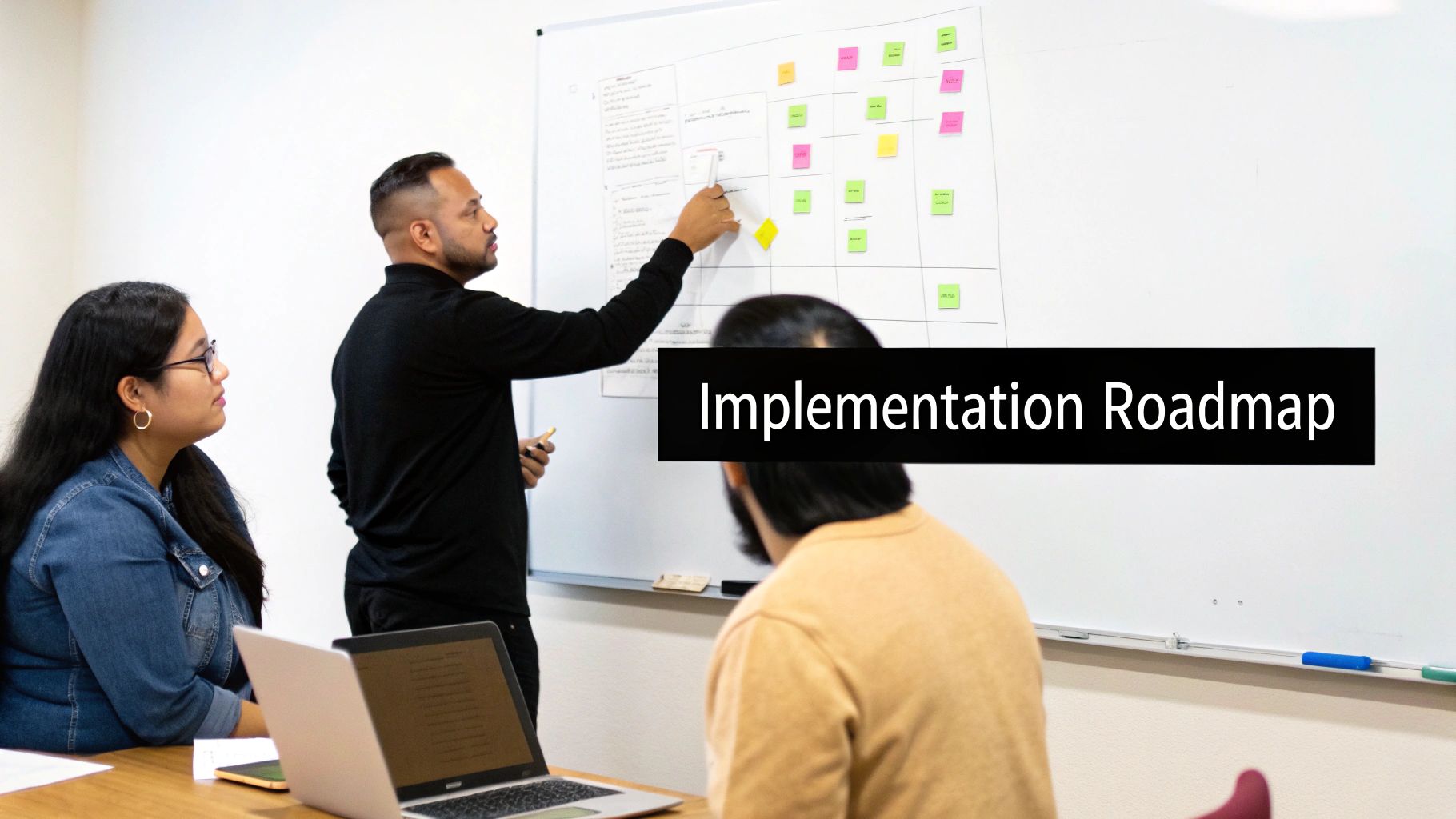
Rolling out enterprise automation is as much about people as it is about technology. The key is to build momentum with a clear, phased approach that proves its value at every step. This shifts the conversation from anxiety to opportunity.
Start Small and Prove Value Fast
The best way to win support is to deliver a quick, undeniable win. Don’t start with your most complex process. Instead, choose a pilot project that is high-impact but manageable—a repetitive, error-prone task that is a known headache.
- Choose a High-Visibility Pain Point: Automating monthly expense reporting provides immediate relief to many employees.
- Define Clear Success Metrics: Track metrics like processing time reduction, error rate decrease, or hours saved.
- Showcase the Outcome: A successful pilot becomes a powerful internal case study that builds enthusiasm for what’s possible.
This tactic proves the value of enterprise automation solutions with hard evidence, turning skeptics into champions.
Measure Your Wins and Establish a Center of Excellence
With a successful pilot complete, it’s time to get more structured. Track key performance indicators (KPIs) for every project and share the results. Hard data showing a 40% reduction in manual data entry or 30% faster customer response times makes the benefits clear.
As momentum builds, establish a Center of Excellence (CoE). This central team of IT and business experts sets best practices, manages the automation project pipeline, and handles governance.
A CoE is the central nervous system for your automation strategy. It prevents teams from creating disconnected “shadow IT” projects and makes sure every automation effort aligns with the company’s bigger goals, maximizing your overall return.
This structure provides the guardrails needed to scale without chaos, ensuring automation spreads securely, efficiently, and consistently.
Your Top Automation Questions, Answered
Stepping into the world of enterprise automation brings up important questions. Here are answers to the most common ones.
How Secure Are These Automation Platforms?
Security is foundational. Leading automation platforms are built with robust security measures to protect your data and processes. Key features include:
- Role-Based Access Control (RBAC): Ensures users can only access the data and automations necessary for their roles.
- End-to-End Encryption: Protects your data whether it’s in transit or at rest.
- Comprehensive Audit Trails: Logs every action taken by a user or a bot, providing a clear record for compliance and security reviews.
These protections are non-negotiable for meeting strict security and governance standards.
Is Automation Going to Replace Our Team?
The goal of automation is to augment your team, not replace it. It handles the monotonous, repetitive tasks that drain energy and lead to burnout. This frees your people to focus on what humans do best: strategic thinking, creative problem-solving, and building customer relationships.
Automation doesn’t eliminate jobs; it evolves them. It empowers your employees to step into more valuable roles that demand creativity and critical thinking. The result is almost always higher job satisfaction and a more impactful team.
When companies implement enterprise automation solutions, it creates opportunities for employees to upskill into new roles like data analysts, automation specialists, or strategic advisors.
How Fast Will We See a Return on Investment?
The timeline for ROI varies, but quick wins are achievable. By starting with a high-impact pilot project, such as automating a slow or error-prone financial process, you can often see tangible results in the first three to six months.
The initial ROI comes from direct cost savings and efficiency boosts. The long-term value, however, comes from improved accuracy, higher customer satisfaction, and the ability to make smarter, data-driven decisions faster.


