Choosing between a Fixed Price and a Time & Materials (T&M) contract comes down to one thing: how predictable is your project's outcome? For innovative projects like an Agentic AI system, where requirements will evolve, T&M provides essential flexibility to achieve the best result. For smaller, well-defined tasks with a clear, unchanging goal, a Fixed Price model can work.
The choice isn't just about cost—it defines the project's entire dynamic, risk allocation, and potential for innovation.
Comparing Fixed Price vs. T&M for Enterprise Projects
When weighing fixed price vs t&m, it's a mistake to focus only on the initial quote. Each model shapes the relationship with your development partner and, ultimately, the final product's success.
Use Case: Building a static website from a set of fully approved wireframes is a perfect fit for a Fixed Price deal. The scope is locked in, and the outcome is predictable. For details on what "fully approved" means, see how wireframes are the path from concept to completion.
In contrast, developing an AI-powered logistics tool requires adapting to market feedback. The final features aren't known at the start. This project needs the flexibility of a T&M model to succeed.
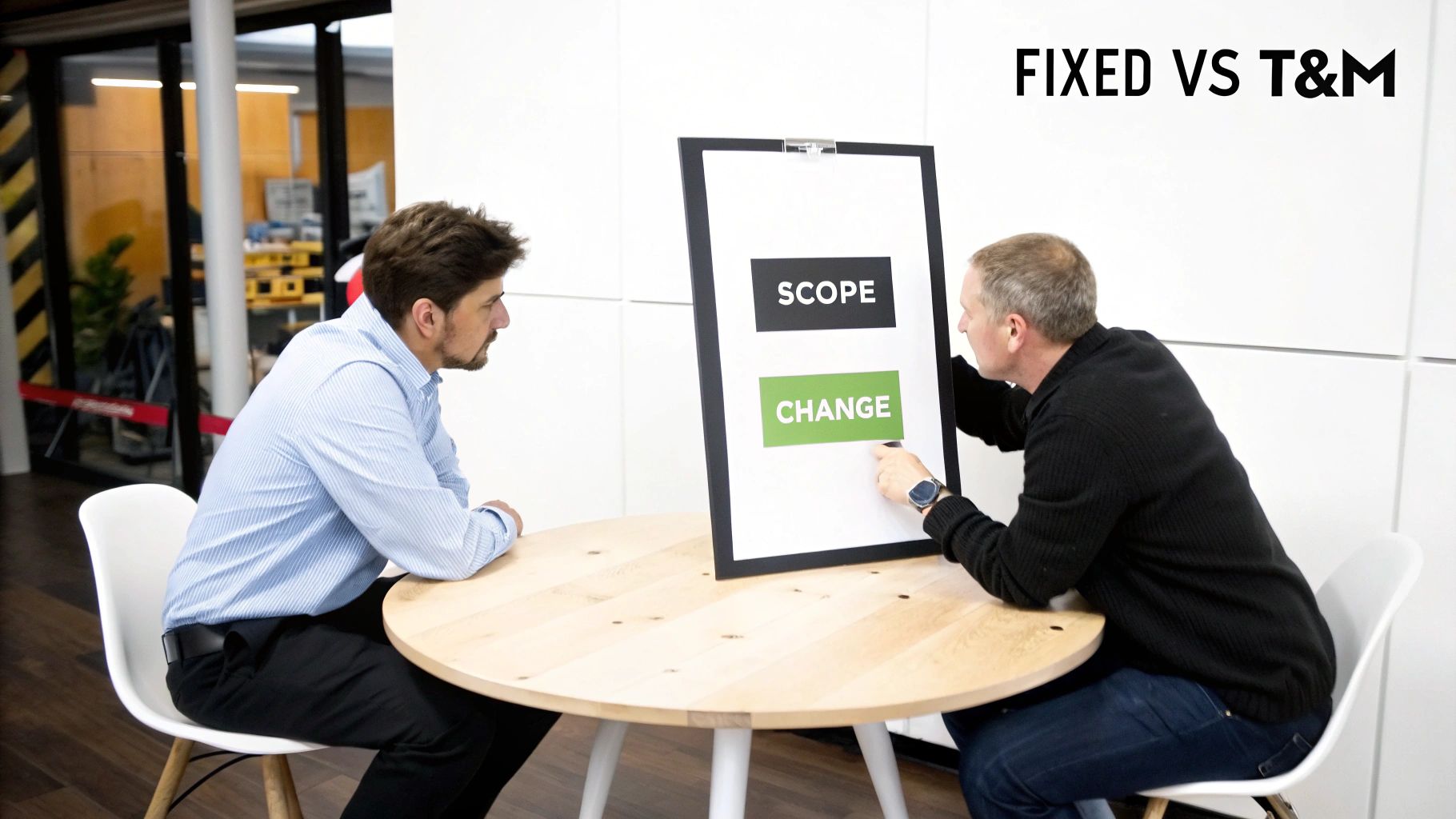
Fixed Price vs T&M At a Glance
This table breaks down the core differences and outcomes for each model.
CriterionFixed Price ModelTime & Materials (T&M) ModelFlexibilityRigid. Scope changes require formal, often expensive, change orders, delaying outcomes.High. Priorities and features can be adjusted each cycle to maximize business value.Risk AllocationThe vendor absorbs budget risk, but the client risks poor quality and scope limitations.The client holds budget risk but gains control over quality and project direction.Client InvolvementLow. Heavy involvement upfront and at final approval, with little input during development.High. Continuous collaboration and feedback are required to steer the project.Best ForSmall, predictable projects with 100% defined and stable requirements.Complex, evolving projects like AI/ML, R&D, and enterprise modernization.
Your development methodology must align with the contract model. Agile, with its iterative sprints, is a natural partner for T&M, enabling you to realize the core benefits of Agile software development. This alignment is foundational to achieving a successful outcome.
Understanding the Core Differences in Engagement
Choosing between fixed-price vs t&m is a choice between two philosophies: one prioritizing predictability, the other built for collaborative adaptation.
A Fixed Price contract is a rigid blueprint. All requirements are mapped out before work begins. The relationship is transactional: you provide detailed specs, and the partner builds that exact thing for a set price.
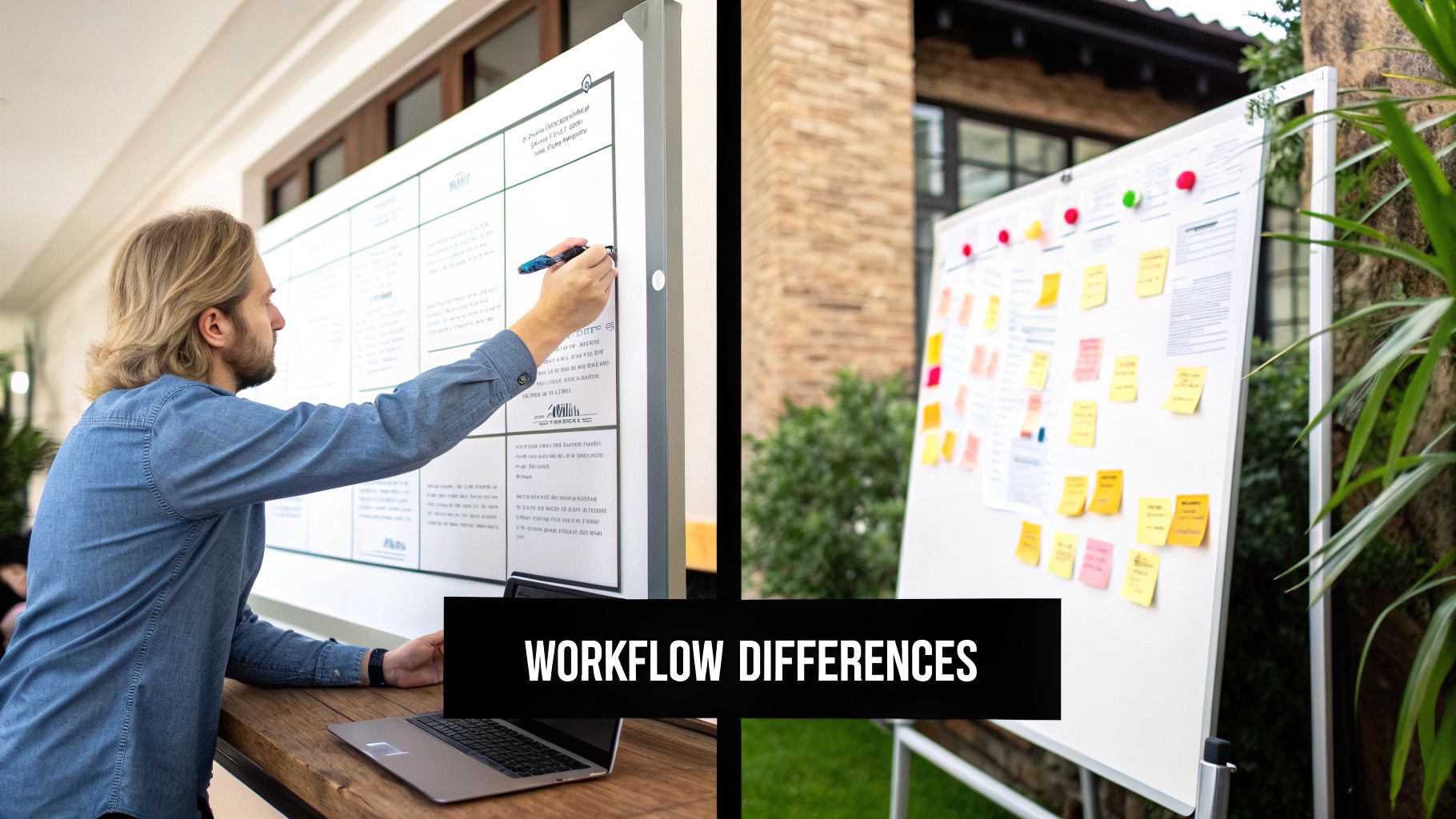
The Waterfall vs. Agile Dynamic
This rigid structure leads to a Waterfall methodology, where work flows sequentially from requirements to deployment. There's little room to revisit decisions without a formal—and often costly—change request.
This works only for projects with zero ambiguity, such as:
- Building a simple marketing website from signed-off wireframes.
- Migrating a small, well-understood database.
- Adding a specific, isolated feature to a stable application.
Industry data shows Fixed Price contracts succeed most on smaller projects with perfectly defined specs, which is about 25-30% of custom software work. Netsuite.com has more data on how project specs influence contract choices.
The Collaborative Partnership of T&M
A Time & Materials (T&M) engagement is a collaborative, agile partnership. You start with a shared vision and pay for the team's actual time, allowing for constant feedback and iterative progress. The entire model is designed for learning and adapting.
T&M shifts the dynamic from a client-vendor transaction to a unified team. The client is deeply involved, steering the project to ensure the final product delivers maximum business value, even as requirements evolve.
This approach is essential for complex projects where you can't know all the answers at the start.
Use Case: T&M for an AI Prototype
Imagine you want to build an AI tool to optimize supply chain logistics. The goal is clear, but the data, algorithms, and user interface are unknown.
- Sprints 1-2: The team builds a basic data pipeline and a simple predictive model.
- Outcome: Early tests show the initial data source is insufficient; predictions are inaccurate.
- Pivot: Under T&M, this is not a crisis. The team pivots in the next sprint to integrate a better data set. There are no contract renegotiations or change orders.
Managing this iterative learning under a Fixed Price contract would be a nightmare. T&M allows the project to evolve, making it the clear winner for AI development, R&D, and large-scale enterprise software.
How Each Model Handles Project Risk and Quality Control
It’s a myth that a Fixed Price model eliminates client risk. It locks the budget but transfers risk directly to your project's scope and quality.
When a vendor is on a fixed price, their incentive is to protect their profit margin. When unexpected complexities arise, the pressure to cut corners on testing or code quality becomes immense.
The Iron Triangle Calls the Shots
Every project balances scope, schedule, and cost. For a project to succeed, at least one of these must be flexible.
- Fixed Price: Scope, schedule, and cost are locked. When something has to give—and it always does—quality is the silent casualty. The vendor is bound to deliver the features on time and budget, but the quality of that delivery is where compromise happens.
- Time & Materials (T&M): The budget is the flexible variable. This allows you to protect quality standards and make smart scope changes as you learn and business needs evolve.
This has a direct impact on project success. A Norwegian study of 35 public software projects found that 83% of T&M projects were successful, compared to only 38% of fixed-price projects. That 45-point gap highlights the risk of using fixed-price models for complex work. You can find the full research on project success rates here.
Quality Control in a Fixed Price World
Under a Fixed Price contract, quality control is a final check against the original Statement of Work (SOW). A feature might technically meet the requirements but be built on a shaky foundation. This is how you accumulate technical debt—poor code that becomes more expensive to fix over time. For more on this, see our guide on managing technical debt in risk control.
In a Fixed Price model, the vendor is driven to deliver the minimum required to satisfy the contract. The goal shifts from building the best solution to building the specified solution, which often leads to long-term quality problems.
Quality Control in a T&M Partnership
A T&M model makes quality an ongoing, collaborative process. You are involved in the development sprints, making quality a shared responsibility.
This structure leads to:
- Iterative Refinement: Teams refactor code and improve architecture as they go.
- Immediate Feedback: You catch small issues before they become big ones.
- Shared Ownership: The team is motivated to produce high-quality work, fostering a true partnership.
Use Case: When Complexity Hits
Imagine a project to migrate a data platform to Snowflake. Two months in, the team discovers the legacy system has undocumented schemas and inconsistent data.
- Fixed Price Outcome: This is a crisis. The original scope is now impossible to deliver on budget. Work halts for a painful renegotiation, souring the relationship as the vendor protects their margin and the client fights scope creep charges.
- T&M Outcome: This is a manageable problem. The team flags the issue, explains the impact, and works with the client to reprioritize. The next sprint focuses on untangling the data inconsistencies. The project adapts, ensuring the final platform is robust and reliable.
Analyzing the True Cost of Fixed Price vs T&M
When comparing fixed price vs t&m, the initial quote is just the beginning. A Fixed Price proposal may look safe but often conceals costs that inflate the final bill.
That feeling of budget safety is often an illusion.

Unpacking the Fixed Price Risk Premium
Vendors build a significant safety buffer—a "risk premium"—into any Fixed Price quote to protect themselves from unexpected issues. This premium is typically 15-30% or more.
You are paying a hefty markup for what ifs. If the project runs smoothly, you have significantly overpaid for the work.
In a Fixed Price model, you pay for both the work and the vendor's uncertainty. If the project is straightforward, that risk premium becomes pure profit for them.
The High Cost of Administrative Overhead
The rigidity of a Fixed Price contract creates its own expensive administrative process. Every change, no matter how small, requires a formal, slow, and costly change request.
This means:
- Formal Change Requests: Documenting every minor tweak.
- Costly Renegotiations: Stopping work to re-estimate effort, cost, and timelines.
- Project Delays: The entire cycle kills momentum and pushes out your launch date.
Each change request adds direct costs and inflates the project's true cost through lost time.
How T&M Creates Opportunities for Savings
A Time & Materials model offers financial transparency. You are billed for the actual hours worked, so costs directly reflect the effort invested.
If a project runs efficiently, the final bill under T&M can be substantially lower than a comparable Fixed Price quote because there is no built-in risk premium.
Quality code also reduces long-term costs. Rushed work on a fixed-price deadline often creates technical debt. Proactively reducing technical debt is one of the best ways to control the true cost of software.
Use Case: Mobile App Development
Imagine you're building a new enterprise mobile app. During user testing, you discover three critical usability flaws.
- Fixed Price Outcome: Each flaw requires a separate change request. The project stalls for weeks during negotiations. The final cost balloons, and the launch is delayed by a month or more.
- T&M Outcome: The feedback is discussed in the next sprint planning meeting. The team immediately reprioritizes and integrates the fixes into the upcoming sprint. There are no administrative delays—just agile development responding to real-world feedback.
This highlights why the lowest initial bid is rarely the cheapest option in the end. The true cost of a project includes the financial impact of inflexibility.
When to Choose Each Model for Your Enterprise Project
Choosing between fixed price vs t&m is a strategic decision based on your project's clarity and complexity. The right choice creates alignment; the wrong one introduces friction. Look past the initial price and focus on the project's context and desired outcome.
The Clear Case for a Fixed Price Model
A Fixed Price contract is the right tool when predictability is paramount and the scope is completely locked down. It’s built for execution, not exploration.
Use a Fixed Price model for projects like:
- Simple Data Migrations: Moving data between two fully documented systems.
- Basic Website Development: Building a standard site from complete and approved wireframes.
- Specific Feature Add-ons: Integrating a well-contained feature into a mature, stable application.
For these scenarios, the goal is known and the path is clear. Fixed Price provides budget certainty for a straightforward job.
A Fixed Price contract excels when the goal is delivering a known quantity. Its rigidity makes it a poor fit for anything requiring creative problem-solving or iterative development.
When to Embrace the T&M Model
A Time & Materials (T&M) model is designed for a journey of discovery. It’s the better choice for complex initiatives where requirements are expected to evolve.
This approach is essential for any project where innovation and adaptation are keys to success. It provides the flexibility to build the right solution, not just the one specified at the start.
A T&M model is essential for:
- Developing Innovative AI Solutions: Building custom AI agents where success depends on experimentation and R&D.
- Building Scalable Data Platforms: Creating sophisticated platforms on technologies like Snowflake, where analytics needs will evolve.
- Creating Custom Enterprise Applications: Developing large-scale software that requires continuous user feedback to deliver business value.
T&M fosters a true partnership, allowing your team to steer the project sprint by sprint to achieve strategic goals.
The Hybrid Approach: A Middle Ground
Sometimes a project doesn't fit neatly into either box. A hybrid model like "T&M with a cap" can be practical.
This model operates on a T&M basis—giving you transparency and agility—but includes a "not-to-exceed" budget. It acts as a financial guardrail, protecting you from uncontrolled spending while preserving the flexibility needed for complex work.
Project Model Decision Matrix
This matrix maps common projects to the recommended model to guide your fixed price vs t&m decision.
Project TypeRecommended ModelKey JustificationAgentic AI DevelopmentTime & Materials (T&M)Requirements are highly emergent and depend on R&D; scope is impossible to define upfront.Basic Marketing WebsiteFixed PriceScope is fully defined by pre-approved designs; minimal technical uncertainty.Custom Enterprise SoftwareTime & Materials (T&M)Requires user feedback, iterative development, and adapting to changing business priorities.Simple Database MigrationFixed PriceThe source and target are known, and the process is standard and repeatable.Complex Snowflake Data PlatformT&M with a CapOffers flexibility for unforeseen data complexities with a budget ceiling for financial control.
The best decision comes from an honest assessment of your project’s characteristics. Match the model to your level of uncertainty to set the foundation for a successful outcome.
Implementing Effective Governance and Contracting
Successful projects depend on governance, no matter which side of the fixed price vs t&m debate you're on. The difference isn't if you govern, but how. One model requires meticulous upfront planning, while the other demands continuous, hands-on management.
Your contract and governance framework are tools for building a successful partnership. It's about agreeing on how you'll work together, solve problems, and define success.
Governance in a T&M Model
In a Time and Materials project, strong governance is critical to connect costs to value. The goal is transparency and control without micromanagement.
Effective T&M governance includes:
- Daily Stand-ups: Quick check-ins to spot blockers and keep the team aligned.
- Transparent Progress Tracking: Real-time visibility into the work using tools like Jira or ClickUp to see who is doing what and how hours are logged.
- Regular Budget Reviews: Weekly or bi-weekly reviews of the budget burn rate against delivered work to eliminate financial surprises.
The core principle of T&M governance is active client participation. You are the product owner, responsible for prioritizing work to maximize business impact.
Contracting for a Fixed Price Model
With a Fixed Price contract, the hard work is front-loaded. Governance focuses on ensuring adherence to the agreement. The entire project's success rests on the Statement of Work (SOW).
A bulletproof SOW must include:
- Crystal-Clear Acceptance Criteria: Define "done" for every feature in objective, measurable terms. Ambiguity is the enemy of a fixed-price project.
- A Well-Defined Change Control Process: You need a formal process for how changes will be requested, estimated, and approved, detailing the cost and timeline impacts.
For example, a strong change control clause might read: "All change requests must be submitted in writing and will be evaluated for cost and schedule impact within 48 hours. No work will commence without a signed contract addendum." This clause prevents scope creep and keeps both sides accountable.
A Few Common Questions
Choosing between a Fixed Price and a T&M model always raises questions. Here are straightforward answers to common dilemmas.
Is a Fixed Price Contract Really the Safest Bet for My Budget?
On the surface, yes. You get a single number, which feels safe. But it often comes at a higher total cost due to a 15-30% risk premium vendors add to protect themselves. If the project goes smoothly, you've overpaid. Worse, any change kicks off a costly change request process that can bloat the "fixed" budget.
How Do I Keep Costs from Ballooning on a T&M Project?
Active governance is the key. This isn't a "set it and forget it" model. You are the co-pilot, steering the project.
Strong T&M governance is simple: daily check-ins, transparent progress tracking in tools like Jira, and regular budget reviews. This rhythm ensures every dollar is tied to visible progress and aligns with your priorities.
By staying involved, you maintain control over the budget and the project's direction, preventing cost overruns.
Can We Switch Models in the Middle of a Project?
Yes, and it can be a smart move. A project might start under a T&M model for an initial discovery or prototyping phase. Once the scope is defined and major technical risks are addressed, both parties can agree to switch to a Fixed Price model for the main execution phase. This hybrid approach gives you flexibility when you need it most and cost predictability when the path is clear.


