The fusion of the Internet of Things (IoT) and data analytics creates a powerful feedback loop for modern business. Connected devices—from factory machinery to delivery trucks—stream real-time data, and analytics translates that information into immediate, intelligent actions. This shift allows companies to move from reactive problem-solving to proactive, data-driven operations that cut costs and boost efficiency.
From Connected Devices to Actionable Intelligence
The concept is straightforward: IoT sensors act as the nerve endings of your business, constantly gathering information from physical operations. Data analytics serves as the brain, processing these signals to spot patterns, predict future events, and guide smarter decisions.
This isn't about collecting data for its own sake; it's about turning raw information into a tangible competitive advantage. The journey from a sensor's raw output to an actionable insight is where advanced business intelligence services unlock value, structuring and interpreting complex data streams. Without analytics, the data from IoT devices is merely noise.
The Unprecedented Scale of IoT Data
The explosion in connected devices has created a data tsunami. The sheer numbers tell the story of an opportunity that is impossible to ignore.
The Evolution of IoT Data Generation
This table illustrates the massive growth in connected devices and the corresponding data volume, highlighting the challenge and opportunity for data analytics.
MetricValue in 2023Projected Value by 2025Number of Connected IoT Devices~ 16.6 billion> 21 billionAnnual Data Generated by IoT~ 40 zettabytes~ 80 zettabytes
This incredible scale powers critical business outcomes today.
- Slash Maintenance Costs: A logistics company tracks its fleet's location, fuel consumption, and engine health in real-time, allowing it to dynamically optimize routes and prevent expensive breakdowns.
- Improve Customer Retention: A smart appliance manufacturer monitors product usage to offer personalized tips and schedule service before a failure occurs, creating a seamless customer experience.
- Create New Revenue: An energy provider uses smart meter data to offer dynamic pricing plans, rewarding customers for off-peak usage and driving new income streams.
The real value of the Internet of Things and data analytics isn't just in connecting devices. It's in connecting the insights from those devices directly to business outcomes, turning operational data into strategic assets.
By bridging the physical and digital worlds, this powerful duo gives leaders a clear, real-time window into their operations. This visibility empowers them to cut waste, improve safety, and innovate faster—turning sensor signals into measurable business success.
Designing Your IoT Data Analytics Engine
Building an effective internet of things and data analytics platform requires a clear blueprint. Every component must work together seamlessly to turn the constant stream of raw sensor data into actionable intelligence. This engine is what transforms device signals into one of your most valuable business assets.
The first and most critical step is data ingestion—reliably getting data from your devices into your system at scale. Streaming platforms are essential here. A tool like Apache Kafka acts as a durable buffer, capturing every data point from your sensors without loss, even during massive traffic spikes. This ensures a constant, orderly flow of raw data is always ready for analysis.
The Foundation of Storage and Processing
Once data is flowing, it needs a home. In the past, companies used separate data lakes for raw data and data warehouses for structured data, creating complexity and silos.
Modern data cloud platforms like Snowflake eliminate this division. They provide a single architecture that handles structured, semi-structured, and unstructured data in one place. This flexibility is essential for IoT analytics, where you deal with everything from simple telemetry readings to complex image files.
A pivotal architectural decision is picking a platform that can handle massive data volumes and diverse query patterns without performance bottlenecks. The goal is to make data accessible for real-time dashboards and complex machine learning models from a single source of truth.
Platforms like Snowflake use tools like Snowpipe Streaming to load data from sources like Kafka in near real-time. This continuous ingestion path is crucial for applications that demand immediate insights, such as fraud detection or live operational monitoring.
Creating a Scalable Architecture
A well-designed IoT data engine is built for growth. The architecture must be elastic—able to scale up to handle peak loads and scale down to control costs. This is a key benefit of cloud-native platforms that separate compute resources from storage.
This separation means you can run numerous analytics workloads simultaneously without them interfering with each other. Your data science team can build predictive models while the operations team monitors live dashboards, all drawing from the same data without performance degradation. By focusing on a modular and scalable design from the start, you create an IoT analytics engine that not only solves today's problems but is also prepared for future demands.
Unlocking Value with IoT Analytics Patterns
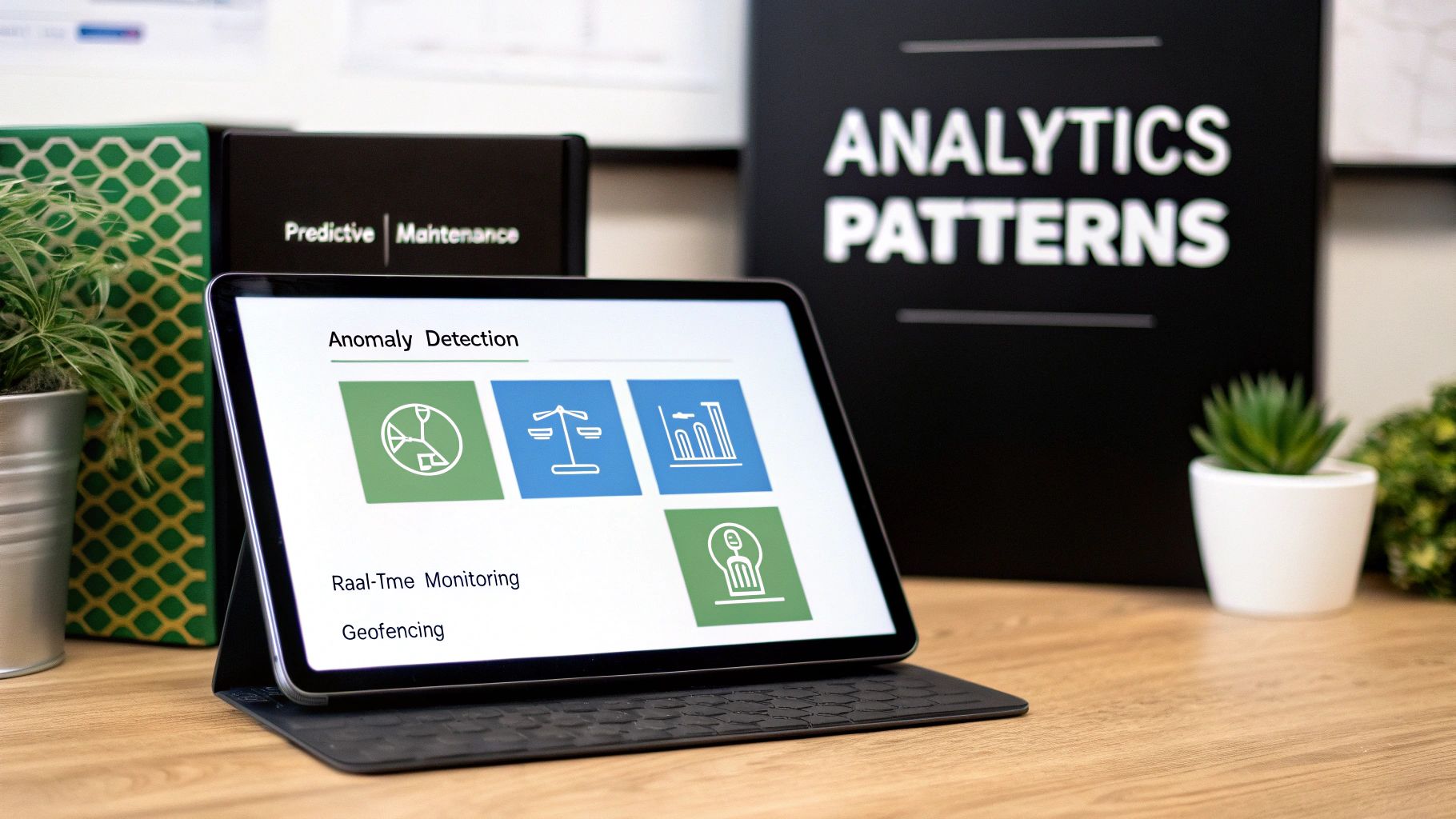
With a powerful data engine in place, you can apply specific analytical patterns to solve tangible business problems. These patterns are proven playbooks for turning a flood of raw sensor data into direct, measurable results. They help shift your operations from reactive to proactive, allowing you to prevent issues, optimize processes in real-time, and uncover hidden inefficiencies.
Predictive Maintenance Prevents Failures
Predictive maintenance uses data to forecast when equipment might fail, so you can service it just before it breaks. By analyzing sensor data like vibration, temperature, and power consumption, you can detect subtle warning signs of an impending breakdown. This approach directly slashes expensive unplanned downtime and extends asset life.
Use Case Outcome: A manufacturing plant attached vibration sensors to its conveyor belt motors. An analytics model flagged a growing anomaly, and the maintenance team was alerted automatically. They replaced a bearing during planned downtime, preventing an estimated $50,000 in lost production that a sudden failure would have caused.
Real-Time Monitoring for Live Operational Control
Real-time monitoring provides a live pulse on your entire operation, enabling an up-to-the-second understanding of every process and asset. This allows supervisors to make immediate adjustments that boost efficiency, safety, and quality.
- Energy Utilities: Operators can monitor grid load and balance power distribution on the fly to prevent blackouts during peak demand.
- Healthcare: Hospitals track critical equipment like infusion pumps, ensuring they are always available where needed, improving patient care.
Anomaly Detection Spots Hidden Issues Instantly
Anomaly detection acts as an automated watchdog, identifying data points that deviate from normal patterns and catching problems a human observer would likely miss. This could indicate anything from an equipment malfunction to a security breach.
Use Case Outcome: A water treatment facility's sensors detected an unexpected spike in water turbidity. An automated alert allowed operators to discover and repair a pipeline breach immediately. This swift action prevented contaminated water from reaching consumers, protecting public health and avoiding severe regulatory fines.
Geofencing Optimizes Asset Tracking and Logistics
Geofencing creates virtual boundaries around real-world locations. When an IoT-enabled asset, like a delivery truck or construction equipment, enters or leaves a zone, it triggers a pre-set action. This simple concept unlocks huge efficiencies in logistics and asset management.
- Improved Route Efficiency: A fleet management company used geofences to confirm deliveries and optimize routes automatically, cutting idle time and fuel consumption by over 15%.
- Enhanced Asset Security: A construction firm geofenced its job site. When an excavator moved outside the boundary after hours, an immediate security alert was sent to the site manager, preventing theft.
IoT Analytics in Action Across Industries
The true impact of combining the internet of things and data analytics is seen in real-world applications that solve tangible problems and deliver a clear return on investment. The global IoT market is projected to reach $1.0–1.5 trillion by 2025, fueled by measurable results across every sector. For a deeper dive, you can explore the latest IoT statistics and their economic impact.

Smart Buildings Cut Energy Costs
Commercial buildings are notoriously wasteful, with HVAC systems often running on a timer regardless of occupancy. Smart building operators use IoT sensors to collect real-time data on occupancy, temperature, and CO2 levels. This data is fed into an analytics platform that also considers weather forecasts and energy prices.
The Outcome: A commercial office tower implemented this strategy to dynamically adjust its HVAC system. By rerouting airflow only to occupied areas, the system cut energy consumption by 20%, translating into hundreds of thousands of dollars in annual savings.
Fleet Management Boosts Safety and Efficiency
For any company with a vehicle fleet, fuel costs, maintenance, and driver safety are major concerns. IoT telematics devices provide a constant stream of data on location, speed, braking patterns, and engine health. This data is analyzed in real-time, giving dispatchers a complete view of their fleet.
The Outcome: A national logistics company used telematics to identify and coach drivers on unsafe habits like hard braking. They also used real-time GPS and traffic data to optimize routes. The results were a 15% increase in fuel efficiency and a significant drop in accidents, which lowered insurance premiums.
These systems also enable powerful tools like geofencing in fleet management to automate tasks and improve security.
Energy Grids Prevent Outages Proactively
Traditional power grids are reactive; utilities often learn about outages from customer complaints. Smart grids use thousands of IoT sensors to constantly transmit data on voltage, current, and equipment temperature. An analytics platform monitors this data for anomalies that signal potential failures.
The Outcome: A major energy provider used this data to shift from reactive repairs to proactive maintenance. The system detected subtle voltage dips in a critical transformer and automatically alerted a crew. They replaced the part before it could fail, preventing an outage that would have affected over 5,000 homes and businesses.
In each case, IoT devices capture data, and an analytics engine turns that information into direct business outcomes—cutting costs, improving safety, and making operations more resilient.
Securing Your IoT Data from End to End
While the internet of things and data analytics offers immense opportunity, it also expands your security risks. IoT cyberattacks soared to 112 million in 2022, an 87% jump in one year. These IoT device growth statistics highlight a rapidly expanding threat landscape.
Security cannot be an afterthought; it must be integrated into your IoT strategy from day one. Protecting your data pipeline requires a layered approach, securing everything from the sensor on the factory floor to the analytics platform in the cloud.
A Practical Security Checklist
A secure IoT ecosystem relies on a chain of trust. A single weak link can compromise the entire system.
Here’s where to focus:
- Device Authentication: Every device must prove its identity before connecting to your network to prevent rogue devices from injecting malicious data.
- Data Encryption: Data must be encrypted both in transit (from device to cloud) and at rest (in your database) to render it useless if intercepted.
- Secure Network Protocols: Use proven protocols like MQTT over TLS or HTTPS to create a protected channel for data transmission.
Security in the IoT world is not a product; it's a continuous process. It requires a comprehensive strategy covering the device, the network, and the data platform, all monitored by automated threat detection.
The Role of Data Governance
Robust data governance ensures that the data you collect is trustworthy, compliant, and handled responsibly. It builds confidence in your data so that leaders can trust the insights it produces.
Key governance practices include:
- Data Quality Enforcement: Use automated checks to validate incoming sensor data and filter out anomalies or corrupted readings.
- Data Lineage Tracking: Maintain a clear audit trail of where your data came from, what transformations it underwent, and who accessed it.
- Granular Access Controls: Modern data platforms like Snowflake allow you to define precise, role-based access controls, ensuring users only see the data they are authorized to view.
Essential IoT Security and Governance Checklist
DomainKey ActionPrimary GoalDevice SecurityImplement unique identities and credentials for every device.Prevent unauthorized devices from connecting to the network.Data ProtectionEnforce end-to-end encryption (in-motion and at-rest).Ensure data confidentiality and integrity from sensor to cloud.Network SecurityUse secure protocols (e.g., TLS) and network segmentation.Protect data during transmission and limit lateral movement by attackers.Data GovernanceEstablish clear data ownership, quality rules, and lineage tracking.Ensure data is accurate, trustworthy, and compliant with regulations.Access ControlImplement Role-Based Access Control (RBAC) in your data platform.Grant users the minimum level of data access needed for their job.MonitoringDeploy continuous monitoring and automated threat detection tools.Identify and respond to security incidents in real-time.
By embedding these principles into your operations, you build a resilient IoT analytics foundation that delivers powerful insights while protecting your organization from digital threats.
Your IoT Analytics Implementation Roadmap
A successful IoT analytics initiative begins with a clear, structured plan. The journey starts not with technology, but with sharp business goals. Before you begin, define what success looks like. Are you aiming to cut unplanned downtime, reduce energy costs, or improve asset utilization? These objectives will guide every subsequent decisio>>
With your goals defined, start with a focused pilot project. Choose one high-impact use case, connect the necessary assets with sensors, and build a small-scale data pipeline to prove the concept. This approach minimizes initial risk and helps you secure stakeholder buy-in with early win>>
The Recommended Technology Sta>>
A modern IoT analytics platform is a combination of specialized components working together to move data from sensor to decision-make>>
A typical high-performance stack include>>
- Data Ingestio : Tools li e Apache Kaf -e r Snowpipe Streami g handle the high-velocity data streams from your devices without data los>>
- Data Platfor : A unified data cloud li e Snowfla e acts as the central hub, providing a single source of truth for both raw and structured dat>>
- Data Transformatio : Tools li tdb t allow your team to clean, model, and prepare raw sensor data into an analysis-ready forma>>
- Visualization and B : Platforms li e Table pe r Power I connect to your data cloud, enabling you to build interactive dashboards that make complex IoT data easy for business users to understan>>
This stack creates a seamless flow from the device on the factory floor to the dashboard in the boardroo>>
Tracking Success with Essential KP>>
To demonstrate the value of your investment, you must track the right Key Performance Indicators (KPIs). These metrics tie your analytics work directly back to your business goals and provide the hard numbers needed to justify scaling the projec>>
The purpose of an IoT project i'n't just to collect data; 't's to drive specific, measurable improvements. The right KPIs make that value undeniabl>>
Consider tracking outcome-focused metric>>
- Mean Time Between Failures (MTBF : Directly measures equipment reliability and shows the impact of a predictive maintenance progra>>
- Asset Utilization Rat : Reveals how effectively your expensive machinery is being used, highlighting opportunities for efficienc>>
- Overall Equipment Effectiveness (OEE : A manufacturing gold standard that combines availability, performance, and quality into a single scor>>
- First Pass Yield (FPY : Tracks the percentage of products made correctly the first time, indicating production quality and efficienc>>
By following this roadmap, you can de-risk your project, build momentum with a successful pilot, and demonstrate a clear return on investment to stakeholder>>
A Few Common Questions About IoT Analyti>>
As companies explore the intersection f IoT and data analyti>s, several key questions often arise. Practical answers are crucial for moving from concept to a real-world project that delivers result>>
How Long Does It Take to See a Real RO>>
It varies, but pilot projects can deliver a return on investment in as little s three to six mont>s. A predictive maintenance pilot that prevents a single catastrophic equipment failure might pay for itself immediately. The key is to focus on quick wins. A logistics company optimizing routes with a new fleet management solution will see fuel savings almost instantly. The goal is to build a series of compounding returns rather than waiting for a single, massive ROI even>>
The most successful IoT analytics projects start with a clear business problem. They ask" "What is our most expensive operational headache, and how can sensor data help solve i"?" This mindset fast-tracks you to tangible valu>>
What Are the Biggest Hurdles in Getting Starte>>
The biggest challenges are often organizational, not technical. While data integration and security are significant tasks, many projects falter due to a vague strategy or a lack of in-house skills. Initiatives often stall because they start with a technology rather than a clear business outcom>>
To avoid this, leaders shoul>>
- Start Smal : Launch a focused pilot project to solve one specific, high-impact proble>>
- Build a Cross-Functional Tea : Involve IT, operations, and data teams from day on>>
- Establish Data Governance Earl : Define rules for data quality, access, and security from the beginnin>>
Should We Build Our Own Platform or Buy On>>
For most companies, a hybrid approach is best. Building a distributed data infrastructure from the ground up is rarely practical. Buying a managed cloud data platform li e Snowfla e provides a scalable and secure foundation without the massive upfront cost and maintenance overhea>>
Th" "bui"d" component comes in creating the custom analytics and business logic on top of that platform. You migh" "b"y" the core engine (the data platform) and the" "bui"d" the specific applications that solve your unique problems, such as a custom algorithm for anomaly detection. This strategy offers the speed of a managed platform combined with the competitive advantage of custom-built intelligenc>.


