At its core, Internet of things application development services turn a flood of raw sensor data into meaningful, actionable outcomes. These services weave together custom firmware, secure connectivity, and powerful analytics to help businesses sharpen operations, slash costs, and achieve a real competitive edge. The goal isn't just to connect devices; it's to connect data to decisions that drive measurable business results.
Why IoT Application Development Drives Business Outcomes
Think of a full-scale IoT solution as the central nervous system for a smart city or a large enterprise. The sensors are the eyes and ears, constantly gathering real-time data from machinery, vehicles, or entire buildings.
- Devices are the sensory organs, capturing physical signals for monitoring and control.
- A high-speed network acts like the body’s nerve pathways, transmitting that data instantly.
- The software platform is the brain, processing all those inputs to make smart decisions and send out alerts.
From Raw Data to Tangible ROI
A strategic IoT partner bridges the gap between raw data and real-world results, turning endless streams of measurements into optimized shipping routes, automated climate control, or massive energy savings.
For example, logistics companies use IoT to reduce fuel consumption by up to 20% through optimized routing. In commercial real estate, smart buildings dynamically adjust lighting and HVAC systems, trimming energy bills by 30%.
The bottom line is this: a well-designed IoT system drives efficiency, cuts costs, and delivers strategic insights, all in real time.
The market growth tells the same story. The global Internet of Things market was valued at USD 714.48 billion in 2024 and is projected to hit USD 864.32 billion in 2025. It’s not stopping there—forecasts show it expanding to USD 4,062.34 billion by 2032, growing at a 24.30% CAGR. You can read the full breakdown on Fortune Business Insights.
If you want to dig deeper into how this works on a component level, we have a great resource on using smart controllers to boost your bottom line: Guide on Smart Controllers for Profitability.
For a solid primer on the subject, you can find more insights into IoT app development here.
Bringing in a specialized IoT provider makes the whole process faster and ensures security and compliance are baked in from the start—from the smallest sensor to the cloud platform. This integrated approach is what turns data into decisions that truly optimize logistics, facility management, and energy operations.
Drive Measurable Outcomes
The results speak for themselves. Companies with mature IoT deployments often see up to a 25% reduction in maintenance costs and a 40% boost in equipment uptime. When you invest in professional internet of things application development services, you're directly tying technology investment to measurable ROI.
A trusted partner handles all the complex integration, compliance, and scaling challenges, freeing up your team to focus on what they do best: running the business and driving growth.
- Streamlined monitoring and predictive maintenance drastically reduce downtime.
- Real-time analytics empower your team to make proactive, data-backed decisions.
- Flexible architectures ensure your system can adapt as your business needs change.
Working with a provider like Faberwork LLC gives you access to two decades of experience in building secure cloud platforms and data-driven IoT solutions that meet strict industry compliance standards. Our SnowPro Certified engineers are with you every step of the way, from initial sensor design to the final analytics dashboard.
This kind of collaboration helps enterprises achieve lasting efficiency gains, significant cost savings, and new insights that create a powerful competitive advantage. It’s time to explore how an integrated IoT system can fundamentally transform your operations.
Understanding the End to End IoT Application Architecture
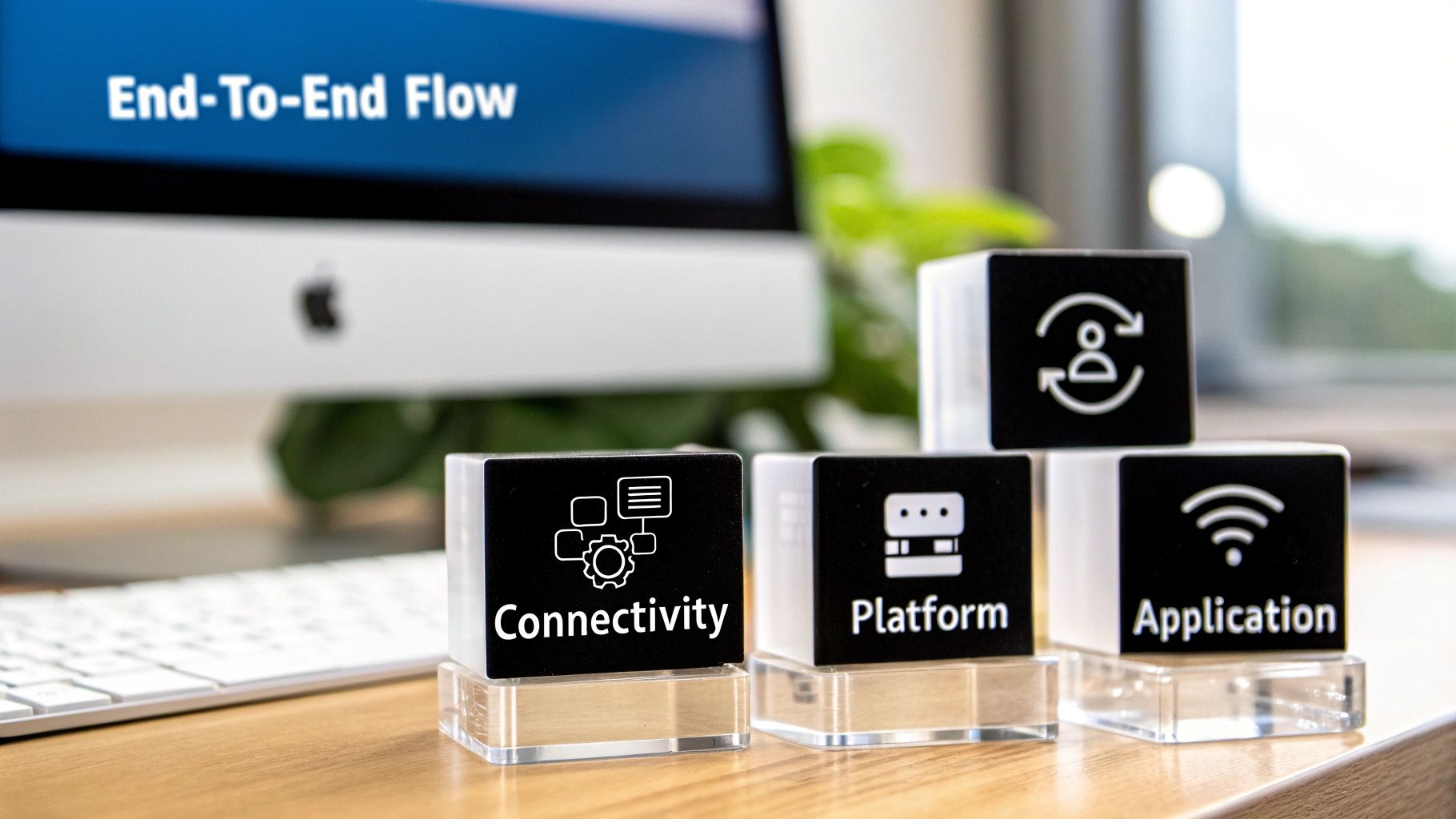
A successful IoT system operates like a data supply chain. Information is captured at the source, moved securely, processed with purpose, and delivered as a valuable insight. This journey unfolds across a four-layer architecture, ensuring data flows smoothly from the real world to your decision-makers.
Understanding this end-to-end flow is crucial before engaging internet of things application development services. Every layer has a job, and if one falters, the whole system can stall.
The Device Layer: Where Data Begins
Everything starts at the "edge" with physical "things." This layer includes sensors, actuators, and embedded devices that interact with the physical world.
Sensors gather raw data—measuring temperature in a refrigerated truck or pressure in a pipeline. Actuators take action based on commands, like adjusting a valve or locking a door. A deep understanding of industrial sensors is non-negotiable for capturing mission-critical data. These devices must be reliable, durable, and power-efficient, especially when deployed in remote locations.
The Connectivity Layer: The Data Superhighway
Once data is collected, it needs a path to a central platform. The Connectivity Layer acts as a superhighway, transmitting raw information from devices.
The right connectivity choice depends on the use case:
- Short-Range: Wi-Fi, Bluetooth Low Energy (BLE), and Zigbee are ideal for devices in a smart office or factory.
- Long-Range: Cellular (4G/5G), LoRaWAN, or satellite technologies are used for assets scattered across a city or country.
This layer ensures data packets arrive securely and reliably, often using lightweight protocols like MQTT designed for low-bandwidth environments.
The core function of this layer is simple but critical: move massive volumes of data from thousands of devices to a central point without loss or corruption.
Core Components of an IoT Application Architecture
This table shows how each layer contributes to the overall system.
Architectural LayerPrimary FunctionExample Technologies & ProtocolsDevice LayerData acquisition from the physical world and performing actions.Sensors (temperature, GPS, pressure), Actuators (valves, motors), Microcontrollers (MCUs)Connectivity LayerSecurely transmitting raw data from devices to the platform.Wi-Fi, Bluetooth (BLE), Cellular (4G/5G), LoRaWAN, Satellite, MQTT, CoAPPlatform LayerIngesting, processing, and storing massive volumes of IoT data.Cloud Platforms (AWS IoT, Azure IoT Hub), Data Platforms (Snowflake), Device ManagementApplication LayerVisualizing data, generating insights, and integrating with business systems.Dashboards (Tableau, Power BI), Analytics Engines, APIs, ERP/CRM Integrations
Each piece is essential for building a system that makes data genuinely useful.
The Platform Layer: The Central Brain
This is where the real magic happens. The Platform Layer is the central processing unit for all incoming IoT data. Built on powerful cloud infrastructure like AWS or Azure, it manages devices, ingests data at scale, and runs rules to process information in real-time. A scalable data platform like Snowflake is critical for handling the sheer volume and speed of IoT data.
The Application Layer: Turning Data Into Action
Finally, the Application Layer is where processed data becomes business value. This is the part of the system your team interacts with.
Key components include:
- Dashboards and Visualizations: User-friendly interfaces showing key metrics and alerts.
- Analytics and Reporting: Tools that find patterns and predict events like equipment failure.
- Alerts and Notifications: Automated systems that send notifications when attention is needed.
- Integration with Enterprise Systems: APIs that connect the IoT platform with your other business software (like an ERP or CRM).
This layer empowers your team to make smarter, faster decisions that positively impact the bottom line.
Exploring Core Services and Technology Stacks
Building a powerful IoT solution is like commissioning a custom vehicle—you need an engine, chassis, and dashboard all working in harmony. Expert internet of things application development services orchestrate an entire suite of services to build a system from the ground up, managing the entire technology stack to turn parts into a high-performance machine.
From Firmware to Front-End Applications
A complete IoT service offering covers every architectural layer to ensure seamless data flow. The best providers act as a single point of contact, avoiding the finger-pointing that occurs with multiple vendors.
Key services include:
- Custom Firmware and Edge Development: The software that tells sensors how to collect data and actuators how to act, all while communicating securely and efficiently.
- Secure Cloud Infrastructure Engineering: Designing and building robust cloud setups on platforms like AWS or Azure to handle millions of data points securely.
- Data Platform Engineering: Building data platforms using solutions like Snowflake that are designed to handle the volume and speed of time-series data from connected devices.
- Front-End Application and Dashboard Development: Creating intuitive web and mobile dashboards that let your team monitor assets, spot trends, and get critical alerts.
This end-to-end model ensures every piece, from the sensor to the dashboard, is perfectly aligned to achieve your business goals.
The Modern Tech Stack That Powers IoT
Behind these services is a powerful set of technologies chosen for the unique demands of IoT. The right tools depend on the job, whether it's real-time fleet management or predictive factory maintenance.
The goal of a well-architected tech stack is to ensure scalability, security, and performance. Each technology is a building block that contributes to a solution capable of growing with your business and delivering reliable insights.
A typical modern IoT stack includes:
- Programming Languages: Python and C++ for firmware and edge computing; Node.js, Java, and Go for scalable cloud platforms and applications.
- Time-Series Databases: Specialized databases like InfluxDB or TimescaleDB, or data platforms like Snowflake that handle the constant stream of timestamped data from IoT devices.
- AI/ML Frameworks: Frameworks like TensorFlow or PyTorch to build predictive maintenance and other advanced machine learning models.
- Integration and APIs: Robust APIs (Application Programming Interfaces) to ensure data flows smoothly between the IoT platform and your other core business software like ERP or CRM.
This combination of technologies, expertly implemented by a skilled partner, forms the backbone of any successful enterprise IoT project.
Seeing IoT Solutions in Action Across Industries
The true value of IoT becomes clear when you see it solving real-world business problems. The right internet of things application development services deliver tangible results that boost efficiency, improve safety, and drive profit. Let's explore a few use cases where IoT is making a serious impact.
Use Case: Optimizing Fleet Management and Logistics
For companies managing vehicle fleets, inefficiencies lead to massive costs. IoT provides the real-time visibility needed to tighten operations, from route planning to cargo protection.
- The Challenge: A logistics company struggles with inefficient routes, high fuel bills, and the risk of spoiled, temperature-sensitive goods.
- The IoT Solution: Real-time GPS tracking enables dynamic rerouting to avoid traffic. Geofencing sends automated alerts when trucks enter or leave key locations, as detailed in this geofencing in fleet management case study. Cold chain monitoring sensors track temperature and humidity, sending immediate alerts if conditions deviate, preventing spoilage.
- The Outcome: The company slashes fuel costs by 15%, cuts spoilage losses by 90%, and boosts its on-time delivery rate by 25%, directly impacting the bottom line.
Use Case: Creating Smarter, More Efficient Buildings
Managing complex commercial buildings often leads to wasted energy and unexpected equipment failures.
- The Challenge: A property manager faces high energy bills from HVAC and lighting running in empty areas, along with expensive, reactive emergency repairs.
- The IoT Solution: Occupancy sensors automatically adjust lighting and temperature based on room usage. Predictive maintenance sensors on HVAC units and elevators analyze vibration and temperature data to predict failures, allowing for scheduled maintenance before a breakdown occurs.
- The Outcome: The building owner cuts energy use by up to 30% and lowers maintenance costs by 20%, while dramatically improving asset uptime and tenant satisfaction.
An IoT-enabled smart building doesn't just reduce costs—it creates a more responsive, comfortable, and secure environment for its occupants while providing predictive insights for facility managers.
Use Case: Modernizing Energy and Utility Grids
Utility companies manage sprawling, critical networks. The Industrial Internet of Things (IIoT) is revolutionizing this sector, which is part of a rapidly growing industrial market.
- The Challenge: An energy provider relies on expensive, error-prone manual meter readings and struggles to locate the source of power outages quickly.
- The IoT Solution: Smart meters automatically send consumption data, eliminating manual readings and enabling precise, automated billing. Grid monitoring sensors continuously track voltage and current, instantly pinpointing the exact location of a fault during an outage.
- The Outcome: The utility improves billing accuracy to 99.9%, slashes operational costs, and cuts outage restoration times by 50%, leading to a huge boost in customer satisfaction.
How to Choose the Right IoT Development Partner
Choosing a provider for internet of things application development services is a strategic decision. The right partner navigates technical complexities while focusing on your business goals. The wrong one can lead to budget overruns, security holes, and a failed project. Look past the sales pitch to find a team that delivers a reliable, secure, and scalable solution.
Look for End-to-End Capabilities
An IoT solution has many moving parts. A partner with expertise across the entire IoT architecture—from firmware to cloud infrastructure on platforms like AWS or Azure—is essential. A holistic view ensures all components work together seamlessly, preventing integration nightmares.
Verify Relevant Industry Experience
IoT is not one-size-fits-all. A partner with successful projects in your specific industry brings invaluable knowledge. Ask for detailed case studies and client references. A company that understands the compliance rules, operational quirks, and data challenges of your sector will reduce project risk and deliver a solution that feels custom-built.
Choosing a partner is a long-term commitment. Their ability to provide ongoing support, strategic guidance, and proactive maintenance is just as important as their initial development skills.
Scrutinize Their Approach to Data and Security
IoT is all about data. Your partner must have sophisticated knowledge of modern data architecture, including platforms like Snowflake that are built for high-velocity IoT data.
Security is non-negotiable. With 57% of IoT devices vulnerable to major attacks, a casual attitude is a massive red flag. Your partner needs a comprehensive security strategy covering:
- Device Security: Protecting hardware from tampering.
- Data Encryption: Securing data in transit and at rest.
- Network Protection: Using firewalls and intrusion detection.
- Application Access Control: Ensuring only authorized users access sensitive data.
A partner who builds security in from day one is the only way to protect your data, customers, and reputation.
Evaluation Checklist for IoT Development Partners
Use this checklist to assess potential partners and ensure you cover all critical bases.
Evaluation CriteriaWhat to Look ForWhy It MattersTechnical ExpertiseIn-house skills across firmware, cloud (AWS/Azure), data engineering, and mobile/web app development.A single partner with full-stack capabilities prevents integration issues and communication breakdowns between different vendors.Industry ExperienceA portfolio of successful projects and detailed case studies specifically in your industry (e.g., logistics, healthcare, manufacturing).They'll understand your unique operational challenges, compliance needs, and business language, reducing project risk and time-to-market.Data & Analytics SkillsProven experience with large-scale data platforms like Snowflake, Kafka, and implementing AI/ML models.The value of IoT is in the data. Your partner must be able to build a scalable architecture that turns raw data into actionable insights.Security & ComplianceA clear, multi-layered security framework (device, network, cloud, app). Knowledge of regulations like GDPR, HIPAA, or industry-specific standards.A breach can be catastrophic. A security-first mindset is non-negotiable for protecting your assets and reputation.Scalability & SupportA clear plan for scaling the solution from a pilot to full production. Post-launch support, maintenance, and operations (DevOps) offerings.An IoT solution is a living system. Your partner should be prepared to support and grow it with you long after the initial launch.Business & Strategic AcumenDo they ask "why" and challenge your assumptions? Do they focus on business outcomes (ROI, efficiency) over just technical features?You're looking for a partner, not just a contractor. They should contribute strategically to help you achieve your business goals.
Using this checklist will help you find a partner truly equipped to bring your IoT vision to life.
Common Questions About IoT Development Services
Here are clear answers to some of the most common questions business and tech leaders have about engaging with internet of things application development services.
How Long Does It Take to Develop a Custom IoT Application?
The timeline depends on complexity. A Minimum Viable Product (MVP) with core features like basic sensor monitoring and a simple dashboard often takes 3-6 months. This approach allows you to test the concept and gather user feedback quickly. A full-scale enterprise solution with advanced analytics, custom hardware, and multiple system integrations can take 12-18 months or longer. A good partner will recommend a phased rollout to deliver value early while building toward the long-term vision.
What Are the Biggest Security Challenges in IoT?
IoT security must be addressed across multiple fronts from the very beginning. Key areas of focus include:
- Device Security: Protecting hardware from tampering and ensuring only authorized firmware can run.
- Data Encryption: Securing data both in transit over the network and at rest in the database.
- Network Protection: Shielding the network from unauthorized access to prevent system-wide compromise.
- Application Access Control: Implementing strong user authentication and permissions.
A solid security strategy can't be an afterthought. It must be woven into every layer of the IoT architecture from day one to effectively mitigate risks and protect your assets.
How Is the Massive Amount of Data from IoT Devices Managed?
Handling the constant stream of data from thousands of devices requires a modern, scalable data platform. The goal is to turn raw data into actionable business insights. The process starts with efficient data ingestion tools that capture high-velocity data without loss. This data then flows into powerful cloud platforms like Snowflake, which are designed to handle petabytes of information and run complex queries instantly. A well-designed data architecture is the key to unlocking the value hidden in your IoT data.
What Is the Typical Cost of IoT Application Development?
The cost of an IoT project varies based on scope, hardware requirements, platform complexity, and the number of system integrations. As a rough estimate, an MVP project typically falls between $50,000 and $150,000. More comprehensive, enterprise-grade solutions with custom hardware and advanced features can cost several hundred thousand dollars or more. The best partners provide a transparent, detailed cost breakdown after a thorough discovery phase to avoid surprises.


