At its core, the Internet of Things (IoT) in retail is about making a physical store smart. It connects everyday objects—shelves, cameras, shopping carts, and price tags—to the internet, creating a network that gathers real-time data.
This network acts like a central nervous system for the store, automating tasks, creating personalized shopper experiences, and streamlining operations. It transforms a passive building into an active, responsive environment that solves problems before they impact the customer.
What IoT in Retail Stores Actually Looks Like
Forget the jargon. Let's look at a practical use case.
Imagine a shopper takes the last carton of oat milk. In a traditional store, that empty spot sits for hours. In a connected store, a sensor on the "smart shelf" instantly alerts a stock associate's handheld device. That’s IoT in retail stores: solving timeless retail headaches like inaccurate inventory and missed sales with a network of connected devices.
It’s about moving from guesswork to data-driven action, turning a live stream of information from the sales floor into immediate, practical outcomes.
Moving from Guesswork to Data-Driven Decisions
Retailers have long relied on manual counts and historical sales data to predict future needs. IoT replaces this guesswork with a live feed of what's happening right now.
This isn't about collecting more data; it's about making that data actionable. Managers can see precisely what's happening, where, and when, allowing them to fix small issues before they become major problems.
IoT technology moves retail operations from a reactive state to a proactive one. Instead of responding to empty shelves or long checkout lines, retailers can anticipate and prevent these issues.
The Real-World Impact on Operations and Customers
This shift is driven by the need for greater efficiency and a better customer connection. The market reflects this urgency, with the global IoT in retail market projected to grow from USD 78.95 billion in 2025 to USD 280.53 billion by 2030, a compound annual growth rate of 28.86%. You can learn more about the retail IoT market growth to see how quickly this technology is being adopted.
The reason for this growth is simple: the outcomes are tangible.
- Outcome: Reduced Costs. Automated temperature monitoring in freezers prevents spoilage, while smart lighting and HVAC systems reduce energy consumption in empty store sections, directly cutting utility bills.
- Outcome: Increased Sales. Real-time inventory tracking eliminates stockouts of popular items. Personalized coupons sent to a shopper's phone as they walk down an aisle drive impulse buys.
- Outcome: Happier Customers. Smart carts and mobile point-of-sale (POS) systems eliminate long checkout lines, creating a faster, frictionless shopping trip.
Ultimately, IoT in retail isn't about gadgets. It's a practical toolkit for building more efficient, profitable, and customer-focused stores.
How Top Retailers Are Using IoT to Win
The true value of IoT lies in the concrete results it delivers on the shop floor. Top retailers are using this technology to solve age-old problems, turning chaotic stockrooms into models of efficiency and transforming generic promotions into personal experiences that build loyalty.

Let's explore specific use cases and the outcomes they produce.
Use Case: Smart Inventory Management
The most immediate benefit of IoT is eliminating out-of-stocks, a major source of lost sales.
- The Problem: A popular cereal runs out on a busy Saturday. The empty shelf goes unnoticed for hours, and dozens of potential sales are lost.
- The IoT Solution: A smart shelf with weight sensors or RFID readers detects when the last box is taken.
- The Outcome: An instant alert is sent to a stockroom employee's device. The shelf is refilled in minutes, not hours, capturing otherwise lost revenue and improving the customer experience.
This transforms inventory management from a reactive chore into a proactive, automated process.
Use Case: Intelligent Shelves and Loss Prevention
IoT sensors are a powerful tool against shrinkage—losses from theft, damage, or error that cost retailers billions annually.
- The Problem: High-value items like electronics or cosmetics are common targets for theft.
- The IoT Solution: Intelligent shelves and product tags detect unusual activity, such as a large number of items being removed at once.
- The Outcome: The system sends a discreet alert to store security, allowing for an immediate response without disturbing honest shoppers. This directly protects profit margins and ensures product availability.
By providing continuous, silent monitoring, IoT helps retailers get to the root cause of shrinkage, protecting their bottom line and ensuring products are available for paying customers.
Use Case: Personalized In-Store Marketing with Beacons
Generic promotions are ineffective. Beacons allow retailers to deliver the right message to the right person at the right time.
- The Problem: Shoppers ignore generic, store-wide sale announcements.
- The IoT Solution: Small Bluetooth beacons are placed throughout the store. When a customer with the store's app walks by, it triggers a personalized offer on their phone.
- The Outcome: A customer lingering in the coffee aisle receives a push notification for 20% off their favorite brand. This hyper-relevant marketing dramatically increases offer redemption rates and builds brand loyalty.
This technology turns a retailer's mobile app into a dynamic in-store shopping partner.
Use Case: Optimizing Store Layout with Footfall Analytics
How do you design a store that encourages exploration and increases basket size? IoT-powered footfall analytics provide the data to make these decisions with confidence.
- The Problem: Retailers rely on guesswork to design store layouts, often resulting in poor traffic flow and missed sales opportunities.
- The IoT Solution: Anonymous sensors and smart cameras generate a "heat map" showing which aisles get the most traffic, where bottlenecks form, and where customers linger.
- The Outcome: A manager moves high-margin products to high-traffic areas, redesigns confusing layouts to improve flow, and schedules staff more effectively during peak hours. This is a prime example of how IoT in retail stores turns raw data into actions that directly boost sales.
This table summarizes how these applications create tangible value.
Key IoT Applications and Their Business Impact
Use CaseCore TechnologyBusiness OutcomeSmart InventoryRFID Tags, Smart ShelvesReduced out-of-stocks by up to 50%, improved sales, automated reordering.Personalized MarketingBluetooth Beacons, GeofencingIncreased offer redemption rates, higher customer engagement and loyalty.Footfall AnalyticsVideo Sensors, Wi-Fi TrackingOptimized store layout, improved staff allocation, increased basket size.Loss PreventionSmart Tags, Shelf SensorsLowered shrinkage rates, improved on-shelf availability for high-value items.
These use cases demonstrate how a connected store becomes a more efficient, responsive, and profitable retail environment.
The Tech Powering Your Smart Store
A retail IoT system functions like a nervous system for your physical space. It's a coordinated ecosystem of hardware, connectivity, and data platforms that work together to sense, communicate, and analyze what’s happening in real time.
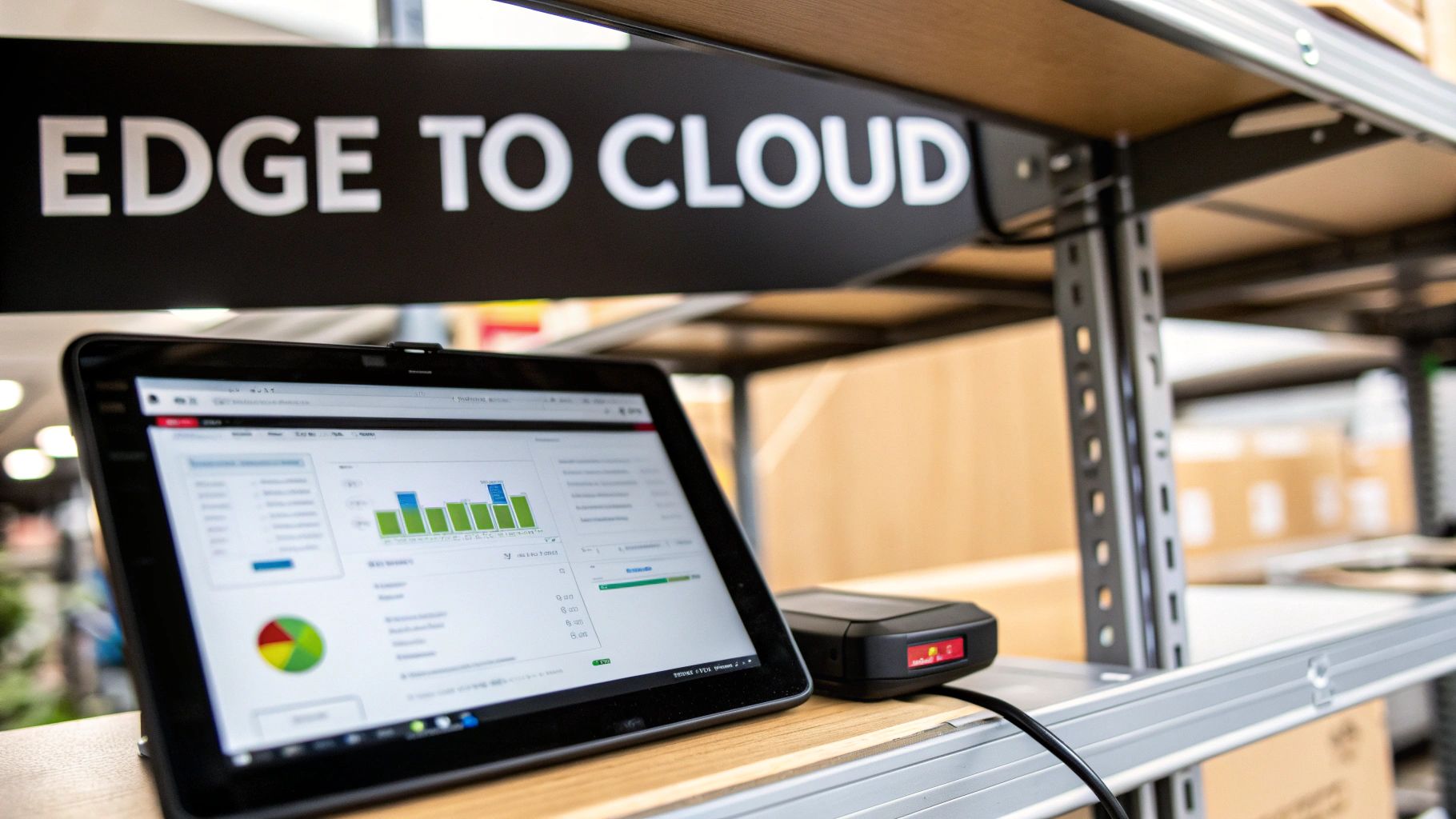
Let's break down the key components that bring this intelligent environment to life.
Hardware: The Senses of the Store
Hardware devices are the "senses" of the store, capturing raw data directly from the environment.
- Sensors and Actuators: These are the workhorses, including weight sensors on shelves, temperature sensors in freezers, and motion detectors in aisles.
- RFID Tags and Readers: Attached to products, these tags enable lightning-fast inventory counts and track an item's journey from stockroom to checkout.
- Beacons and Geofencing Tech: These small, low-power devices use Bluetooth to send personalized offers to nearby smartphones with the store's app.
- Smart Cameras: Beyond security, these cameras anonymously track footfall, create heat maps of customer activity, and monitor shelves for stockouts.
Hardware is the essential foundation. In 2024, components like RFID tags and sensors accounted for roughly 46% of the IoT retail market revenue. You can discover more insights about IoT hardware trends to see how the market is evolving.
Connectivity: The Communication Network
Once hardware collects data, connectivity solutions send it where it needs to go. Common options include:
- Wi-Fi: Ideal for high-bandwidth devices like smart cameras.
- Bluetooth Low Energy (BLE): Perfect for beacons and small sensors requiring long battery life.
- Cellular (4G/5G): Provides reliable connectivity for mobile POS systems or pop-up shops.
Edge and Cloud Computing: The Brains of the Operation
This is where raw data is processed and turned into usable insights.
- Edge Computing: Small, local computers in the store process data that needs an immediate response. For example, an edge device connected to a smart shelf can trigger a restock alert instantly, without sending data to a remote server. This reduces lag time.
- Cloud Computing: The central "brain" of the operation. The cloud platform gathers and analyzes data from all devices across all store locations, providing a complete operational overview.
Powerful analytics and machine learning models in the cloud uncover deep insights, spotting sales trends and predicting future inventory needs. Together, these components create the cohesive system that makes a smart store work.
Turning Raw IoT Data Into Automated Action
Collecting sensor data is only the first step. The true power of IoT in retail stores is unleashed when that raw information drives smart, automated actions that improve the business in real time.
The journey from a data point—like a slight weight change on a shelf—to a meaningful business outcome is where the value lies. This starts with unifying all your data streams.
Creating a Single Source of Truth
To maximize the power of IoT, you need a central hub where data from inventory, sales, and customer traffic can be analyzed together. A modern cloud data platform serves as this single source of truth, creating a unified view of your entire operation.
When you combine real-time shelf sensor data with POS transaction logs and foot traffic analytics, you can see direct correlations that were previously invisible. For example, you might discover that a specific end-cap display drives a 15% sales increase for a related item in the next aisle. Managing these data streams effectively is key; understanding how to handle time-series data with Snowflake provides a solid framework for organizing and querying data collected over time.
By bringing all your data into one place, you move beyond isolated metrics to understand the complex cause-and-effect relationships that define store performance, paving the way for true automation.
Introducing Agentic AI for Proactive Operations
With unified data, the next leap is Agentic AI—specialized software agents that analyze data, spot patterns, and trigger actions automatically, without human intervention.
Think of them as tireless digital managers constantly monitoring every aspect of your store. These AI agents are programmed to watch for specific conditions and execute predefined responses, turning your retail space into a proactive ecosystem that manages itself.
From Insight to Immediate Action
This outcome-focused automation closes the loop between data collection and physical action almost instantly. Here are a few concrete use cases:
- Use Case: Dynamic Pricing. An AI agent detects a surge in foot traffic near coolers on a hot day. It cross-references inventory levels and automatically pushes a "2-for-1" promotion for bottled water to digital signs in that aisle, capturing impulse buys.
- Use Case: Proactive Restocking. An agent analyzes in-store sales velocity and warehouse stock levels. It predicts a potential stockout five days from now and automatically generates a replenishment order, ensuring the product never disappears from the shelf.
- Use Case: Optimized Staffing. By analyzing real-time queue data from checkout cameras, an agent predicts when lines are about to get too long. It then alerts a floor associate to open another register before a bottleneck forms.
This is the ultimate goal of IoT in retail: a system that not only tells you what’s happening but takes the right action on its own, ushering in an era of proactive and truly automated retail management.
Your Practical Roadmap to IoT Implementation
Adopting IoT in your stores is a manageable journey, not a disruptive overhaul. This roadmap guides you from a small, focused pilot to a full-scale, intelligent retail environment, building momentum and proving value at each stage.
The key is to start with one high-impact problem you can solve and measure.
Phase 1: Start with a Targeted Pilot Project
The most successful IoT journeys begin small. Select one specific pain point, such as preventing stockouts of a top-selling product or reducing shrinkage in a high-value category. This approach minimizes initial risk and cost while allowing you to learn the technology in a controlled environment. For example, deploying RFID tags on a single product line can provide clean, measurable data on inventory accuracy without disrupting the entire store.
Phase 2: Define and Measure Success
Before deploying a single sensor, define what a "win" looks like with clear key performance indicators (KPIs) tied to business outcomes.
- For inventory management: Target "achieving 99% inventory accuracy" or "reducing stockouts by 40%."
- For loss prevention: Set a goal like "decreasing shrinkage in electronics by 15% within six months."
These metrics are non-negotiable for calculating your return on investment (ROI) and building a business case for expansion. As you plan, exploring how simulation and IoT mitigate risk can help you prepare for more complex systems.
Phase 3: Choose the Right Technology Partners
With your pilot and KPIs defined, select technology partners who understand retail and offer solutions that match your goals. You're looking for an ecosystem that provides end-to-end support, from sensor selection to data platform integration. This ensures all components work together seamlessly.
The scale of IoT in retail is undeniable. Projections show the global market exploding from USD 57.30 billion in 2024 to an astonishing USD 350.85 billion by 2032. Choosing partners who can scale with that growth is essential.
Phase 4: Scale and Integrate Thoughtfully
Once your pilot proves its value against your KPIs, it’s time to scale. This involves methodically expanding the solution across other product lines, departments, or locations. The key is integration. Ensure IoT data flows directly into your core business systems, such as your ERP and POS software. This transforms your IoT initiative from a standalone project into the central nervous system of your entire operation.
Got Questions About Retail IoT? We’ve Got Answers.
Adopting in-store IoT brings up practical questions about cost, security, and integration. Getting clear answers is the first step toward building a successful strategy.
Here are the key concerns retailers have when considering a connected store.
What’s the Typical ROI for an IoT Project?
Return on investment depends on the problem you're solving but is often compelling and measurable. The key is to target a specific, high-impact issue first.
For example, implementing RFID for inventory management isn't just a new way to count stock; it directly impacts the bottom line. Retailers often reduce stockouts by up to 50% and achieve over 99% inventory accuracy, leading to immediate sales growth. Similarly, smart energy systems can cut a store's utility bills by 15-20% through automated lighting and HVAC adjustments.
While there's an upfront investment, the long-term gains are significant. Most well-planned pilot projects focused on a clear pain point begin to show a positive ROI within 18 to 24 months, providing a powerful case for further investment.
How Do We Handle Data Privacy and Security?
Data privacy and security are non-negotiable and must be built into your IoT strategy from day one. Protecting devices, networks, and data is critical for maintaining customer trust.
The approach breaks down into three key areas:
- Device-Level Security: Every sensor and camera must be secured with strong authentication and encrypted communications.
- Network Security: Your IoT network should be separate from other critical systems, particularly payment networks. Using secure protocols like WPA3 creates a firewall against potential breaches.
- Data Security: All collected data must be encrypted, both in transit (from store to cloud) and at rest (in your database).
Furthermore, transparency is essential. Use clear in-store signage to inform customers about data collection. For analytics like foot traffic, ensure all data is anonymized to protect individual identities. Complying with regulations like GDPR and CCPA isn't just a legal requirement—it's fundamental to earning and keeping customer trust.
Can IoT Solutions Integrate with Our Existing Systems?
Yes, and this integration is where IoT delivers its greatest value. A modern IoT platform is designed to connect with your existing tech stack, making the tools you already use smarter.
This is typically achieved through APIs (Application Programming Interfaces), which allow real-time data from your IoT devices—such as stock counts or customer traffic—to flow directly into your other platforms.
- Enterprise Resource Planning (ERP): Live inventory data from smart shelves can automatically trigger reorders in your ERP, streamlining your supply chain.
- Point of Sale (POS): Combining foot traffic data with POS sales numbers reveals the true effectiveness of a new store layout or promotion.
- Customer Relationship Management (CRM): Understanding how customers move through the store adds a rich behavioral layer to their CRM profiles, enabling more personalized marketing.
This integration transforms IoT from a simple monitoring tool into a strategic engine for your business, ensuring everyone from marketing to operations is working with the same up-to-the-second information.


