Imagine a factory that predicts machine failure weeks in advance and automatically optimizes production for maximum yield. This isn't science fiction; it's the reality of machine learning for manufacturing. This guide cuts through the hype to show how ML turns operational data into tangible, profitable outcomes, transforming reactive factories into predictive, self-optimizing powerhouses.
The Smart Factory Revolution
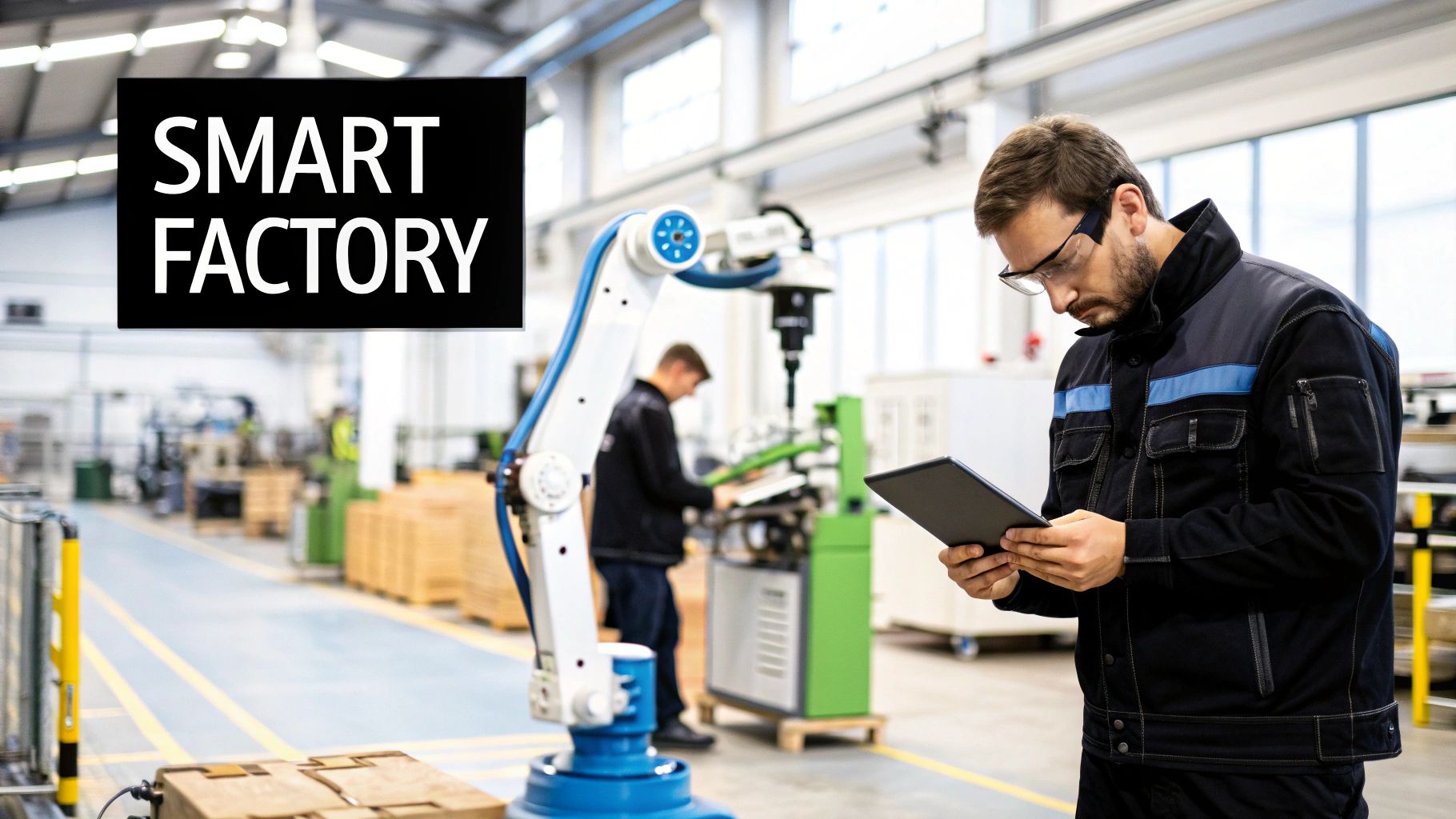
Machine learning is a fundamental shift in factory operations. Instead of relying on rigid schedules or institutional knowledge, manufacturers now use algorithms to analyze massive streams of sensor and production data. The core outcome is simple: turning operational data into profitable action.
This allows companies to escape the costly break-fix cycle. For instance, an algorithm can detect subtle changes in a machine's vibration patterns that signal an impending breakdown. This provides weeks of advance notice to schedule maintenance, preventing an expensive emergency shutdown and shifting the entire culture from reactive to proactive.
Why Is This Happening Now?
Three key factors have made machine learning a practical tool for manufacturers: the explosion of low-cost Industrial Internet of Things (IIoT) sensors, affordable cloud computing power, and significant advances in algorithm design.
The market reflects this opportunity. The global machine learning in manufacturing market is projected to hit $503.40 billion by 2030. This investment is driven by results, with 92% of manufacturers viewing smart manufacturing as their primary competitive driver.
Real-World Business Outcomes
The true value of machine learning isn't the technology itself—it's the measurable impact on the bottom line. It's about achieving specific improvements across the entire operation.
The table below highlights the key outcomes manufacturers are achieving today.
Key Machine Learning Outcomes in Manufacturing
Operational AreaBusiness OutcomeExample MetricAsset ManagementDrastically reduced unplanned downtime20-30% reduction in equipment downtimeQuality AssuranceHigher product quality and lower scrap rates15% decrease in defect ratesSupply ChainMore accurate demand forecasting and inventory control25% reduction in excess inventoryProduction OperationsOptimized processes for higher throughput and yield10% increase in Overall Equipment Effectiveness (OEE)
These outcomes demonstrate that machine learning is a capability that elevates the entire manufacturing ecosystem.
The ultimate goal is to create a self-optimizing ecosystem. A factory powered by machine learning continuously learns from its own data, identifying opportunities for improvement that would otherwise go unnoticed and turning operational information into a strategic asset.
This approach transforms static processes into a dynamic, data-driven environment. Operations become living systems that constantly adapt, driving a new level of efficiency and resilience in a fiercely competitive industrial world.
High-Impact Use Cases in Action

So, how does machine learning for manufacturing deliver real-world results? By targeting specific, high-value problems where data can deliver a measurable payback. Successful projects focus on solving persistent challenges that directly impact efficiency, costs, and quality.
These are not tools to replace experienced operators. They are tireless assistants that analyze thousands of data points every second to spot patterns and predict failures—a task impossible for a human in real-time. This creates a powerful partnership between seasoned professionals and intelligent systems.
Let's explore some of the most impactful applications.
Predictive Maintenance: From Reactive to Proactive
Unplanned downtime kills profitability. Traditional maintenance is either reactive (fixing broken machines) or calendar-based (servicing them too early or too late). Predictive maintenance flips that script. By analyzing sensor data on vibration, temperature, and pressure, ML models learn the subtle signs of impending failure.
- Outcome: Eliminates unexpected equipment failures and costly emergency repairs.
- Use Case: A model analyzes a machine's "health profile" and flags any deviation from its normal operating signature, predicting the remaining useful life (RUL) of critical components.
- Business Value: This can slash equipment downtime by up to 50% and cut maintenance costs by 40%, turning the maintenance team into a strategic asset.
Automated Quality Control With Computer Vision
Manual inspections are slow, prone to error, and cannot detect microscopic flaws on a high-speed production line. Automated quality control uses high-resolution cameras and computer vision to solve this. Trained on thousands of images, the system learns to spot the tiniest defects—hairline cracks, scratches, or misalignments—with superhuman speed and accuracy. For a closer look at how automation enables this kind of precision, check out our work on PCB layout with Python.
A major automotive manufacturer used computer vision to inspect engine block castings. The system identified hairline cracks invisible to the human eye, cutting the defect rate in finished engines by 90% and preventing massive potential recalls.
This not only improves the final product but also creates a rapid feedback loop. Operators get instant alerts, helping them trace defects back to the source and fix the root cause much faster.
Demand Forecasting for Leaner Operations
Overproduction ties up cash in inventory, while underproduction leads to backorders and unhappy customers. Accurate demand forecasting syncs your production schedule with actual market demand. ML algorithms analyze historical sales, market trends, and even external factors like competitor promotions to generate highly accurate demand predictions.
This delivers clear outcomes:
- Optimized Procurement: Order raw materials just in time, avoiding both shortages and expensive overstock.
- Efficient Scheduling: Align labor and machine resources with expected demand, preventing unnecessary operational costs.
- Lean Inventory: Reduce warehousing costs and free up working capital.
Process Optimization to Maximize Yield
Every manufacturing process involves hundreds of variables—temperature, pressure, speed—that affect quality and yield. Finding the perfect combination traditionally relies on trial and error. Machine learning models analyze real-time process data to pinpoint the ideal settings for maximum output. The system continuously learns and suggests small adjustments, nudging the process toward peak performance to boost overall equipment effectiveness (OEE) and profitability.
Building Your ML Data Foundation

A powerful machine learning model is like a high-performance engine: it’s useless without high-quality fuel. For machine learning for manufacturing, that fuel is data. Without a solid data foundation, even the most advanced algorithms will fail to deliver results. This foundation is the central nervous system of your smart factory.
It starts with the Industrial Internet of Things (IIoT)—thousands of sensors embedded in machinery that generate a constant torrent of information on everything from vibration and temperature to production speed. But simply collecting this raw data isn't enough. It must be processed through a modern data pipeline.
Architecting a Modern Data Pipeline
A data pipeline refines raw operational data into a clean, analysis-ready asset. A robust data platform is essential for this process, which typically involves three stages:
- Ingestion: Data from IIoT sensors, MES, and ERP systems is streamed into a central hub.
- Storage: The information is stored in a scalable cloud data platform like Snowflake that handles both structured and unstructured data.
- Transformation: Raw data is cleaned, standardized, and enriched to remove errors and create a single source of truth.
The goal is to create a pristine dataset that accurately reflects your operations. Poor data quality is the single biggest reason ML projects fail. A model trained on bad data produces flawed predictions—a classic "garbage in, garbage out" scenario.
Platforms like Snowflake are built for this challenge, allowing manufacturers to affordably store petabytes of data while scaling compute power as needed. Mastering time-series data with Snowflake is a game-changer for building predictive models that learn from past equipment behavior.
From Raw Data to Model-Ready Fuel
Once your data is centralized and clean, the final step is feature engineering. Here, domain experts help select the most relevant data points (features)—such as vibration amplitude or operating temperature—that will influence the model's predictions. This critical step ensures the model learns from the right signals, not irrelevant noise. A well-constructed data foundation streamlines this entire process, turning a chaotic flood of information into the structured, high-quality fuel needed to power accurate machine learning for manufacturing.
From Model to Production with MLOps
Building a working model in a lab is one thing; deploying it as a reliable tool in your daily operations is another. Many machine learning for manufacturing projects get stuck in "pilot purgatory" and never deliver value at scale. The bridge from lab to factory floor is MLOps (Machine Learning Operations).
MLOps applies the robust, automated principles of modern software development to machine learning. It provides the framework to deploy, monitor, and maintain models in a live environment, ensuring they remain accurate and trustworthy long after launch. Without MLOps, deployment is a manual, high-risk process. With it, you build a repeatable system that turns models into dependable assets that drive business results.
Building Automated CI/CD Pipelines
At the core of MLOps is the CI/CD (Continuous Integration/Continuous Deployment) pipeline. This automates the entire model lifecycle, from training and testing to deployment. When new data arrives or a model is improved, the pipeline automatically handles critical steps:
- Automated Testing: The model is validated against predefined benchmarks to ensure it meets quality standards before deployment.
- Safe Deployment: New models are rolled out carefully, often running in parallel with the old version to compare performance without disrupting operations.
- Versioning: Every model, dataset, and line of code is tracked, creating a complete audit trail. If a new model underperforms, you can instantly roll back to a stable version.
This automation eliminates human error and cuts the time to deploy an improved model from months to days.
The Critical Role of Continuous Monitoring
Once a model is live, its job is not over. Manufacturing environments change—new product lines, aging equipment, and different raw material suppliers can all cause a model's predictive power to decay over time. This is known as model drift.
Model drift occurs when the real-world data a model sees in production differs from its training data. It is the silent killer of ML value, causing an unmonitored model to make bad predictions that lead to costly operational mistakes.
Continuous monitoring acts as an early warning system, tracking model accuracy and incoming data profiles. If performance dips below a set threshold, MLOps systems trigger an automatic alert. This proactive oversight allows your team to intervene before a drifting model impacts quality or equipment health, prompting a retraining cycle with fresh data. Without this vigilance, the ROI you worked hard to achieve can quietly disappear.
Measuring ROI and Navigating Challenges
Implementing machine learning is a business investment that must deliver a clear return. To prove its worth, you must move beyond technical jargon and translate predictions into the language of the bottom line. It’s not about telling the CFO your model is "95% accurate"; it’s about showing them how that accuracy cuts costs or boosts revenue.
Success hinges on defining key metrics before you start and having a plan for the inevitable roadblocks.
Defining and Measuring Success
To track ROI effectively, focus on both operational and financial metrics that paint a clear picture of ML's impact on efficiency, quality, and profit margins.
Key metrics to watch:
- Overall Equipment Effectiveness (OEE): Predictive maintenance should directly increase equipment uptime, boosting your OEE score.
- Scrap Rate Reduction: A quality control model's success is measured by the drop in defective products—a direct financial saving.
- Mean Time Between Failures (MTBF): This number should climb as your predictive maintenance program matures, signaling greater asset reliability.
- Maintenance Costs: A successful project should shift spending from expensive emergency repairs to planned, cost-effective maintenance, potentially reducing costs by 10-40%.
By establishing a baseline for these metrics, you can demonstrate the tangible impact of your machine learning for manufacturing project with hard numbers.
Navigating Common Implementation Hurdles
While the rewards are significant, the path is rarely straightforward. Proactively planning for common challenges can separate a successful rollout from a failed project.
Anticipating obstacles isn't a sign of doubt—it's a mark of strategic planning. When you prepare for things like messy data and skill gaps, you build resilience into your project. It ensures it can handle real-world pressures and actually deliver on its promise.
Here’s a look at the most common challenges and how to get ahead of them.
Common Challenges and Mitigation Strategies
ChallengePotential ImpactMitigation StrategyPoor Data QualityModels produce inaccurate and unreliable predictions, undermining trust and leading to poor decisions.Start with a data audit. Invest in automated data cleaning pipelines and establish clear data governance policies from the project's outset.Internal Skills GapLack of in-house expertise stalls the project or leads to a reliance on external consultants for every step.Invest in cross-functional training. Pair data scientists with seasoned floor operators to combine analytical skill with deep domain knowledge.Securing Budget ApprovalDifficulty justifying the initial investment to leadership who may see ML as a purely experimental cost.Frame the project around a specific, high-pain business problem. Build a clear business case with conservative ROI projections and start with a small-scale pilot.Integrating with Legacy SystemsOlder machinery and siloed IT systems make it difficult to access the clean, centralized data needed for model training.Use modern data integration tools and IIoT gateways to bridge the gap. Focus on creating a central data repository in a scalable platform like Snowflake.
By understanding these challenges upfront, you can build a more robust and successful implementation plan.
Your Phased Implementation Roadmap
Getting started with machine learning for manufacturing doesn't require a massive, high-risk overhaul. The most successful rollouts are built on deliberate, phased steps. This approach allows you to secure early wins, prove value to stakeholders, and build the momentum needed to scale. Think of it as a methodical climb, where each phase builds on the last.
Phase 1: The Pilot Project
Start with a single, high-impact business problem. A classic starting point is predictive maintenance for a critical piece of equipment, as its ROI is clear and measurable.
Your focus should be razor-sharp:
- Set a Specific Goal: Define a tangible outcome, like "Reduce downtime on CNC Mill #5 by 20% within six months."
- Gather Targeted Data: Focus only on data for that one asset, including sensor readings and maintenance logs.
- Build a Proof-of-Concept (PoC): Develop a simple model to prove the concept works and can generate useful predictions.
A successful pilot provides the hard evidence needed to gain broader support and budget for the next phase.
Phase 2: Infrastructure and Scaling
With a successful PoC, it’s time to build a foundation that can support more than one model. This phase is about establishing your core data architecture and MLOps practices to enable reliable scaling.
Key objectives include:
- Centralize Your Data: Implement a scalable data platform like Snowflake to act as the single source of truth for all operational data.
- Automate Your Pipelines: Build out initial MLOps pipelines to automate model training, testing, and deployment.
- Scale the First Model: Roll out your predictive maintenance solution to a larger group of similar machines to refine the model with more diverse data.
Case Study in Action: A mid-sized automotive parts supplier started with a pilot targeting a single stamping press that was a constant bottleneck. After proving a 30% reduction in unplanned downtime, they secured approval to build a centralized data platform. Within a year, they scaled the solution across their entire press line and now use their MLOps practice to support quality control and energy optimization models.
Phase 3: Enterprise-Wide Maturity
In the final phase, machine learning becomes embedded in your operations. Your MLOps practice is mature, and your teams can rapidly develop and deploy new solutions to tackle a range of business challenges, from supply chain logistics to product design. At this stage, machine learning for manufacturing is no longer an isolated project but a core competency that fuels a self-reinforcing cycle of data-driven innovation and continuous improvement.
Frequently Asked Questions
When exploring machine learning for manufacturing, a few practical questions always arise. Here are direct answers to the most common concerns.
What Is the Best First Project for a Manufacturer Starting with Machine Learning?
Start with predictive maintenance. It’s the ideal first project because it solves a universal and costly problem—unplanned downtime—and delivers a clear, measurable ROI. You likely already have the necessary sensor data, and a successful pilot here builds the momentum needed to secure buy-in for future projects.
How Do You Handle Data Security with Cloud-Based ML Solutions?
Data security requires a multi-layered strategy. Use end-to-end encryption for all data, whether at rest or in transit, and implement strict role-based access controls. Partnering with established cloud providers like AWS, Azure, or GCP provides a secure, compliant infrastructure. Additionally, anonymize or pseudonymize sensitive operational data whenever possible before it is used for model training.
The real goal of machine learning on the factory floor isn't to replace people, but to supercharge them. ML tools take on the repetitive, data-heavy lifting, freeing up your team to focus on what they do best: solving tough problems and innovating.
Will AI Replace Human Workers in Manufacturing?
No, it will augment them. An ML system can flag a potential quality defect in a split second, but it still takes an experienced engineer to diagnose the root cause and implement a permanent solution. This creates a powerful "human-in-the-loop" system where technology enhances human expertise, making teams more productive and the work more engaging.


