So, what exactly is a modern data stack architecture? It’s a collection of specialized, cloud-native tools designed to deliver a single, critical outcome: turning raw business data into actionable intelligence. Unlike the rigid, all-in-one systems of the past, this approach prioritizes flexibility, allowing you to pick the best tool for each stage of the data journey. The result is a system that can power everything from real-time sales dashboards to sophisticated AI agents.
From Rigid Silos to Flexible Factories
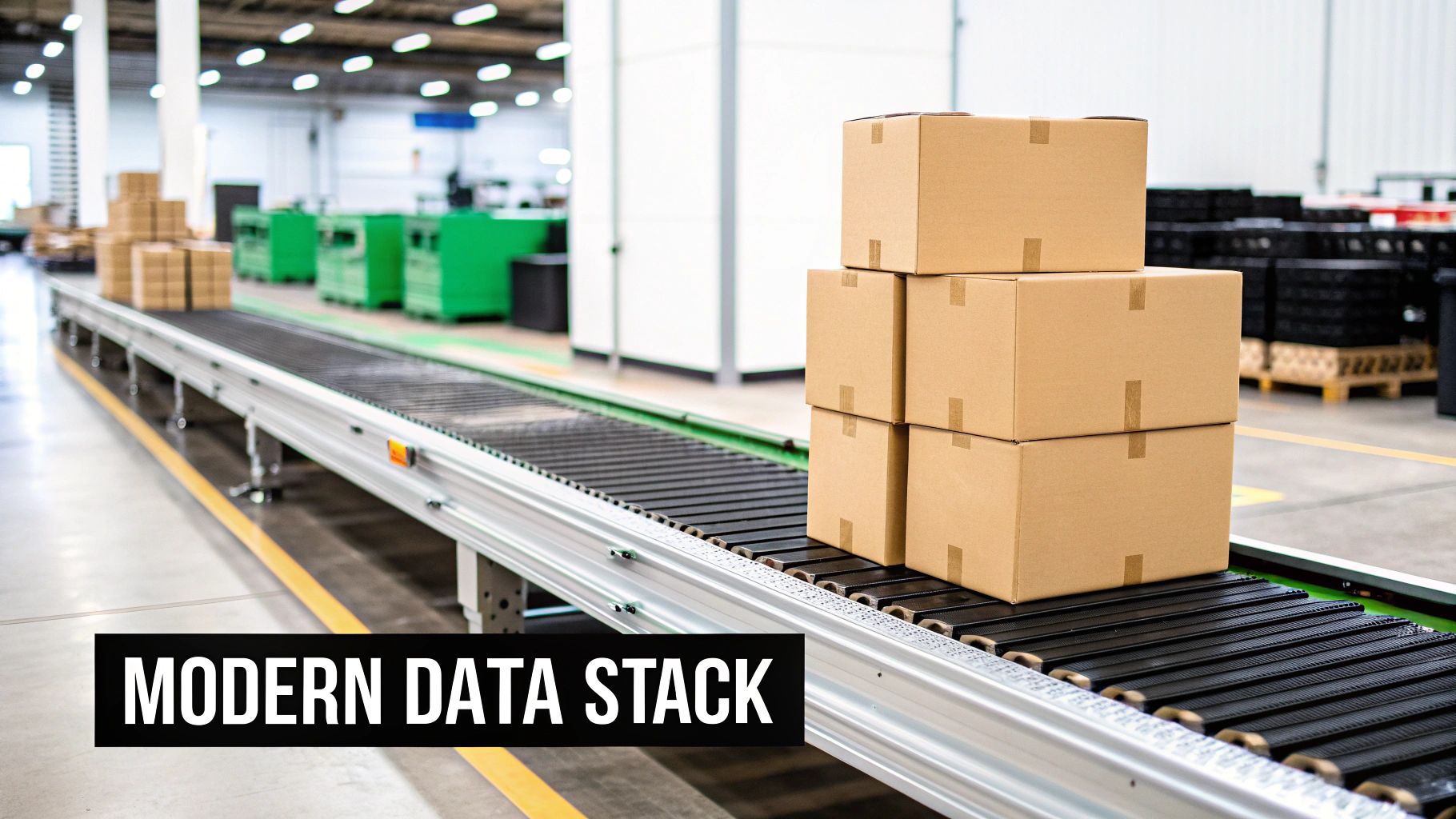
Think of traditional data systems as old-school factories. Every process—from raw material intake to final shipping—was handled by one massive, interconnected machine. If a single part needed an upgrade, the entire production line would grind to a halt.
A modern data stack operates like a sophisticated assembly line where each stage uses a specialized, high-performance tool. Raw data flows in from countless sources, is refined by different components, and emerges as a valuable finished product—a clear insight for a business leader or an automated trigger for a sales workflow.
The Core Philosophy Shift
This approach is built on one powerful idea: decoupling storage from compute. In older systems, the resources for storing data were tied to the resources for processing it. To scale one, you had to scale both—an incredibly inefficient and costly model.
Cloud-native platforms like Snowflake shattered this dependency. This allows businesses to scale storage and processing power independently, paying only for what they use. This shift aligns with modern software architecture best practices that champion scalability and modularity.
The business outcomes are immediate:
- Faster Answers: Analysts get the data they need in minutes, not days, accelerating the entire decision-making cycle.
- Greater Agility: Teams can quickly integrate new data sources or pivot analytics to address urgent business questions.
- Cost Efficiency: The pay-as-you-go model eliminates massive upfront hardware investments.
- Future-Proof Design: Swap out tools as better technology emerges, avoiding vendor lock-in and keeping your stack competitive.
The real bottom-line benefit is a massive reduction in the time it takes to get from a business question to a data-driven answer. This accelerated cycle empowers teams to innovate faster, fine-tune operations in near real-time, and build a genuine data culture.
Traditional BI vs Modern Data Stack Architecture
When compared side-by-side, the strategic advantages of the modern approach become clear. It marks a fundamental shift from slow, centralized control to fast, democratized access to information.
AttributeTraditional BI ArchitectureModern Data Stack ArchitectureFoundationOn-premise servers with coupled storage and computeCloud-native with separated storage and compute for elasticityData FlowRigid, IT-managed ETL (Extract, Transform, Load) pipelinesFlexible, analyst-friendly ELT (Extract, Load, Transform) workflowsToolingMonolithic, all-in-one vendor suitesModular, best-of-breed tools for each specific functionScalabilityLimited, expensive, and requires significant planningNear-infinite scalability on demand, pay-as-you-go modelAccessibilityRestricted to technical users, creating data bottlenecksDemocratized access for business users, analysts, and scientists
The modern data stack is built for the speed and complexity of today's business environment, while traditional systems were designed for a slower, more predictable world.
Understanding the Core Components
A modern data stack isn't one piece of software; it's a collection of specialized tools working in concert. Think of it like building a high-performance car: you choose an expert-built engine, a specialized transmission, and a custom chassis. The integrated result is far more powerful than the sum of its parts. This layered approach ensures every stage of the data journey is handled by a tool optimized for that specific job.
Data Ingestion: The Fuel Intake
This first layer reliably pulls data from all your sources—CRM, marketing platforms, application databases, third-party APIs—into one central location. Tools like Fivetran or Airbyte use pre-built connectors to automate this process. Use Case: A marketing team can automatically sync campaign data from Facebook Ads, Google Ads, and Mailchimp into their warehouse daily, eliminating manual CSV uploads and providing a complete view of ad spend.
Centralized Storage: The Chassis
This is the scalable foundation where all your data lives, typically a cloud data platform like Snowflake. It becomes the single source of truth for the entire organization. The key feature is the separation of storage and compute, allowing you to store massive datasets cost-effectively while scaling processing power up or down on demand. This model gained traction in the early 2020s as companies needed more agile analytics. For instance, RaceTrac, a major U.S. gas station chain, cut its redundant datasets by 65%, streamlining operations. You can explore how modern stacks are driving industry change by reading more about these data trends.
Data Transformation: The Engine
This layer refines raw data into something useful. The raw data is cleaned, modeled, and organized to be ready for analysis. The standout tool here is dbt (data build tool), which allows engineers to apply software best practices like version control and testing to their data models. Use Case: An e-commerce company uses dbt to join raw tables of orders, customers, and payments into a single, clean customer_lifetime_value model that business users can trust.
This ELT (Extract, Load, Transform) workflow is a cornerstone of the modern data stack architecture. By transforming data after it's loaded into the warehouse, analysts gain the flexibility to model it for multiple use cases without altering the raw source data.
Business Intelligence: The Dashboard
The Business Intelligence (BI) layer is where refined data is visualized to provide actionable insights. This component makes data accessible to everyone. Tools like Tableau, Looker, or Power BI connect to the data warehouse, letting users build interactive dashboards. Use Case: A sales manager uses a Power BI dashboard to track daily sales performance against quarterly targets, drilling down by region and product line to identify opportunities in real-time.
Reverse ETL and Orchestration: The GPS
These advanced layers operationalize your data. Reverse ETL tools (like Census or Hightouch) push insights from the warehouse back into the tools your business teams use daily. Orchestration tools like Dagster or Airflow manage the schedules and dependencies for the entire stack, ensuring data flows smoothly. Use Case: A "customer health score" calculated in Snowflake is automatically pushed back to Salesforce via Hightouch. This gives the sales team a data-driven signal to prioritize accounts at risk of churning.
Choosing Your Cloud Data Platform Foundation
At the center of any modern data stack is the cloud data platform. Platforms like Snowflake, Databricks, and Google BigQuery are the essential foundations for any data-driven company. This choice is a strategic decision that defines your agility, scalability, and cost-effectiveness for years to come. It directly impacts how quickly you can answer business questions and the sophistication of applications you can build. A key part of this involves understanding how to choose a cloud provider, as this underpins everything from performance to budget.
Why Snowflake’s Architecture Is a Game Changer
Snowflake’s unique multi-cluster, shared data architecture provides a powerful model for a modern foundation. Its design solves legacy system problems by separating compute power from data storage. This separation unlocks true elasticity. You can affordably store petabytes of data, then spin up independent "virtual warehouses" (compute clusters) to run queries. This means the finance team can run massive reports without slowing down the data science team’s machine learning models. They get dedicated resources while working with the exact same data.
The real win here is multi-cluster concurrency without performance trade-offs. Multiple teams can run wildly different workloads at different scales, all at the same time, eliminating the data silos and resource bottlenecks of traditional data warehouses.
Key Architectural Pillars and Their Business Outcomes
Snowflake's design delivers tangible business results.
- Separation of Storage and Compute: This drives cost efficiency. You pay only for the storage you use and the compute you need. A logistics firm can store enormous volumes of IoT fleet data affordably, scaling compute power only during peak analysis periods.
- Multi-Cluster Concurrency: This democratizes data access. Dozens of users can query the same data at once without waiting. The result is a massive acceleration in how quickly the entire organization can get insights.
- Secure and Governed Data Sharing: Collaboration becomes radically simpler. A financial services company can securely share real-time transaction data with a fraud detection partner without creating risky, outdated data copies. See how certified experts can help unlock these features in our guide on collaborating with Faberwork, a Snowflake Partner.
Real-World Use Cases Unlocked by Elasticity
These architectural advantages enable powerful, real-world applications.
Logistics and Fleet Management A global shipping company ingests terabytes of daily IoT data from vehicle sensors. With an elastic platform like Snowflake, analysts can run complex queries to optimize routes in near real-time, predict maintenance needs, and reduce fuel costs—all directly impacting the bottom line.
Financial Services Fraud Detection A bank feeds millions of transaction records into its data platform. By using dedicated compute clusters, its fraud detection algorithms can scale instantly to spot and flag suspicious activity in seconds instead of hours, preventing huge financial losses.
The modern data stack architecture will continue to build on these elastic foundations. The 2026 modern data stack focuses on simplifying the toolchain, with platforms like Snowflake and Databricks as the undisputed enterprise engines. A steady 10% increase in consumption signals deep adoption. Building on this solid ground ensures your organization is ready for what's next.
Common Architecture Pitfalls to Avoid
Building a modern data stack isn’t just about picking shiny new tools; it's about sidestepping common mistakes that lead to expensive rework and a system that never delivers on its promise. Too many teams get caught up in the technology and lose sight of the business outcomes they’re trying to achieve.
The Tool Explosion Trap
One of the easiest pitfalls is the "tool explosion," where teams add more and more overlapping solutions. This creates a fragmented, chaotic system that’s a nightmare to manage and expensive to maintain. This fragmentation introduces a massive "integration tax," where engineers spend most of their time writing glue code instead of delivering business value. You're left with a brittle architecture where one small change can cause a cascade of failures.
A well-designed modern data stack architecture is built on simplicity and cohesion. The goal should be a powerful, manageable system with a minimal number of well-integrated tools—not a complex web of loosely connected software.
Neglecting Governance and Observability
Another classic mistake is treating data governance and observability as an afterthought. Teams rush to build pipelines and dashboards, only to find months later that nobody trusts the data. When governance is ignored, you end up with inconsistent metrics, duplicate datasets, and a lack of confidence in any insights produced. Without observability, you’re flying blind, unable to monitor pipeline health, track data quality, or troubleshoot effectively.
Data Unprepared for AI and Analytics
Ultimately, a modern data stack should produce reliable data to fuel advanced analytics and AI. Yet, many organizations build incredible infrastructure only to find their data isn't ready for these critical use cases. The gap between data infrastructure and business outcome is where many projects fail.
Recent findings show that by 2026, despite huge investments, nearly half of enterprises won't fully trust their data for decisions, deeming it unready for AI. The consequences are immediate: almost 70% face rework within a quarter, and 66% report significant productivity losses. This stems from a fragmented toolchain creating an 80% engineering integration tax, pulling teams from valuable work. You can explore the full impact in the 2026 Modern Data Report.
To bridge this gap, focus on three key areas from the start:
- Data Quality: Build automated testing and validation into every stage of your pipeline.
- Rich Metadata: Document data assets so users understand context, lineage, and business meaning.
- Clear Ownership: Assign owners to data domains to ensure accountability for quality and reliability.
By consciously avoiding these pitfalls, you can design a modern data stack architecture that is resilient, manageable, and capable of delivering the business breakthroughs you're after.
Real-World Architecture Blueprints and Use Cases
Theory is great, but the true value of a modern data stack shines when solving actual business problems. Let's look at three concrete blueprints, each built to deliver a specific enterprise outcome. These examples highlight the stack's flexibility—it's a versatile toolkit you can configure to meet your exact goals.
AI Agent Automation Blueprint
Outcome: Build a pipeline for training and deploying autonomous AI agents that can handle customer service escalations, allocate resources, or flag fraud.
The data flow is a continuous learning cycle:
- Data Ingestion: Fivetran pulls structured data (user clicks, purchase history) and unstructured data (support tickets, call transcripts) into a central Snowflake data cloud.
- Transformation and Feature Engineering: Using dbt, raw data is cleaned and shaped into features that machine learning models can understand—the signals that steer the AI agent's decisions.
- Model Training and Deployment: Data scientists use platforms like Databricks or Snowpark to train models. Once validated, a model is deployed via API for real-time action.
- Feedback Loop: The agent's actions and results are logged back into Snowflake, allowing the model to constantly learn and improve.
This blueprint turns operational data into an active, intelligent workforce that scales on demand.
IoT and Smart Building Analytics Blueprint
Outcome: Turn raw sensor data from commercial real estate or manufacturing plants into actionable insights for energy optimization and predictive maintenance.
The workflow is designed for high-velocity data:
- High-Velocity Ingestion: A tool like Snowpipe Streaming or Kafka ingests continuous streams of time-series data from HVAC, lighting, and occupancy sensors directly into Snowflake.
- Real-Time Processing: Dynamic Tables or streams within Snowflake process data on the fly, calculating key metrics like average temperature or peak energy usage as data arrives.
- Analytics and Visualization: A BI tool like Tableau connects to these processed tables, powering dashboards that facility managers use to monitor building health, spot energy waste, and receive alerts before equipment fails.
This approach gives operators a holistic view of their facilities. For more on this, see how we manage time-series data with Snowflake.
Supply Chain Optimization Blueprint
Outcome: Give logistics and retail companies a predictive advantage by blending internal data with external feeds (weather, traffic) to build a resilient supply chain. The result is a forward-looking model that predicts disruptions and suggests optimal routes.
The process breaks down like this:
- Blended Data Ingestion: Internal ERP data is loaded into Snowflake alongside external data feeds.
- Data Transformation and Enrichment: Using dbt, internal shipment data is enriched with external context. For example, a delivery schedule is combined with a 7-day weather forecast and real-time traffic data.
- Predictive Modeling: Analysts build models to predict delivery times, flag at-risk shipments, and recommend optimal inventory levels.
- Operationalization with Reverse ETL: Using a tool like Hightouch, predictions are sent back to operational systems. A logistics coordinator’s dashboard is automatically updated with a "Predicted Delay Risk" score for each shipment, enabling proactive rerouting.
Your Roadmap to a Modern Data Platform

Moving to a modern data stack is a journey that requires a clear map. This roadmap breaks the process into manageable stages to de-risk the migration and deliver business value at every step. Starting small, proving the concept, and iterating builds the momentum and buy-in needed for a full-scale transformation.
Stage 1: Discovery and Strategy
Before touching any tools, anchor the project in business outcomes. What are you trying to solve? Cut customer churn by 15%? Optimize supply chain routes? Be specific. Audit your current systems, data sources, and workflows to find the biggest pain points and highest-impact opportunities. The result should be a prioritized list of use cases that will guide every technical decision.
Stage 2: Foundational Setup and Proof of Concept
With priorities set, it's time to lay the foundation. Pick the core pieces of your stack: the cloud data platform, ingestion tools, and transformation layer. Start with a focused proof-of-concept (PoC).
Pick one high-impact but low-complexity use case from your list. For a retailer, this might be building a single view of customer purchase history to power a new marketing campaign. This becomes a small-scale, real-world test of your modern data stack architecture.
A successful PoC proves your chosen tools work, gives your team hands-on experience, and delivers a quick win that demonstrates real value to stakeholders.
Stage 3: Phased Migration and Expansion
After a successful PoC, begin the broader migration. This must be an iterative process. Move data sources and analytical workloads in strategic phases, starting with low-risk, high-value areas to maintain momentum. For instance, tackle marketing analytics first, then sales operations, and later more complex domains like finance. This approach minimizes business disruption and allows your team to learn and adapt.
Stage 4: Governance and Security Implementation
Governance and security cannot be an afterthought. Implement controls as you migrate each new data source and workload. This means establishing clear data ownership, defining quality rules, and using role-based access controls to ensure people only see the data they should. Set up monitoring to track pipeline health, query performance, and costs. By embedding these practices from the start, you build a foundation of trust and ensure the platform remains reliable and secure as it grows.
A Few Common Questions
Here are answers to common questions that arise when considering a modern data stack.
Warehouse vs. Lake vs. Lakehouse
Think of these as different libraries for your data.
A data warehouse is like a classic library with neatly cataloged books. It's built for structured, processed data, optimized for BI questions. It's reliable but can be rigid.
A data lake is like a massive, unsorted archive. It’s flexible for exploring raw, unstructured data but can become a messy "data swamp" without proper management.
The data lakehouse combines the best of both. Platforms like Snowflake offer the structure and performance of a warehouse with the flexibility to handle diverse data types in one place.
How Do We Manage Consumption-Based Costs?
The pay-as-you-go model requires active management to control costs.
- Keep an Eye on Usage: Use built-in dashboards to monitor what’s running and where credits are going.
- Write Smarter Queries: Train analysts to write efficient SQL and use features like materialized views to cut processing time.
- Set Up Guardrails: Configure resource monitors to send alerts or automatically suspend compute resources to prevent overages.
Proactive management lets you enjoy the benefits of an elastic model without surprise bills.
What’s the Big Deal with dbt?
dbt (data build tool) brings software engineering discipline to data transformation, enabling analytics engineers to build reliable data models. Instead of tangled SQL scripts, teams use dbt to define transformations as code. This provides version control, automated testing, and documentation. The result is trustworthy, documented, and maintainable data feeding your dashboards—a massive leap forward for reliability and speed.


