Modernizing legacy systems isn't just an IT project; it's a critical business survival strategy. The goal is to transform aging, clunky infrastructure from a liability that drains your budget into a powerful asset that drives growth and delivers tangible outcomes.
Why Modernizing Legacy Systems Is a Business Imperative
- Outdated software doesn't just sit there; it actively holds you back, frustrating your teams, creating poor customer experiences, and handing a massive advantage to your competitors. Successful modernization projects are driven by clear, tangible business outcomes, not just a desire for new tech.Slash Operational Costs: Many companies spend 70-80% of their IT budget just maintaining old systems, leaving little for innovation. Modernization flips this ratio, freeing up capital for growth initiatives.
- Plug Critical Security Holes: Legacy software is a primary target for hackers due to unpatched vulnerabilities. Modernization is one of the most effective security upgrades you can make, protecting customer data and brand reputation.
- Unlock Speed and Agility: If your old system prevents you from launching a new feature or entering a new market, it's a direct roadblock to revenue. A modernized stack enables your teams to develop and deploy at the speed the market demands.
The Real-World Urgency
The financial push to modernize is clear. The market for these projects is projected to grow from USD 24.98 billion in 2025 to USD 56.87 billion by 2030. This isn't a trend; it's a market-wide consensus that doing nothing is no longer an option.
Use Case: A retail company stuck on a monolithic e-commerce platform can't roll out the personalized shopping features customers now expect. A financial institution shackled to a mainframe will struggle to launch a mobile banking app that can compete with nimble fintech startups. These aren't just IT problems—they're direct threats to revenue and customer loyalty.
The true cost of a legacy system isn't just its maintenance budget. It's the lost opportunities, the security breaches waiting to happen, and the inability to respond to market shifts.
Understanding the full scope of Legacy System Modernization is the first step. Acknowledging that technical debt is a growing threat is key; our take on why legacy code just got worse lays it out plainly. This guide provides a roadmap to turn that old liability into your new competitive edge.
Building Your Modernization Blueprint
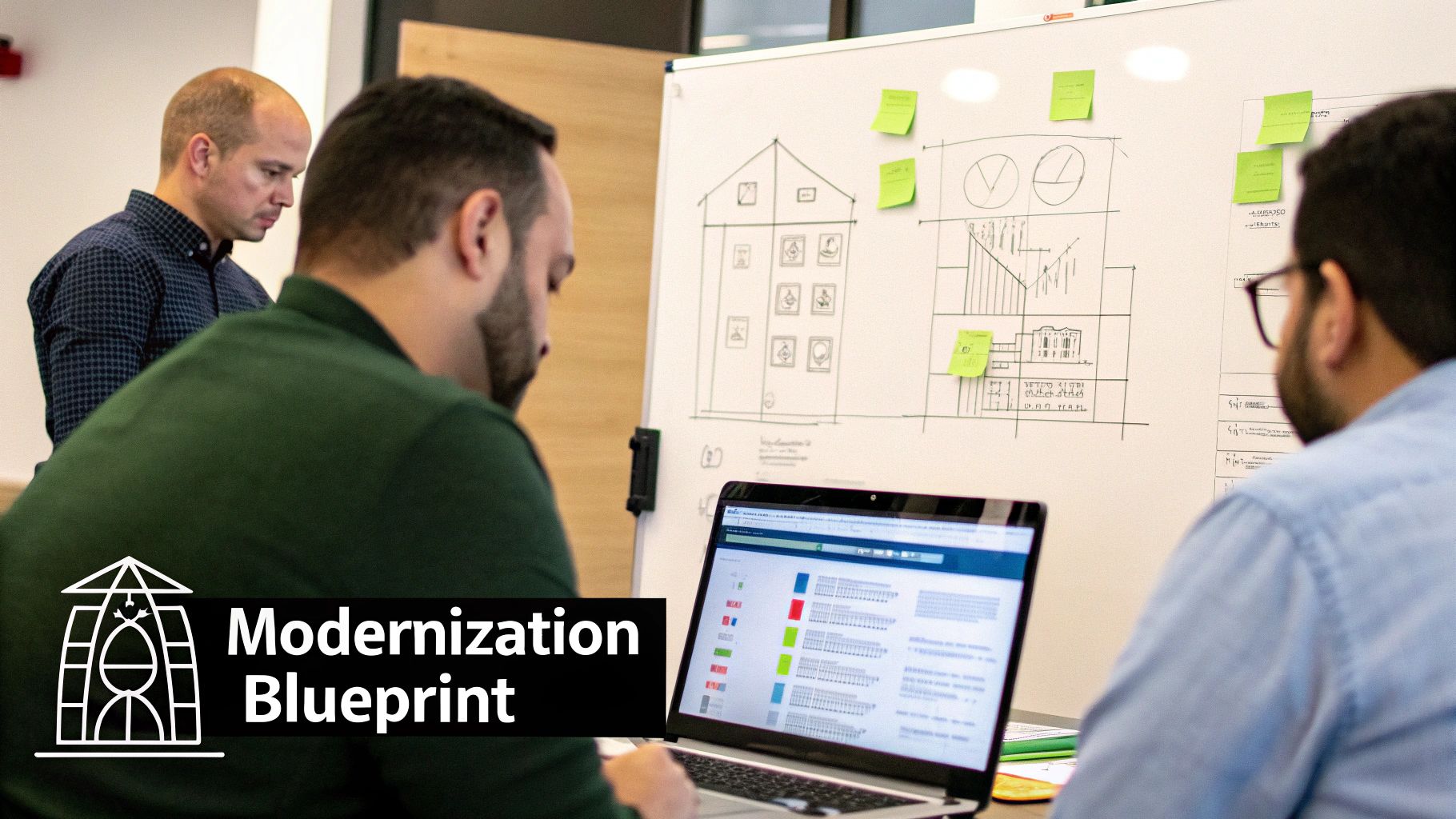
Starting a modernization project without a solid blueprint is a classic mistake. The first, most critical phase is a deep assessment of your current environment to understand not just the technical debt, but the real-world business impact.
This discovery process goes beyond a simple code audit. You must map the entire ecosystem: Which teams depend on this system? What critical functions would halt if it went down? Answering these questions provides the data needed for smart, strategic decisions.
Quantifying the cost of inaction is a powerful motivator. We've seen organizations spend 70–80% of their IT budget on legacy life support, leaving almost nothing for innovation. That figure doesn't even touch the operational burdens, like the U.S. federal government's high-priority legacy systems, which consume an estimated USD 337 million a year in maintenance. For more details, check out these industry stats.
Conducting A Comprehensive System Audit
A proper audit gathers the ammunition needed to build a compelling business case. You're creating a complete profile of each application—its role, dependencies, and technical baggage.
Your audit should focus on three key areas:
- Business Impact: Pinpoint the system's core function. A platform processing millions in daily transactions has a different risk profile than an internal reporting tool.
- User Dependency: Map who uses the system and how. Uncover the real-world friction and bottlenecks caused by clunky, outdated tech.
- Technical Health: Assess code complexity, developer availability for the language (is it a common stack or a forgotten relic?), and all integration points.
The goal of an audit isn't just to list problems. It's to create a clear hierarchy of risk and opportunity, shifting the narrative from "our tech is old" to "this system costs us X dollars in lost productivity each month."
Building A Business Case That Resonates
Armed with audit data, build a business case that ties technical problems directly to dollars and cents. Don't talk about code maintainability; talk about the sky-high cost of retaining specialized COBOL developers or the slow feature delivery that’s letting competitors win. A simple prioritization matrix helps visualize where to start.
Legacy System Prioritization Matrix
Priority LevelBusiness ValueTechnical ComplexityExample Use CaseP1: Quick WinsHighLowAn internal reporting tool with high user frustration but based on a standard, albeit old, tech stack. Modernizing it delivers immediate productivity gains.P2: Strategic BetsHighHighA core ERP or CRM system that runs the entire business but is a monolithic, custom-built application. This requires significant investment and careful planning.P3: Tactical FixesLowLowAn outdated departmental workflow app. It's not mission-critical, but modernizing it can serve as a pilot project to test new technologies and processes.P4: Deprecate/MonitorLowHighA highly customized, rarely used system with obscure code. The effort to modernize outweighs the benefit. The best path might be to contain it and plan for eventual replacement.
This matrix turns a daunting list of legacy applications into an actionable roadmap.
Use Case: A financial services firm has a core banking platform (high-value, high-risk) and a clunky internal reporting tool (lower-value, low-risk). Using the matrix, the reporting tool is a P1: Quick Win. Tackling it first delivers immediate value, builds momentum, and lets the team test new processes on a less critical app. This pragmatic approach proves the value of modernization, making it easier to get buy-in for the high-stakes core platform next.
Choosing Your Modernization Strategy
Once you've mapped your legacy environment, you must choose a strategy that balances speed, cost, risk, and business objectives. There are four main playbooks, but picking the wrong one is a fast track to wasted money. The key is to match the approach to the system and your goals.
Replatform: The "Lift and Shift Plus"
Replatforming is your quickest route to the cloud, moving an application to a cloud environment with only minor code changes to take advantage of the new environment (e.g., swapping a database for a managed service).
- When to Use It: The primary driver is a need to exit a data center, slash infrastructure maintenance costs, or improve reliability and scale without a major development effort.
- Outcome Focus: The big win is an immediate drop in hardware and IT overhead costs, plus better operational resilience and scalability with low risk.
Refactor: To Evolve and Adapt
Refactoring involves restructuring existing code to clean up the internal architecture, making it more modular, efficient, and easier to maintain. This is the classic path for breaking down a monolithic application into nimble microservices.
Use Case: A logistics company's tangled system intertwines its core routing algorithm with user management and billing. By refactoring, they can pull the routing logic into its own microservice. This strategic decoupling allows the logistics team to innovate on their core competitive advantage—that routing algorithm—without redeploying the entire application, dramatically speeding up time-to-market for new features.
Replace: For a Complete Overhaul
Some systems aren't worth saving. If an application is so outdated, insecure, or misaligned with business needs that you're throwing good money after bad, it's time to replace it by building or buying a new solution.
- Ideal Scenario: The application's core logic is irrelevant, the tech stack is unsupported, or the maintenance costs are eye-watering compared to a modern SaaS solution.
- Outcome Focus: This offers a clean slate to completely rethink a business process, eliminate all technical debt, and build a solution perfectly designed for today’s needs.
Wrap: To Extend Value
For a legacy system that's a black box but still works, the "wrap" strategy is ideal. You build a modern API layer around it, allowing new systems to access its data and functions without touching the core code. It’s a low-risk, high-impact way to unlock value from stable workhorses like mainframes.
Use Case: A bank can wrap its decades-old core banking system with a modern REST API. This allows them to quickly build a new mobile app that securely pulls account balances and transaction histories without modifying the incredibly stable (and complex) mainframe code.
Comparing Modernization Architecture Options
The table below breaks down these four strategies to help you weigh the pros and cons.
StrategyBest ForProsConsTypical Use CaseReplatformQuickly exiting data centers; reducing infrastructure costs with low risk.Fast implementation; immediate cost savings; minimal code changes; improved performance & scalability.Does not address technical debt or core architectural flaws; limited long-term modernization.Moving a stable, on-premise CRM or ERP system to a cloud IaaS provider like AWS or Azure to reduce hardware overhead.RefactorImproving maintainability and agility of a monolithic but valuable application.Reduces technical debt; enables agile development (microservices); improves code quality; future-proofs the app.Higher upfront cost & time investment than replatforming; requires skilled developers; can introduce new bugs.Breaking a monolithic e-commerce platform into separate microservices for product catalog, cart, and payments.ReplaceWhen a system is technically obsolete, misaligned with business needs, or too costly to maintain.Creates a modern, purpose-built solution; eliminates all technical debt; opportunity to redesign business processes.Highest cost, risk, and time commitment; potential for major business disruption during transition.Decommissioning an unsupported, custom-built HR system in favor of a modern SaaS solution like Workday.WrapUnlocking data and functionality from stable, black-box legacy systems (like mainframes).Low risk (no core code changes); fast way to enable modern integrations; extends the life of valuable assets.Doesn't fix underlying legacy issues; can create a dependency on the old system; potential performance bottlenecks.Building a REST API around a mainframe banking system to allow a new mobile app to access customer account data.
Ultimately, the best approach often involves a mix of these strategies. As you dig deeper, mastering enterprise cloud migration strategies becomes critical for any organization looking to modernize.
Getting Your Data Migration Right
No part of a modernization project is more nerve-wracking than data migration. Get it right, and you build immediate trust in the new platform. Get it wrong, and you can corrupt your most valuable asset. Success hinges on meticulous planning and choosing a strategy that fits your business operations.
A big bang migration moves everything at once during a scheduled downtime. It's fast but carries enormous risk; a single failure can mean a painful rollback and a major business outage. The alternative is a trickle migration, a phased approach where you move data in smaller pieces. It dramatically lowers risk and avoids a massive downtime window, but it requires keeping data synchronized between two systems.
Choosing Your Migration Pattern
The decision boils down to a trade-off: your company's tolerance for downtime versus its tolerance for complexity.
- Go with Big Bang When: You have a smaller, non-critical dataset and can afford a significant maintenance window (e.g., a full weekend).
- Opt for Trickle When: You’re moving a large, mission-critical database that must stay online. This is the only real choice for systems where even a few hours of downtime is unacceptable.
The trickle method is almost always the safer bet for complex enterprise systems. It forces you to solve synchronization and validation problems early, building confidence with each small success.
A Practical Scenario: Moving to a Cloud Data Warehouse
A common project is moving a large on-premise transactional database to a cloud platform like Snowflake. The process begins with a bulk load of historical data. Once complete, a continuous sync process using a Change Data Capture (CDC) tool is established. This tool watches the legacy database for any changes and replicates them to the new cloud database almost instantly, keeping both systems in lockstep until the final switch.
For a deeper dive, our case study on managing time-series data with Snowflake shows how modern data platforms handle these complex challenges.
You Moved the Data. Is It Correct?
Data migration isn't just about copying bytes; it's about preserving accuracy. A robust validation strategy is essential.
- Profile Before You Move: Profile your source data to find and fix inconsistencies, duplicates, and missing values. It is always easier to clean data before you migrate it.
- Validate After Every Chunk: After each piece of data lands in the new system, run automated checks, from simple row counts to complex business rule validations.
- Run in Parallel: For a set period, run key reports against both old and new systems. The results must match perfectly.
This methodical approach turns a risky gamble into a controlled, predictable process, building a rock-solid data foundation for your new system.
Integrating AI And Automation For Faster Results

Manually modernizing a massive legacy system is slow, expensive, and dangerously prone to error. AI and automation are changing the game, transforming a multi-year slog into a more predictable and accelerated process. Modern tools can map tangled code dependencies in days, not months, fundamentally de-risking the entire project.
Accelerating Code Analysis And Refactoring
A huge time sink in modernization is understanding what legacy code actually does, especially with no original developers or documentation. AI-powered tools scan millions of lines of code to automatically map dependencies, extract hidden business logic, and flag security vulnerabilities. The result is a clear, data-driven blueprint of your application.
Use Case: An AI tool can analyze a monolithic Java application and pinpoint specific clusters of code that are perfect candidates for being broken out into microservices. It can even suggest logical service boundaries based on runtime data, removing guesswork from your new architecture. This helps avoid project stalls, as some studies show over 70% of digital transformations get bogged down by legacy bottlenecks. Recent research on AI's role in legacy modernization details how these tools get ahead of such problems.
A Practical Use Case For Agentic AI
Moving beyond simple analysis, an Agentic AI—an autonomous agent—can be tasked with hardening the security and quality of your modernization project.
Here’s a real-world scenario:
- Goal: "Analyze the legacy payment processing module and ensure its microservice replacement is secure and well-tested."
- Autonomous Analysis: The agent dives into the old code, identifying vulnerabilities like SQL injection risks or outdated encryption.
- Test Generation: Based on the business logic it uncovers, the agent autonomously generates a full suite of unit and integration tests for the new microservice.
- Continuous Monitoring: As developers build the new service, the agent continuously runs these tests in the CI/CD pipeline, providing instant feedback on new security flaws or bugs.
This approach shifts security and testing from a manual, end-of-line checklist to an automated, continuous process baked into development. The outcome is a more secure and reliable product built faster.
The CI/CD Pipeline As Your Rollout Engine
Your Continuous Integration/Continuous Deployment (CI/CD) pipeline is the engine that delivers the results. A modern pipeline automates everything from building and testing code to deploying it, enabling strategies like canary releases or blue-green deployments. You can automatically route a tiny fraction of user traffic—say, 5%—to a new microservice while the old system handles the rest. This tight feedback loop of automated testing and controlled rollouts is what enables you to deliver value to the business faster and more safely, dramatically shortening your time to ROI.
Measuring Success And Demonstrating ROI
A modernization project is only complete when you can prove it delivered real business value. Measuring success means looking past technical milestones and connecting your work directly to the bottom line. This begins with setting baseline KPIs in your initial business case to create a clear before-and-after picture.
Key Quantitative Metrics
Hard numbers are your best friend for demonstrating return on investment (ROI). These metrics translate technical improvements into financial gains and operational efficiencies.
- Reduced Maintenance Costs: The most immediate win. Tally the decrease in licensing fees, hardware expenses, and specialized developer support you no longer need.
- Faster Feature Deployment: Track your team's deployment frequency. A manufacturing client, for example, measured how quickly they could add new sensor integrations to their modernized IoT platform, which directly improved production line efficiency.
- Improved System Performance: Monitor application response times and error rates. A 40% reduction in customer support tickets related to system crashes is a powerful indicator of a more stable platform.
Capturing Qualitative Benefits
Not all benefits fit neatly into a spreadsheet. Qualitative wins are just as important for telling the complete success story.
Modernization is successful when it transforms how the business operates, not just how the software runs. The true ROI is found in a more agile, innovative, and resilient enterprise.
Consider the impact on your people. Improved developer morale is a huge outcome. When engineers aren't wrestling with obsolete tools, they are more productive, creative, and easier to retain, strengthening your ability to attract top talent. Finally, measure your enhanced business agility. If marketing can now launch a campaign without a six-week lead time from IT, that newfound speed is a competitive advantage, proving that modernizing legacy systems was an investment in future growth.
Common Questions on Modernization
Leaders need straightforward, practical answers to guide their decisions on a complex legacy system overhaul. Here are a few of the most common questions we hear.
What’s The Absolute First Step in Modernizing a Legacy System?
Before choosing a cloud provider or architecture, the first step is always a deep-dive assessment. You need a clear picture of the current system's business value, technical debt, and true operational cost. This discovery phase provides the hard data to build a compelling business case and helps you decide which systems to tackle first for the biggest, fastest impact.
How Can We Modernize a System Without Shutting Down the Business?
Avoid a risky "big bang" replacement. Instead, use incremental, phased strategies to minimize disruption. A proven method is the Strangler Fig Pattern, where you gradually build new services around the old system.
You route traffic to new, modern components piece by piece. Over time, these new services effectively "strangle" the old system until it can be safely decommissioned. This provides a controlled, low-risk transition that keeps the business running.
This approach lets your team deliver value continuously while keeping risk manageable at every stage.
Is a Complete System Replacement Always the Best Option?
Absolutely not. A total replacement is often the most expensive and riskiest path. The right strategy depends on the specific system and its business function.
- Replatforming is ideal if a system provides unique value but is stuck on an outdated platform. Moving it to the cloud may be all you need to achieve scalability and cost savings.
- Refactoring is effective when the core business logic is solid but trapped in a monolith. Breaking it into microservices delivers agility without starting from scratch.
A full replacement should be reserved for systems where the business logic is obsolete, the technology is unsupportable, or maintenance costs are astronomical. Ultimately, modernizing legacy systems is about making smart, strategic choices—not defaulting to the most dramatic one.


