What if you knew exactly what your customers wanted before they did? That’s the core promise of predictive analytics for retail. It’s about using historical data, machine learning, and statistical models to see what’s coming next, turning guesswork into a strategic advantage that directly impacts your bottom line.
From Guesswork to Growth: How Predictive Analytics Works
Traditionally, retailers have relied on past sales reports and intuition to make decisions on inventory, pricing, and marketing. This approach is like driving while only looking in the rearview mirror—it tells you where you’ve been, but not where you're going.
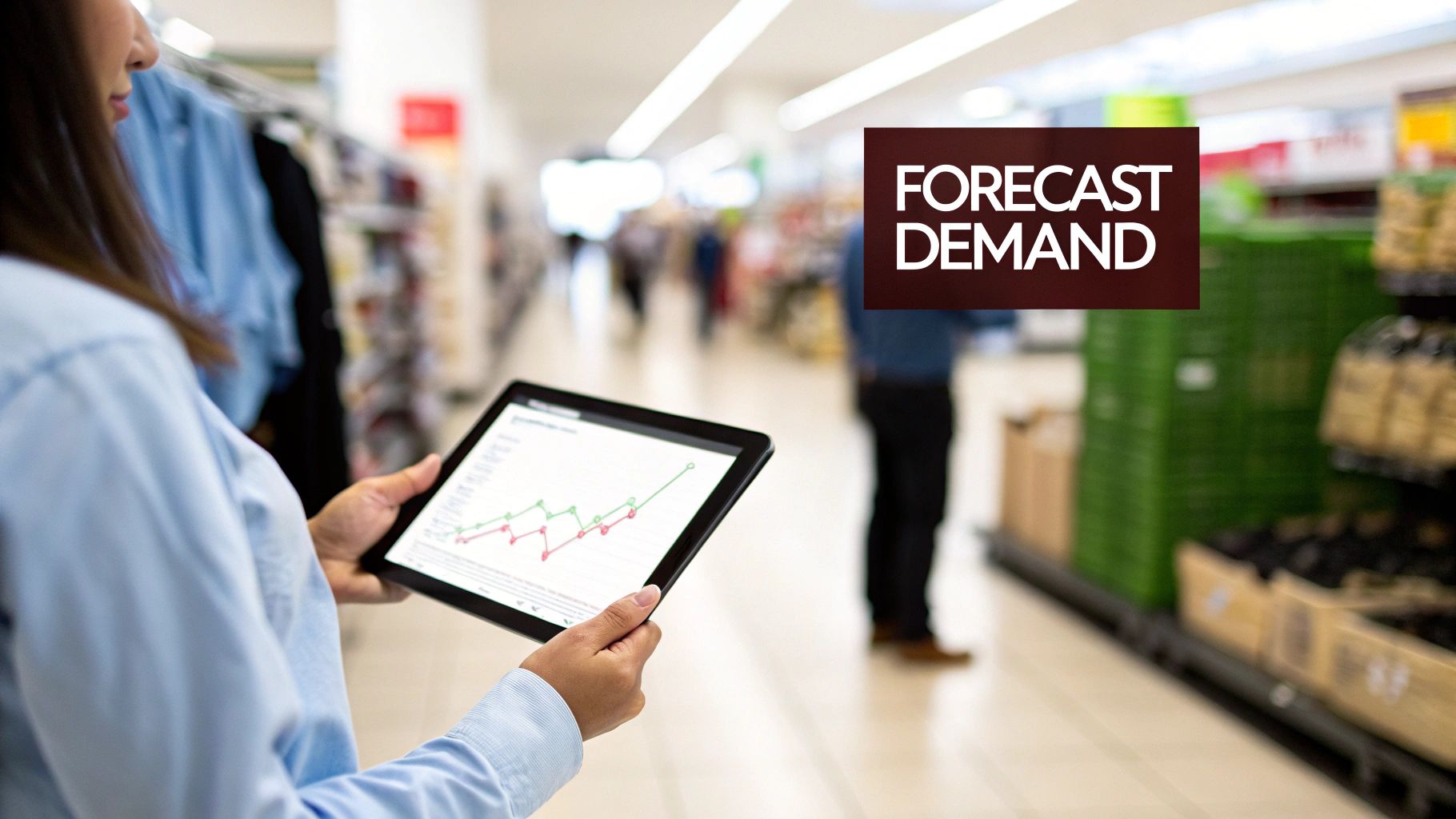
Predictive analytics flips that script. It acts as a detailed business forecast, analyzing vast amounts of data to predict future trends and customer behaviors. This process turns raw information into actionable insights, helping you get ahead of the curve.
Shifting from Reactive to Proactive Decisions
The fundamental shift is from making reactive fixes to building proactive strategies. Instead of marking down unsold summer apparel in August, a predictive model could have flagged a cooling sales trend six weeks earlier, prompting a smaller initial order. This foresight prevents costly overstocks and captures emerging opportunities.
At its core, predictive analytics empowers retailers to make smarter, faster decisions. It’s a fundamental capability for any business aiming to thrive in a competitive market.
By uncovering hidden patterns in your data, this technology answers the critical questions that directly affect profitability.
- Anticipating Demand: Which products will be bestsellers next quarter?
- Optimizing Inventory: What are the ideal stock levels to prevent sellouts without causing overstock?
- Personalizing Experiences: Which specific offer will convert a particular customer?
The Tangible Business Impact
The outcomes of using predictive analytics for retail are measurable. By implementing machine-learning demand forecasts, major retailers have achieved significant gains. Target, for example, reported a 21% reduction in out-of-stock items and cut excess inventory costs by 15% through more precise planning.
To understand the mechanics behind these results, it's useful to explore the top predictive modeling techniques. This data-driven approach is what separates market leaders from the competition, turning past performance into a clear roadmap for future growth.
Core Use Cases That Deliver Real Retail ROI
Predictive analytics isn't just theory; it’s a practical engine for solving retail's most persistent challenges. Its value shines when applied to core business functions, turning historical data into tangible financial returns by anticipating what will happen.
Let's explore the most impactful use cases where predictive analytics for retail delivers a strong return on investment.
Dynamic Demand Forecasting
Balancing supply and demand is a constant challenge. Overstock ties up capital and leads to markdowns, while understock results in lost sales and frustrated customers. Dynamic demand forecasting tackles this directly.
By analyzing sales history, seasonality, promotions, and external factors like weather, predictive models forecast demand with high accuracy. This empowers smarter purchasing decisions, aligning inventory with what customers are about to want.
- Use Case: A grocery chain uses a predictive model to forecast a 25% spike in demand for barbecue supplies ahead of a holiday weekend in specific regions. The system automatically triggers larger shipments to those stores, preventing stockouts during the rush and avoiding costly overstock elsewhere.
Personalized Customer Journeys
Today's shoppers expect relevance. Predictive analytics creates personalized experiences that boost engagement, increase basket size, and build loyalty. Models analyze browsing habits, purchase history, and demographic data to predict a customer's next likely purchase. This insight powers everything from targeted email offers to dynamic product recommendations.
A recent study found that 71% of retail companies were using or planning to use AI for personalization, with many reporting conversion lifts of 20–30% from recommendation engines alone.
When you understand a customer's intent, you can put the right product in front of them at the perfect moment. This not only drives a sale but also strengthens the relationship.
Impact of Predictive Analytics Across Retail Functions
Retail FunctionPredictive Analytics SolutionExpected Business OutcomeMerchandisingDynamic demand forecasting models to analyze seasonality, promotions, and external factors.5-15% reduction in lost sales from stockouts; improved inventory turn.MarketingCustomer segmentation models to predict the next likely purchase and identify at-risk customers.10-30% uplift in campaign conversion rates; higher customer lifetime value (CLV).Supply ChainInventory optimization models that automate replenishment and allocate stock geographically.15-25% reduction in inventory holding costs; improved in-stock availability.PricingDynamic pricing engines that adjust prices based on demand, competition, and inventory levels.2-5% increase in gross margin without sacrificing sales volume.
Intelligent Inventory Management
Knowing what will sell is only half the battle; ensuring the product is in the right place at the right time is the other. Intelligent inventory management uses predictive models to optimize the entire supply chain, from distribution centers to store shelves.
This involves predicting optimal stock levels for each store, identifying slow-moving items for clearance, and automating replenishment orders to prevent stockouts before they happen.
- Use Case: A fashion retailer uses predictive analytics to launch a new seasonal collection. Instead of uniform distribution, the system analyzes local sales data and ships more winter coats to colder climates and more swimwear to coastal stores, maximizing sales from day one.
Strategic Price Optimization
Pricing is a powerful lever for profitability. Predictive analytics helps find the optimal price point by analyzing competitor pricing, demand elasticity, inventory levels, and customer behavior. These dynamic pricing strategies allow you to maximize margins without hurting sales volume.
These use cases are often part of a larger transformation. To learn more about integrating these capabilities, this guide on digital transformation strategies for retail offers valuable insights. Each example proves that data-driven foresight builds a stronger, more resilient business.
Building Your Data and Technology Foundation
Turning raw data into profitable predictions requires a solid technical foundation. Before any model can forecast demand or personalize an offer, you need to connect disparate data streams into a unified engine for growth.
Identifying Your Essential Data Sources
Predictive models are only as good as the data they learn from. For retailers, combining various sources is key to uncovering complex patterns.
Critical data sources include:
- Transactional Data: Point-of-sale (POS) and e-commerce records showing what was bought, when, where, and for how much.
- Customer Data: Information from CRM and loyalty programs detailing customer purchase history and brand engagement.
- Web & App Behavior: Website clicks, product views, and cart abandonment data that reveal customer intent.
- External Signals: Contextual data like weather forecasts, local events, and social media trends that impact buying behavior.
Unifying Data with a Modern Architecture
Scattered data prevents you from seeing the full picture. The solution is a centralized, scalable architecture, typically a cloud data platform. Platforms like Snowflake act as a central hub, ingesting and unifying massive amounts of data from all sources. This breaks down data silos and creates a single source of truth for your teams.
This architecture provides the scale and speed needed for modern analytics, enabling complex queries and machine learning model training without system slowdowns. To see this in action, explore real-world examples of managing time-series data with Snowflake for sharper forecasting.
Understanding Key Predictive Model Types
Once your data is unified, you can apply different predictive models to answer specific business questions. Think of these as specialized tools, each designed for a particular job.
The model you choose depends on the outcome you want to predict. Are you grouping similar customers, forecasting a number, or classifying an outcome?
Here are the three main types with retail use cases:
- Classification Models: Predict a category or a yes/no answer.
- Use Case: Predict customer churn. The model answers, "Is this person likely to stop shopping with us in the next 90 days?" (Yes/No).
- Regression Models: Predict a continuous number, like a quantity or sales figure.
- Use Case: Forecast demand. The model predicts how many units of a new sneaker you are likely to sell next month.
- Clustering Models: Group data points based on similarities to discover natural segments.
- Use Case: Customer segmentation. A model might automatically identify groups like "high-spending loyalists," "bargain hunters," and "occasional gift shoppers."
Putting Predictive Insights into Action
A predictive model is just a number until it drives a decision. The true value of predictive analytics for retail emerges when you embed its insights directly into your daily operations, closing the gap between analysis and action.
The goal is to move beyond static reports. Predictions should fuel dynamic dashboards for merchandising teams and automated triggers for marketing campaigns. The most advanced retailers pipe these outputs directly into their core business systems, creating a seamless line from data to execution.
From Dashboards to Automated Decisions
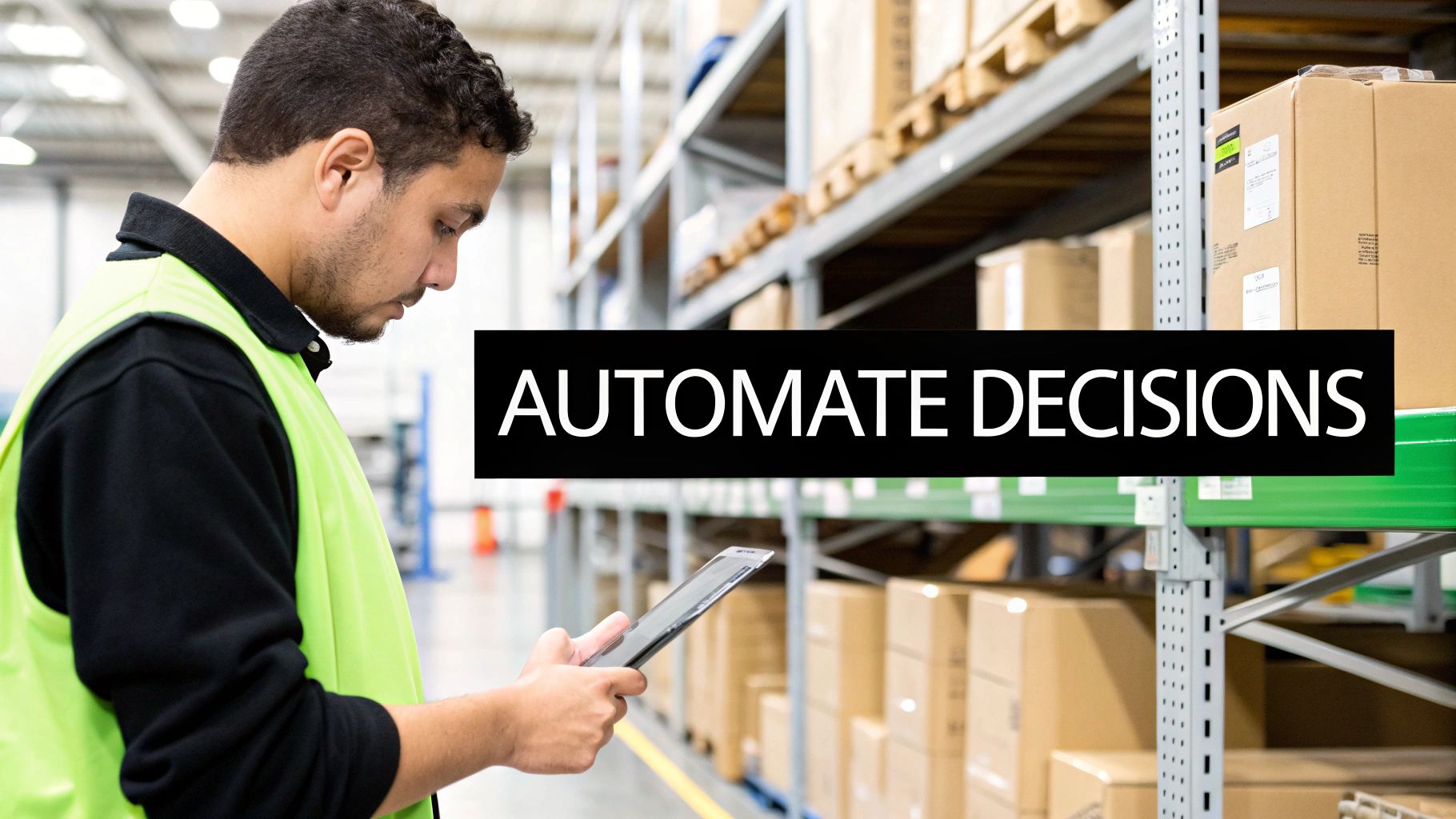
The first step is often visualization, where teams use dashboards showing real-time demand forecasts to make data-informed choices. The real competitive edge, however, comes from automation. Instead of just showing a forecast, the system acts on it.
A predictive model’s output is not just a report; it's a command. It's the signal that tells your supply chain software to reorder a product or your marketing platform to send a targeted discount.
This shift to automated execution is a game-changer for speed and efficiency, freeing up teams to focus on strategy. Retailers using this approach have seen up to a 30% reduction in both overstock and stockout events.
Activating Insights with AI Agents
The next evolution is using AI agents—autonomous systems that take predictive outputs and execute complex tasks. An AI agent acts as a digital team member, working 24/7 to implement your data-driven strategies.
These agents monitor predictive signals and act in real time, creating a truly responsive operation.
Here are some real-world examples:
- Automated Inventory Replenishment: An AI agent monitors demand forecasts and stock levels. When it predicts inventory will dip below a critical point, it automatically places a purchase order with the appropriate supplier.
- Dynamic Price Adjustments: An agent tracks competitor prices, inventory, and demand signals, autonomously tweaking an item's online price to maximize margins or clear out aging stock.
- Proactive Customer Retention: An agent connected to your CRM identifies customers flagged by a churn model and independently triggers a personalized retention campaign to win them back.
The Strategic Edge of Automation
Automating routine, data-driven decisions guarantees that every operational choice aligns with the most current data, eliminating the guesswork and human bias that lead to costly inventory and pricing errors.
This level of automation is also essential for managing complex logistics. To learn more about how data enables this, explore these insights on enhancing logistics with Python data analytics. By putting predictive insights into action, you build a more agile and intelligent business, delivering greater efficiency, higher margins, and a superior customer experience.
Your Implementation Roadmap from Pilot to Scale

Successfully integrating predictive analytics is a journey. The most common mistake is trying to do too much, too soon. A smarter approach is to start small, prove value quickly, and build momentum. Tackling one specific, high-impact business problem first de-risks the initiative and demonstrates tangible returns.
Phase 1: Define and Launch Your Pilot Project
Get specific. Instead of a vague goal like "improve inventory," target a measurable outcome like "reduce stockouts for our top-selling beverage category by 15% in Q3."
- Assemble a Cross-Functional Team: Include experts from IT (for data access), merchandising or marketing (for business context), and project management. This ensures your solution is technically sound and solves a real-world problem.
- Validate Your Data: Identify and prepare the necessary data sources, such as sales history and promo calendars. Clean, trustworthy data is the foundation of a reliable model.
- Build and Test a Prototype: Develop a minimum viable product (MVP) model and test its accuracy against historical data before going live.
- Measure Against Clear KPIs: Track your predefined KPIs during the pilot. Hitting your goal, such as the 15% stockout reduction, provides the proof needed to justify expansion.
Phase 2: Secure Buy-In and Plan for Scale
A successful pilot gives you a powerful story backed by real results. Use these concrete numbers to build a compelling business case for leadership, showing the direct financial impact and a clear path to replicating the success across the organization.
Securing an early, measurable win is the most effective way to turn skepticism into support. A successful pilot transforms the conversation from a theoretical discussion about technology to a practical plan for driving growth.
This phase is about creating a strategic roadmap that identifies the next business problems to solve, the resources required, and a realistic timeline.
Phase 3: Scale Across the Organization
With executive backing, it's time to expand. Scaling is about more than just building models; it requires focusing on people and processes to ensure adoption.
Key challenges include:
- Change Management: Communicate the benefits of new data-driven workflows to show teams how insights will make their jobs more impactful, not replace them.
- User Training: Provide training so merchants and planners can confidently interpret model outputs and act on them.
- Ongoing Model Maintenance: Implement a process for monitoring performance, retraining models with fresh data, and retiring outdated ones to ensure continued accuracy.
Predictive Analytics Implementation Phases
PhaseKey ObjectivePrimary ActivitiesSuccess Metric1. PilotProve value on a small scaleDefine a specific problem, assemble a team, prepare data, build a prototype model, track KPIs.Achieving the predefined pilot KPI (e.g., 15% stockout reduction).2. Secure Buy-InGain executive supportPresent pilot results, create a business case, develop a multi-stage rollout plan.Approved budget and resources for broader implementation.3. ScaleIntegrate across the businessImplement change management, provide user training, establish model maintenance processes.Widespread adoption and measurable ROI across multiple departments.4. OptimizeContinuously improve and expandMonitor models, explore new use cases, integrate new data sources and technologies.Year-over-year improvement in key business metrics (e.g., forecast accuracy, margin).
This structured approach ensures each step builds on the last, creating a solid foundation for a truly data-driven retail operation.
Measuring Success and Ensuring Responsible AI
To justify the investment in predictive analytics, you must connect model performance to tangible business results. It’s not enough for a model to be technically accurate; it must be profitable, secure, and fair. This means focusing on the key performance indicators (KPIs) that matter to the business.
Tying Model Performance to Business KPIs
The true test of a predictive model is its impact on your bottom line. You must draw a straight line from a model's output to a positive business outcome.
Track these critical connections:
- From Forecast Accuracy to Inventory Health: A 5% improvement in demand forecasting should directly lead to a measurable drop in stockouts and overstock. This translates to lower carrying costs, fewer markdowns, and increased sales.
- From Churn Prediction to Customer Retention: The success of a churn model is measured by the lift in customer lifetime value (CLV) from saved at-risk customers.
- From Recommendation Clicks to Revenue: A personalization engine's success is determined by its ability to increase average order value (AOV) and overall conversion rates.
Proving ROI is about demonstrating cause and effect. You must show that a predictive insight led to an action that produced a positive financial outcome. This builds the business case for further investment.
Building a Foundation of Trust and Compliance
As you leverage more customer data, governance becomes critical. A responsible AI practice is about earning and maintaining customer trust through robust data security, privacy, and model fairness.
Compliance with regulations like GDPR and CCPA is the baseline. Your data handling must include strong access controls, encryption, and transparent policies. Beyond compliance, you must actively work to ensure your models are fair and do not amplify existing biases. Predictive models learn from historical data, which can contain hidden biases. Without regular audits and fairness checks, a model could unfairly exclude certain customer groups. Ensuring equitable decisions builds a more inclusive and ethical retail operation.
Common Questions About Predictive Analytics in Retail
Even with a clear plan, implementing predictive analytics can seem daunting. Answering common questions is key to moving forward with confidence.
What Is the Best First Step to Get Started?
Start by picking a single, high-impact business problem with a measurable outcome. For example, focus on "reducing stockouts for our top 20 best-selling items." This laser-focused approach allows you to run a manageable pilot project, prove ROI quickly, and build a solid business case for wider adoption.
Do I Need a Large Team of Data Scientists?
Not necessarily at the start. Modern cloud platforms and AutoML (Automated Machine learning) tools have lowered the barrier to entry significantly.
Many retailers achieve early success by partnering with a specialized consultant for their first project. Another effective strategy is to upskill existing business intelligence analysts, who already possess deep domain knowledge and understand your data landscape.
How Do You Keep Predictive Models Accurate Over Time?
Predictive models are not "set and forget." They require ongoing maintenance, a practice known as MLOps (Machine Learning Operations). Market conditions and consumer behavior change, causing a model's accuracy to "drift."
A robust implementation plan must include processes for:
- Regularly retraining models with fresh data to maintain their accuracy.
- Continuously monitoring performance by comparing predictions to actual outcomes.
- Establishing alerts that notify your team when a model's accuracy begins to decline.
This proactive approach ensures your predictive analytics remain a reliable asset for making critical business decisions.


