In banking, Robotic Process Automation (RPA) creates a digital workforce. These are not physical robots, but smart software 'bots' that take over repetitive, rule-based tasks like data entry, loan processing, and compliance checks. This digital team works 24/7, delivering measurable outcomes: increased efficiency, near-zero errors, and significant operational cost savings.
How RPA Delivers a High-Performing Digital Workforce
Imagine a bank where loan applications are processed overnight, customer data is instantly synced across all systems, and compliance checks run flawlessly around the clock. This is the reality banks are building with Robotic Process Automation (RPA). By deploying a digital workforce, banks turn high-volume, error-prone tasks into streamlined, automated operations.
These software bots mimic human actions—clicking, typing, and moving files—to execute workflows with perfect accuracy. They are designed to handle tedious but critical tasks, freeing up your skilled employees to focus on high-value work like strategy, customer relationships, and complex problem-solving.
The Core Function of a Digital Workforce
A digital workforce excels at processes that are manual, repetitive, and rule-driven. Because they are software, these bots interact seamlessly with your existing applications—even legacy systems—without needing costly or complex integrations.
Key Use Cases:
- Data Entry: Pulling data from loan applications or invoices and entering it into core banking systems.
- KYC Checks: Cross-referencing customer information across multiple databases to verify identities.
- Report Generation: Automatically compiling data for daily, weekly, or monthly regulatory reports.
- Credit Card Processing: Evaluating applications against a predefined set of rules to approve or deny.
A key outcome of building a digital workforce is the ability to scale operations without a proportional increase in headcount. Banks can handle massive transaction volumes, like those during peak loan seasons, without delays or hiring temporary staff.
From Task Automation to Operational Excellence
The goal isn't just to automate isolated tasks, but to create a connected ecosystem where human experts and digital workers operate in tandem. For example, a bot can handle all initial data gathering for a mortgage application, presenting a complete file to a human loan officer for the final, nuanced decision.
This collaborative model delivers tangible results. By deploying bots for these manual processes, banks achieve cost reductions of 30% to 70%. Tasks that once took days, like mortgage approvals, can be completed in hours. The outcome is a more resilient, efficient, and customer-focused operation. This approach isn't just for banking; you can learn more about how different industries are applying automation to sharpen their operations.
The Most Impactful RPA Use Cases in Banking
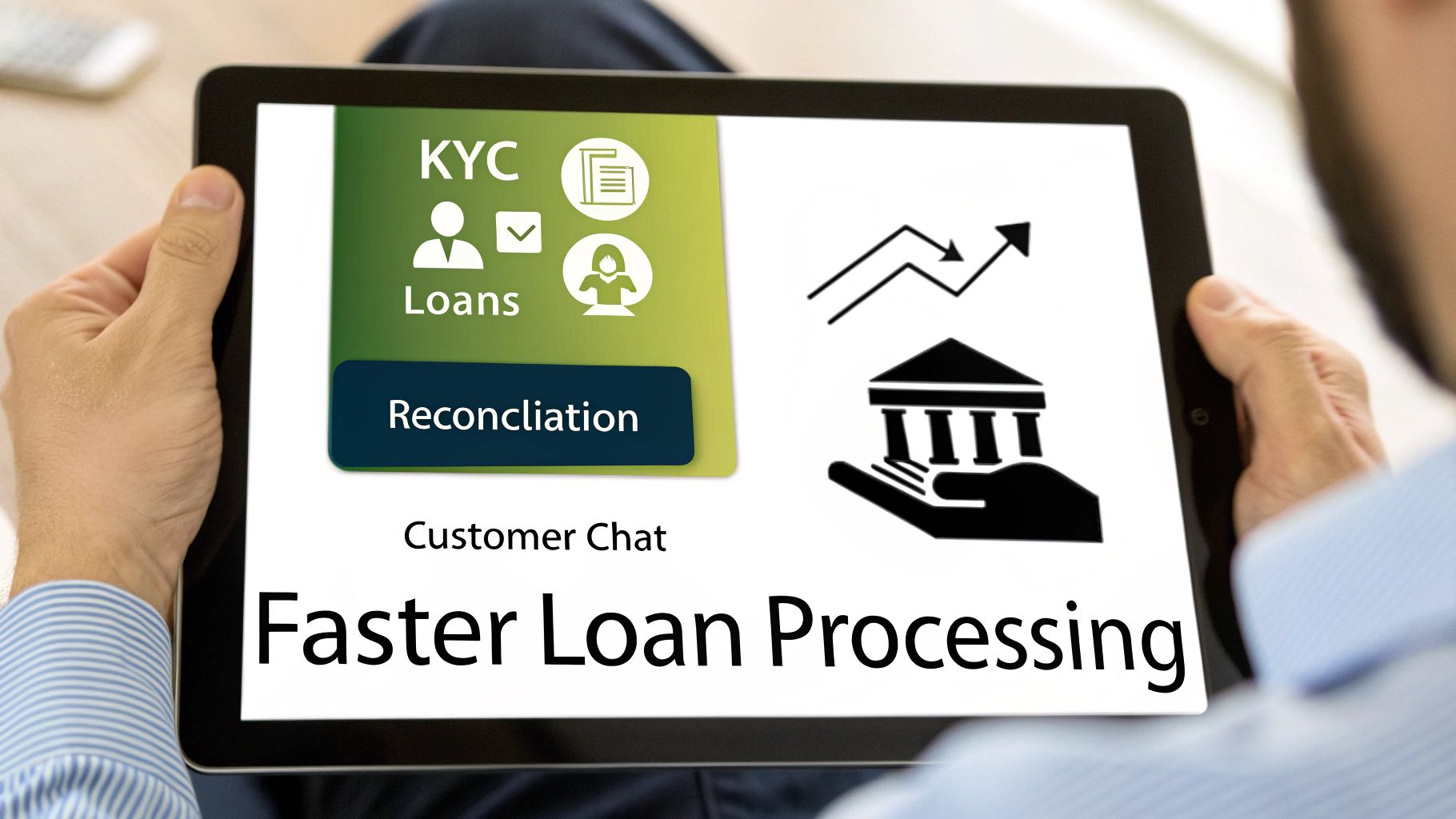
The true value of a digital workforce is measured by its impact on specific, high-friction banking operations. RPA is a practical tool that delivers measurable wins by targeting the exact areas that need it most: cost, speed, accuracy, and compliance.
Streamlining KYC and Customer Onboarding
Know Your Customer (KYC) is a critical but notoriously slow compliance step. Manually, it involves collecting documents, cross-referencing data across multiple systems, and documenting every action for regulators. This results in long waits for new customers and high labor costs.
RPA transforms this process. A software bot instantly extracts data from customer documents using Optical Character Recognition (OCR) and validates it against government and internal databases in seconds.
- Outcome: The entire data validation process shrinks from days to minutes. This leads to onboarding times being cut by over 85%, creating a better customer experience and a more robust, auditable compliance trail.
Accelerating Loan and Mortgage Processing
The traditional mortgage process can take over 50 days, bogged down by manual credit checks, employment verifications, and compiling paperwork. Each step is a potential point of delay and human error.
RPA bots automate this structured workflow. They gather applicant data, run credit checks, verify income, and assemble the complete loan file for the underwriter.
By automating data collection and initial verification, banks slash loan processing times from weeks to hours. This not only delights customers but also enables the bank to process a higher volume of loans without increasing staff.
Automating Account and General Ledger Reconciliation
Reconciliation is a vital back-office function, but manually comparing thousands of transactions between systems is tedious and prone to costly mistakes.
An RPA bot executes this process flawlessly. It logs into the required systems, extracts transaction data, compares line items based on predefined rules, and instantly flags any mismatches for human review.
How RPA Transforms Core Banking Functions
Banking FunctionManual Process Pain PointsOutcome with RPAKYC VerificationTakes days; prone to data entry errors and compliance gaps.Completed in minutes with 99%+ accuracy and a full audit log.Loan ApprovalMulti-week timeline with frequent delays and high labor costs.Preliminary approval in hours, reducing operational costs by over 30%.Account ReconciliationDays of manual effort, risk of financial misstatements.Completed daily with automated exception reporting for immediate resolution.
This automation ensures financial statements are always accurate and up-to-date, reducing reporting errors and simplifying audit preparations.
Enhancing Customer Service Operations
Bank contact centers handle a flood of routine inquiries like balance checks and password resets, often requiring agents to navigate multiple systems. This leads to longer call times and frustrated customers.
RPA bots act as an agent's assistant, instantly pulling up a complete customer profile from all relevant systems onto a single screen. For simple queries, chatbots powered by RPA can provide 24/7 support without human intervention.
- Outcome: Call handling times are reduced, first-call resolution rates improve, and human agents are free to focus on more complex, high-value customer conversations.
Simplifying Compliance and Regulatory Reporting
Banking is heavily regulated, requiring constant monitoring and reporting to avoid penalties. Manually aggregating data for these reports is an enormous drain on resources. A survey found that 73% of financial executives view RPA as a key tool for meeting compliance obligations.
RPA automates this data aggregation. Bots can be scheduled to run daily or weekly, pulling data, formatting it into regulatory templates, and flagging anomalies for human review. This ensures reports are accurate, timely, and created through a consistent, auditable process.
Moving from Automation to Intelligent Operations

Basic RPA is excellent for repetitive tasks, but its true power is unlocked when combined with technologies like Agentic AI and unified data platforms. This is the leap from simple task automation to intelligent operations, where bots can learn, adapt, and handle complex exceptions without constant human oversight. This next level of RPA in banking moves beyond just mimicking clicks and keystrokes.
An intelligent system doesn't just process a transaction; it understands the context. For example, instead of merely flagging an unusual payment, an Agentic AI bot can analyze the customer's history, calculate the risk, and initiate a secure verification process—all autonomously.
The Role of a Unified Data Platform
For intelligent bots to work effectively, they need a clean, reliable stream of information. A centralized data platform like Snowflake acts as a "single source of truth," feeding high-quality, real-time data to your digital workforce. This is essential for intelligent automation.
- Data Integrity: Ensures data from all systems (core banking, CRM, etc.) is consistent and accurate.
- Scalability: A cloud data platform scales with your data volumes and automation complexity.
- Real-Time Insights: Bots access up-to-the-minute data to react instantly to market shifts or customer actions.
This architecture is the foundation of an intelligent automation strategy. The data platform provides the fuel, and Agentic AI provides the engine. For a broader view, understanding automated infrastructure management can show how these efficiency principles apply across the tech stack.
Unlocking Next-Level Capabilities
When you combine smart bots with a solid data foundation, you move past cost-cutting and start generating revenue and strategic advantages. The synergy between Agentic AI and a platform like Snowflake unlocks powerful new capabilities.
This is not a futuristic concept. The industry is rapidly evolving. By 2026, RPA will be less about rules-based automation and more about Agentic AI and hyperautomation, integrating with blockchain, low-code platforms, and analytics to make banking smarter and more transparent. This shift is explored in Deloitte's industry outlook on their financial services insights page.
The ultimate goal is to create a self-optimizing operation where intelligent bots not only execute tasks but also identify opportunities for improvement. They can analyze process data to find bottlenecks and even suggest new automation workflows, creating a cycle of continuous enhancement.
Practical Outcomes of Intelligent Operations
This powerful combination produces tangible results that directly impact your bottom line and customer experience.
Here’s what this looks like in the real world:
- Hyper-Personalized Customer Offers: An intelligent bot analyzes a customer's spending and savings to proactively offer a perfectly timed mortgage pre-approval or investment product.
- Sophisticated Fraud Detection: An Agentic AI bot learns to spot subtle, evolving patterns of fraud in real time, stopping threats before they cause damage.
- Predictive Risk Analysis: By crunching massive datasets, smart bots can forecast potential loan defaults or market risks with greater accuracy, allowing the bank to take preventive action.
Your Strategic Roadmap for RPA Implementation

A successful RPA program is built on a clear, phased strategy that progresses from small experiments to enterprise-wide value. A structured roadmap ensures every bot delivers a measurable return and helps you sidestep common pitfalls.
Phase 1: Discovery and Process Identification
First, identify the right processes for automation. You are looking for tasks that are high-volume, repetitive, and strictly rule-based. Good candidates include account reconciliation, data entry for new accounts, or generating daily compliance reports.
- Key Question: Which processes, if automated, would free up the most employee time and reduce the most operational risk?
- Outcome: A prioritized list of automation projects, ranked by expected ROI and implementation complexity. This is crucial for building early momentum for your RPA in banking initiative.
Phase 2: Proof of Concept and Pilot Program
Next, prove the concept on a small scale. A Proof of Concept (PoC) involves automating a single, well-defined task to demonstrate that the technology works in your specific IT environment.
For example, a bank might pilot a bot to automate the validation of customer ID documents for KYC. Success metrics should be clear, such as cutting validation time from 15 minutes to 90 seconds.
A successful pilot program becomes a powerful internal case study. It gives you hard data on cost savings, error reduction, and speed improvements, making it infinitely easier to justify a bigger investment down the road.
Phase 3: Scaled Implementation and Governance
With a successful pilot, you can scale implementation to more complex processes and departments. This phase requires a solid governance framework to manage your growing digital workforce.
Governance sets the rules for your automation program, defining roles, development standards, and security protocols. It ensures every bot is built, deployed, and maintained consistently and securely. At the same time, open communication with employees is critical to manage the transition and emphasize how RPA will augment their roles. For more on building robust tech solutions, our guide on professional technology services offers valuable context.
Phase 4: Continuous Optimization and Center of Excellence
The final stage focuses on long-term success. Leading banks establish an RPA Center of Excellence (CoE)—a dedicated team that manages the automation pipeline, maintains existing bots, and identifies new opportunities.
The CoE acts as the central hub for all automation activities. This team monitors bot performance, ensures they function correctly after application updates, and continually measures their impact on business metrics. This creates a feedback loop for continuous improvement and value delivery.
Measuring Success and Maximizing Your ROI
How do you prove that your investment in RPA in banking is paying off? A strong measurement framework is essential to track the right Key Performance Indicators (KPIs) and calculate a genuine Return on Investment (ROI) that goes beyond simple cost savings.
Defining Your Key Performance Indicators
A holistic view looks at strategic metrics that reveal deep operational improvements.
These KPIs paint a clear picture of automation's real impact:
- Process Cycle Time: How long does a process take from start to finish? One regional bank reduced its mortgage processing time by 80%.
- Error Rate Reduction: Track the percentage of mistakes before and after automation. RPA can achieve near-zero error rates in areas like compliance and financial reconciliation.
- Employee Productivity: Measure the time given back to employees to focus on high-value activities like customer engagement and strategic planning.
- Customer Satisfaction (CSAT): Link faster service and fewer errors to higher CSAT scores and quicker ticket resolution.
The best ROI stories connect automation directly to business growth. Faster loan processing doesn't just cut operational costs—it means you can handle more applications, which directly boosts revenue.
Calculating Your True Return on Investment
Calculating ROI for RPA involves weighing the costs of development, licensing, and maintenance against both direct financial savings and strategic benefits.
The growth of RPA in banking underscores its value. The market surpassed USD 2 billion in 2019 and is projected to grow at a 40% CAGR, driven by demand from financial services. You can explore detailed market analysis on Global Market Insights.
Selecting the Right Technology and Partner
Maximizing ROI also depends on choosing the right tools and implementation partner. Your solution must align with your long-term vision and integrate with your existing technology.
Key criteria to consider:
- Scalability: The platform must be able to handle more bots and complex processes as you grow.
- Security and Compliance: Your partner must have deep expertise in banking regulations, and the platform should offer robust security features like encryption and audit trails.
- Ease of Use: A low-code or no-code platform can empower business users to build simple automations, accelerating adoption.
- Support and Maintenance: Choose a partner who provides ongoing support, as bots require maintenance when underlying applications are updated.
By focusing on these strategic measures, you can ensure your RPA investment delivers real, lasting value.
Navigating the Road Ahead: Challenges and Future-Proofing
Implementing RPA in banking has its challenges. Projects can stall if banks automate the wrong processes, underestimate maintenance requirements, or fail to manage the human side of change. Success comes from anticipating these common traps.
One frequent misstep is choosing an overly complex or unstable process for the first automation project. This often leads to brittle bots that break easily. Another is neglecting to build a dedicated team to manage the digital workforce, turning a cost-saving initiative into a maintenance burden.
Common Pitfalls and How to Sidestep Them
A proactive approach is key to keeping your automation program on track. This includes a deep understanding of Compliance and Risk Assessment to navigate financial regulations.
Actionable strategies for common issues:
- Poor Process Selection: Start with stable, high-volume, rules-based tasks like general ledger reconciliation or report generation. This delivers early wins and builds momentum.
- Lack of Governance: Establish an RPA Center of Excellence (CoE) from day one to set standards, manage the bot lifecycle, and ensure alignment with business goals.
- Ignoring Change Management: Communicate openly with employees about how their roles will evolve. Frame RPA as a digital assistant that frees them for higher-value work.
The goal isn't just to deploy a few bots; it's to build a resilient automation ecosystem. You have to treat your digital workforce like any other critical asset—with dedicated oversight, regular maintenance, and a strategy for continuous improvement.
The Future of Banking Automation
The evolution of RPA is accelerating. The next wave will be defined by hyperautomation, which combines RPA with AI and machine learning to automate more complex, end-to-end business processes. Cloud-native RPA platforms are also becoming standard, offering better scalability and faster deployment.
This momentum is reflected in market projections. The finance-specific RPA market is expected to hit $15.28 billion in 2026, up from $12.23 billion in 2025, growing at a 24.9% CAGR. You can discover more insights about these banking technology trends on Automation Edge. Building a flexible, forward-looking strategy today will prepare your institution for the opportunities of tomorrow.
Answering Your Questions About RPA in Banking
Any new technology initiative brings questions about security, integration, and its impact on people. Here are answers to the most common questions about RPA in banking.
Is RPA Secure Enough for Banking Data?
Yes, when implemented correctly. Enterprise-grade RPA platforms are designed for highly regulated industries and include core security features:
- Role-Based Access Controls: Ensure bots and their managers can only access approved data and systems.
- Encryption: Protects sensitive data both at rest (in databases) and in transit (between applications).
- Comprehensive Audit Logs: Records every bot action in a tamper-proof log for compliance and security reviews.
Can RPA Work with Our Old Legacy Systems?
Absolutely. This is a key strength of RPA. Bots interact with applications at the user-interface level—just like a person—by clicking, typing, and navigating screens. This "surface automation" allows them to work with mainframes, AS/400 systems, and other legacy platforms without altering any underlying code, effectively bridging the gap between old and new technology.
Will RPA Replace Our Employees?
No, the goal of RPA is to augment your team, not replace it. By automating high-volume, repetitive tasks, RPA frees skilled employees from tedious work that often leads to burnout and errors. This allows them to focus on high-value activities that require human insight, such as complex problem-solving, strategic thinking, and building deeper customer relationships. RPA handles the robotic tasks so your people can drive real value.


