
The choice between Time and Materials (T&M) vs Fixed Price is about outcomes. T&M delivers flexibility for innovation, while Fixed Price delivers a predictable scope. If you're building an Agentic AI system or executing a complex Snowflake migration, you need the adaptive nature of T&M to achieve the best result. If your project is a known quantity with zero ambiguity, a Fixed Price model provides clear budget certainty.
Choosing Your Project Pricing Model: A Quick Comparison
Picking a pricing model is a critical decision that shapes your project's outcome. It defines the budget, your ability to adapt, and the partnership with your development team. The right choice paves the way for success; the wrong one leads to scope creep, blown budgets, and friction.
This guide focuses on the trade-offs to help you choose wisely. Think of a Time and Materials contract as investing in a dedicated team to navigate discovery and deliver the best possible outcome. A Fixed Price contract is buying a predefined product with a set scope and a guaranteed price tag.

T&M vs Fixed Price At a Glance
This table breaks down how each model delivers against key project goals. Use it to match your project’s needs with the right contractual approach.
CriterionTime & Materials (T&M)Fixed PriceScope FlexibilityHigh. Pivots are welcome to achieve a better outcome.Low. Scope is locked. Changes require costly change orders.Budget PredictabilityLower. Final cost is based on actual time invested.High. The cost for the defined scope is known upfront.Client InvolvementHigh. Requires constant collaboration to steer the project.Low. Heavy involvement upfront, then minimal interaction.Ideal Project TypeComplex, innovative projects with emergent needs (e.g., AI, R&D).Simple, short-term projects with clear deliverables (e.g., website migration).
T&M is designed for the journey of discovery, while Fixed Price is for a trip to a known destination. Let's explore what that means for your project's outcome.
Understanding How Each Pricing Model Works
To make an informed decision in the time and materials vs fixed price debate, you need to understand how each model works to produce different results. These aren't just billing methods; they are different philosophies for managing risk, collaboration, and ultimately, project success.
A Time and Materials (T&M) contract is a pay-as-you-go model. You are billed for the actual hours worked and the cost of resources used. This structure is built for flexibility, allowing you to pivot, add features, or change priorities based on market feedback or technical discoveries. The outcome is a product that can evolve to meet real-world needs.
A Fixed Price contract is a single, locked-in price for a meticulously defined scope. Every deliverable is agreed upon before work begins. You get absolute cost certainty, but this comes at the price of rigidity. Any change requires a formal, slow change order process. The outcome is the delivery of a predefined specification, regardless of whether it’s still the best solution by the end of the project.
The Core Financial Trade-Off
The key difference is who carries the financial risk. In T&M, the client shoulders the risk that the project may take longer than estimated. In a Fixed Price model, the vendor absorbs that risk, but they charge a premium for it.
To protect themselves, vendors often add a risk premium of 15–30% to Fixed Price quotes. On a project estimated at $1.5M, a 20% premium adds $300,000 to the cost. You pay for worst-case scenarios that may never happen. For innovative projects where requirements will evolve, that premium becomes a penalty for uncertainty.
This is why T&M is the standard for agile development. It aligns with the iterative, discovery-driven nature of building modern software, where the goal is to create the most valuable product, not just the one specified months ago.
A Closer Look at Billing and Resource Management
Under a T&M model, you receive detailed invoices showing hours worked and tasks completed. This transparency gives you a clear view of where your budget is going. Understanding offshore software development costs helps you evaluate T&M pricing effectively.
Fixed Price projects typically use milestone-based payments:
- 25% at contract signing
- 25% after design approval
- 25% at user acceptance testing completion
- 25% after final deployment
This simplifies financial planning but offers little visibility into day-to-day progress.
The choice is simple: Do you want to pay for a predictable output or for a dedicated team’s expertise to achieve the best outcome? The answer dictates your project's entire dynamic.
How Your Contract Choice Impacts Project Risk And Outcomes
The Time and Materials vs. Fixed Price decision fundamentally defines risk, shapes the client-vendor relationship, and directly impacts the final outcome. A well-chosen contract is a framework for success that aligns with your project's reality.
A Fixed Price agreement seems safe, promising specific deliverables for a guaranteed cost. But for complex software, Agentic AI, or Snowflake projects, this safety is often an illusion. When scope is rigid but requirements are fluid, the contract itself becomes a source of risk.

Risk Distribution in Fixed Price Contracts
In a Fixed Price model, the vendor is incentivized to control scope at all costs, which can lead to an adversarial relationship. Every new idea becomes a slow negotiation. The focus shifts from building the best product to just sticking to the original statement of work. This introduces its own risks to the outcome:
- Scope Disputes: Minor disagreements over requirements can lead to major conflicts.
- Quality Compromises: To protect margins, a vendor might cut corners or deliver the bare minimum.
- Stifled Innovation: The team is discouraged from suggesting improvements outside the predefined scope.
This model makes managing technical debt in risk control nearly impossible, as improvements are deferred to avoid renegotiations.
Risk and Collaboration in Time and Materials Contracts
A Time and Materials (T&M) contract creates a partnership focused on a shared goal: achieving the best outcome. It places budget risk on the client but, in return, mitigates delivery and quality risks.
The main client risk is budget oversight, which can be managed through active governance and transparent reporting. The T&M model fosters an environment where adaptation is part of the process, not a crisis.
In a T&M model, risk is managed through collaboration and transparency, not contractual rigidity. The focus is on delivering value, allowing teams to pivot and improve the product iteratively.
This is why T&M arrangements report higher client satisfaction for projects with evolving requirements. Applying fixed-price contracts to complex work often leads to disputes and missed goals. For an ambiguous Agentic AI proof-of-concept, change orders can exceed 10–25% of the original value, causing delays. This is why T&M is the preferred model for iterative work.
Ultimately, the choice between time and materials vs fixed price is about managing uncertainty. For predictable tasks, fixed price offers clarity. For outcome-driven projects, T&M provides the adaptive partnership needed to succeed.
When to Use Each Pricing Model: Real-World Scenarios
Applying the time and materials vs fixed price theory to real projects is where the decision counts. The best model mirrors your project’s goals, uncertainties, and potential for evolution. Let's look at concrete use cases.
Ideal Use Cases for a Fixed Price Contract
A Fixed Price model excels when the "what" and "how" are fully known, ensuring a predictable outcome with no surprises.
- Use Case: Straightforward Website Migration. Moving a site to a new host is a defined process: transfer files, migrate the database, reconfigure, and test. The steps are predictable, making it perfect for a fixed bid. The outcome is a functioning website on a new server.
- Use Case: Adding a Standard Feature. Implementing a password reset function involves a standard workflow and routine technical work. The effort is easily estimated, making it ideal for a fixed price. The outcome is a specific, well-understood feature.
- Use Case: Limited-Scope MVP. If you're building a Minimum Viable Product with a strict, non-negotiable feature list to test a hypothesis, a fixed budget works well. The outcome is a contained experiment with a hard cap.
Prime Use Cases for a Time and Materials Contract
The Time and Materials (T&M) model is designed for exploration and complexity, where learning and pivoting are key to achieving the best outcome.
- Use Case: Developing an Agentic AI Automation. Building an AI agent is R&D. You don't know which algorithms will work best until you test them. The project’s direction is guided by experimental results, making a flexible T&M model essential. The outcome is a high-performing AI system, discovered through iteration.
- Use Case: Building an IoT Data Platform on Snowflake. Ingesting data from thousands of devices will reveal unforeseen challenges. T&M lets the team adapt the architecture and optimize pipelines based on real-world data, not a rigid initial scope. The outcome is a scalable and robust data platform.
- Use Case: Creating a User-Feedback-Driven MVP. This project is designed to be shaped by early user interactions. T&M provides the agility to pivot and build what the market truly wants based on what you learn. The outcome is a product with proven market fit.
For projects defined by R&D or evolving requirements, a T&M contract creates a true partnership. It aligns everyone toward a common goal: finding the best possible outcome, not just delivering a pre-defined checklist.
Decision Matrix for Pricing Models
Use this matrix to align your project's goals with the right pricing structure.
Project CharacteristicRecommended for Time & MaterialsRecommended for Fixed PriceScope DefinitionFlexible or undefined; high uncertainty.Clear, detailed, and stable; low uncertainty.Project ComplexityHigh; involves R&D or new technology.Low to moderate; uses known processes.Risk ToleranceClient shares risk for greater flexibility.Client transfers risk for budget certainty.TimelineFlexible and driven by iterative progress.Rigid with a firm deadline.Client InvolvementHigh; requires active collaboration.Low; minimal involvement after initial phase.Innovation GoalTo explore and find the best possible solution.To deliver a known output efficiently.
Exploring Hybrid Models for Balanced Risk And Flexibility
The time and materials vs fixed price debate often presents a false choice. For large, complex projects, hybrid models offer a practical path, blending the best of both approaches to manage risk without stifling agility.
Blended contracts de-risk projects by providing budget guardrails for finance teams and flexibility for development teams. This structure evolves with the project, ensuring a better outcome.
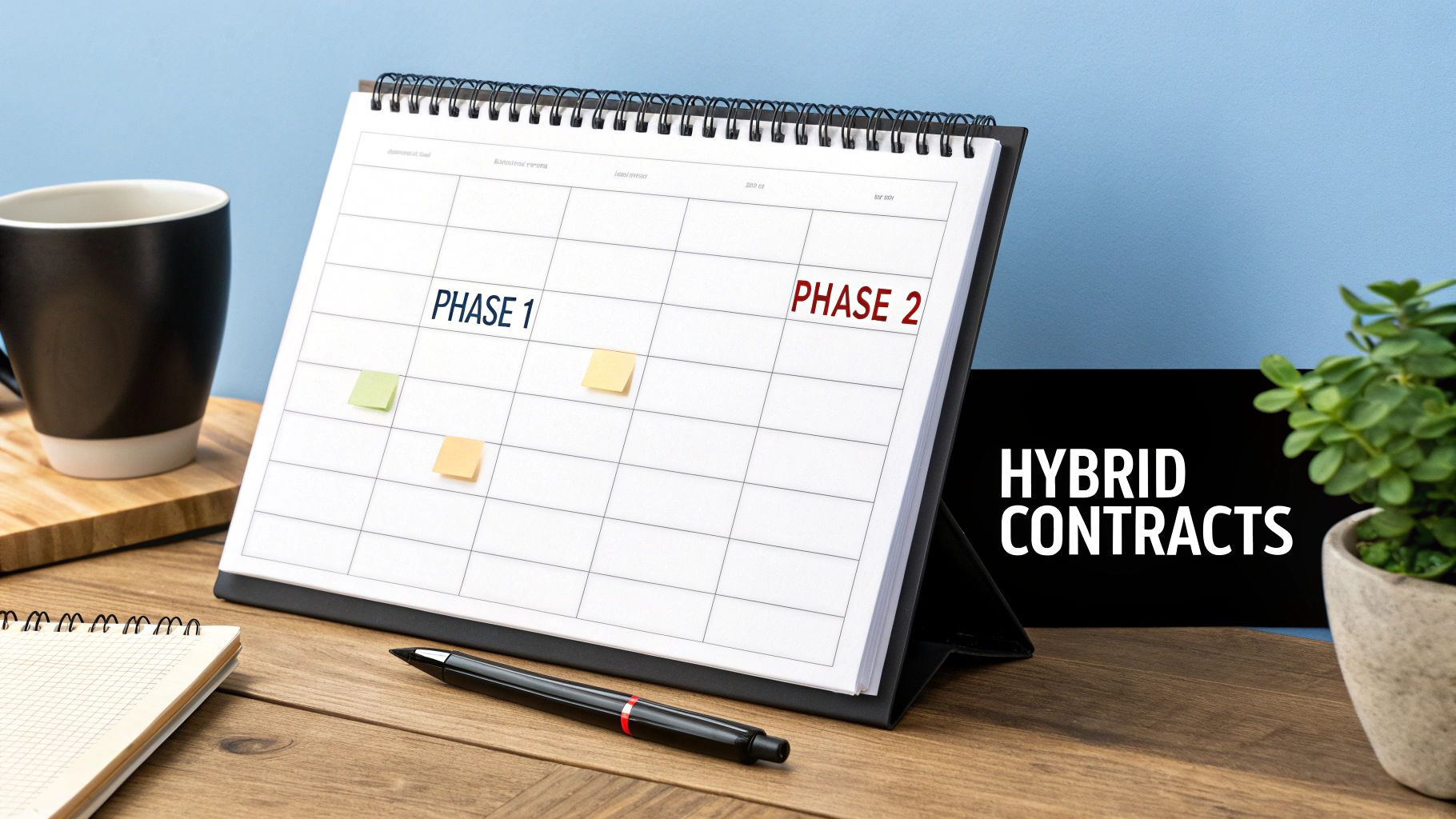
Common Hybrid Structures in Practice
Hybrid models are proven structures that balance cost control with the need to adapt. Here are a few effective models:
- Fixed Price for Discovery, T&M for Execution: This is a popular hybrid. A small, fixed-price engagement (5–10% of the total budget) is used for the discovery phase. This produces a clear project roadmap and backlog. The project then shifts to T&M for agile execution.
- Time & Materials with a Cap: This model offers the flexibility of T&M but with a "not-to-exceed" price, providing budget security. It forces the team to prioritize ruthlessly and deliver the most critical features within the cap.
- Fixed Price per Sprint or Milestone: The project is divided into smaller chunks (e.g., two-week sprints), each with a fixed price. This provides short-term budget predictability while allowing future sprints to be adjusted based on learnings.
By combining fixed-price predictability for defined phases with T&M flexibility for development, hybrid models create a balanced partnership. They align incentives and give clients better control over project direction and cost.
These blended approaches are becoming best practice for cloud and AI projects. As detailed in this analysis of how hybrid pricing balances risk and incentives, these models align incentives for a successful outcome.
When to Use a Hybrid Model
A hybrid approach is ideal for projects with a mix of knowns and unknowns.
- Use Case: Large-Scale Platform Modernization. For a multi-quarter Snowflake migration, use a fixed price for the initial data audit. The complex work of migrating data sources and building pipelines is better suited for a T&M with a cap model.
- Use Case: New Product Development. For a new AI-powered app, a fixed-price discovery phase can validate the core concept. Afterward, a fixed-price-per-sprint model allows the roadmap to evolve based on user feedback.
By combining elements from both structures, you can create a contract that supports your technology goals.
Making the Right Choice for Your Next Project
Choosing between time and materials vs fixed price is about matching the contract to your project's reality. The decision hinges on three factors: scope clarity, risk appetite, and the need for adaptation.
First, evaluate your scope. Is it completely locked down? If so, a Fixed Price model can provide budget certainty. But for exploratory projects like building an Agentic AI system, the scope is naturally fluid. Forcing such work into a fixed scope stifles innovation.
A Framework for Your Decision
Next, weigh your organization's risk tolerance against its need for collaboration. A Fixed Price contract offloads budget risk to your vendor, but you pay a premium and lose flexibility.
If your primary goal is to avoid building the wrong thing, a Time and Materials model is the better choice. It requires more active involvement but gives you the control to guide the project toward maximum business value. This ensures the final product solves real-world needs.
For projects where innovation and adaptation create value, Time & Materials is a strategic partnership framework. It focuses everyone on the real goal: delivering a successful outcome.
Final Considerations Before You Commit
Invest in a solid discovery process before signing any contract. The discovery phase of a project is the best way to clarify scope, mitigate risks, and avoid budget overruns. It provides the clarity needed to choose the right contract.
The right decision makes your contract a tool for success. For straightforward work, Fixed Price is simple. For the complex projects that define modern tech, T&M provides the adaptive partnership needed for exceptional results. Check out our Agentic AI and data services to see how we build transparent partnerships that deliver real value.
Frequently Asked Questions
When deciding between time and materials vs fixed price, practical questions always come up. Here are answers to common concerns from technology leaders.
How Can We Control Costs in a Time and Materials Project?
A common myth is that T&M means a blank check. In reality, cost control in a T&M project comes from rigorous governance and transparency. Active budget management is key.
Core practices include:
- Set a Budget Forecast: Start with a realistic budget estimate to guide financial planning.
- Demand Detailed Reporting: Insist on weekly or bi-weekly reports with granular timesheets and task breakdowns.
- Hold Regular Prioritization Meetings: Use sprint planning to ensure the team is always working on the most valuable tasks.
Constant communication, detailed burn-down charts, and continuous updates are your best tools for preventing financial surprises.
Can a Fixed Price Project Be Agile?
It’s challenging. You can incorporate agile-like principles by breaking a large project into smaller, fixed-price phases. This allows for feedback and minor course corrections.
However, the scope within each phase remains rigid. The administrative burden of drafting change orders for every adjustment can crush momentum.
If you need true agility where the plan is expected to change, T&M is a more natural fit. It’s built to embrace change, not fight it.
What Happens If Scope Changes in a Fixed Price Contract?
Any change in a Fixed Price contract triggers a formal change request process. This is a slow procedure that can derail timelines.
The cycle typically involves:
- Documenting the New Requirement: The client formally requests the change.
- Assessing the Impact: The vendor analyzes the effect on the timeline, resources, and cost.
- Negotiating a Contract Amendment: Both sides must agree on and sign a new contract or addendum.
This rigidity protects the vendor but can suffocate progress on innovative projects where change is inevitable. In these cases, a T&M or hybrid model provides a healthier foundation for success.


